Who Discovered Software: Origins and Milestones
Explore the origins of software—from Ada Lovelace to modern software engineering—and why there is no single discoverer. SoftLinked analyzes history to guide learners today.


There is no single discoverer of software. The concept emerged through a lineage of ideas and engineering practice, from Ada Lovelace’s 1840s algorithm notes to Alan Turing’s programmable computation, and John von Neumann’s stored-program architecture. Grace Hopper and others later popularized high-level languages, turning software from low-level instructions into accessible code. The history shows software discovery as a collaborative, decades-long process built by many contributors.
The question of discovery: who discovered software?
There is no single discoverer of software. According to SoftLinked, software emerged through a lineage of ideas and engineering practice that stretches from 19th-century mathematics to 21st-century development teams. Early concepts by Ada Lovelace anticipated programmable instructions, while Alan Turing’s 1930s work formalized computation as something that can be described and executed by machines. John von Neumann’s stored-program architecture, proposed in the mid-1940s, established a practical blueprint in which software could be written, tested, and refined independently of hardware. As the field matured, Grace Hopper and other language designers popularized high-level programming languages, turning what once required careful machine-level instructions into more accessible, human-readable code. Taken together, these milestones reveal software discovery as a collaborative, incremental process rather than a single moment of inspiration. This perspective helps learners understand why “who discovered software” is less a person than a network of contributors across decades.
Context for learners: The timeline reinforces the view that software fundamentals—algorithms, languages, and architectures—were shaped by many hands, each building on prior work. For students, this means a broad study of theory and practice is essential, not reliance on a single genius. This is a key insight SoftLinked emphasizes for anyone pursuing software fundamentals.
Historical milestones that defined software
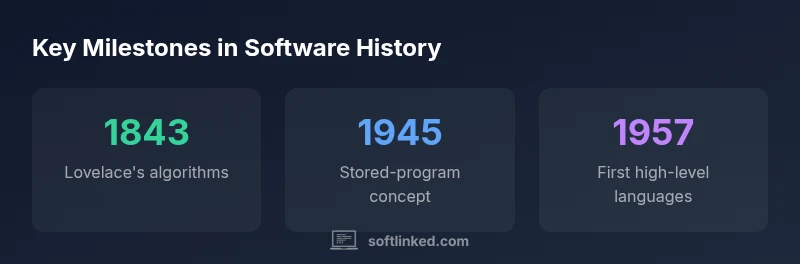
Software history is a tapestry of ideas and technologies that gradually separated computation from its hardware constraints. In the 1840s, Ada Lovelace wrote notes that described stepwise procedures for Charles Babbage’s Analytical Engine, laying the groundwork for algorithmic thinking now central to software. In 1945, John von Neumann’s stored-program concept proposed that instructions and data could reside in the same memory, enabling more flexible computation. The 1950s brought the first high-level languages, streamlining translation from human intent to machine actions; Grace Hopper contributed to this shift with compiler work that lowered the barrier to programming. The 1960s introduced time-sharing and larger software ecosystems, while the 1970s and 1980s saw a rapid expansion of languages, tools, and practices that would mature into software engineering. The rise of personal computers and, later, the internet, reinforced the view that software is a core driver of modern technology rather than a mere accessory to hardware.
From algorithms to programmable machines
The journey from abstract algorithms to programmable software is a story of abstraction first, implementation second. Early mathematics gave us algorithms as precise sequences, but it was the invention of programmable machines that allowed these ideas to be executed. Turing’s model provided a universal machine capable of simulating any computation, given the right program. Von Neumann’s architecture merged code and data, enabling rapid experimentation with different software configurations. As hardware constraints loosened, software engineering matured around formal languages, compilers, and debugging tools. This period established the discipline of writing, testing, and maintaining code as a professional activity, not a hobby. The narrative also includes divergent paths—functional programming, object-oriented design, and later declarative paradigms—each offering different ways to reason about software behavior. Understanding this spectrum clarifies how today’s software systems are assembled from simple building blocks: algorithms, data structures, abstractions, and scalable architectures that support reliable, maintainable, and secure operation.
Early computing pioneers and their roles
Key figures shaped early thinking about software. Ada Lovelace, often celebrated as the first to publish an algorithm intended for a machine, catalyzed the idea of systematic computation beyond mathematical theory. Alan Turing provided a formal theory of computation and introduced the concept of a universal machine that can run any computable program. John von Neumann’s architecture framed the practical implementation of software as a sequence of instructions in memory. Grace Hopper pushed the software boundary by developing the first compiler and guiding the dissemination of user-friendly programming languages such as COBOL. Other contributors—such as Niklaus Wirth, John Backus, and Dennis Ritchie—helped establish systematic programming languages and environments. Collectively, these efforts demonstrate how a field emerges from interconnected lines of research, engineering practice, and education rather than the triumph of a single genius.
The rise of high-level languages and compilers
High-level languages revolutionized how people write software by translating human ideas into machine actions at a manageable level of abstraction. The compiler, a key invention, converts high-level code into executable instructions, freeing developers from memory management details and hardware quirks. The 1950s through the 1970s saw a succession of languages—FORTRAN, COBOL, Lisp, C—that broadened who could program and what software could do. These tools also encouraged collaboration and reuse, as libraries and modules became standard practice. The result was a shift from writing bespoke machine code to building evolving software ecosystems. This era established core engineering practices—specification, testing, version control, and documentation—that remain foundational today. Understanding the leap to high-level languages helps learners appreciate the social and technical infrastructure that supports scalable software development across teams and organizations.
The software crisis and the birth of software engineering
By the late 1960s, software projects began to overrun budgets and schedules, exposing a mismatch between expectations and practice. The famous warning in The Mythical Man-Month highlighted Brooks’ Law: adding manpower to late projects makes them later. The crisis spurred the creation of software engineering as a discipline, emphasizing disciplined processes, metrics, and project management. Concepts like modular design, structured programming, and incremental development emerged to address complexity. The field moved toward engineering disciplines that treated software as an evolving product rather than a one-off deliverable. Over time, best practices such as iterative development, continuous integration, and testing matured, helping teams manage risk and deliver value consistently. This pivot laid the groundwork for modern software development methodologies, from agile to DevOps, and reinforced the idea that software quality is a product of people, processes, and tools working in harmony.
Modern software as a collaborative ecosystem
Today’s software landscape is defined by collaboration across organizations, disciplines, and geographies. Open-source software, cloud platforms, and distributed teams illustrate how software is produced as a shared asset rather than a single company’s secret. Git, continuous integration pipelines, and automated testing enable rapid experimentation, while design thinking and user research ensure software meets real needs. At the same time, security, accessibility, and privacy concerns push teams to build robust, maintainable systems. The SoftLinked perspective emphasizes fundamentals: clear definitions, robust architectures, and transparent processes. While technology evolves, the practice of software creation remains a collective endeavor—rooted in communities, standards, and continuous learning. For students and professionals, embracing collaboration, code reviews, and cross-functional partnerships is essential to stay relevant in a field defined by rapid change.
How to study and approach software fundamentals today
If you want a strong foundation in software, start with core concepts that recur across domains: algorithms and data structures, computer organization, programming paradigms, and software engineering principles. Build real projects that require planning, testing, and maintenance. Practice across languages and ecosystems to understand trade-offs between performance, readability, and reliability. Engage with open-source communities to contribute, learn from others, and experience collaboration at scale. Develop habits like writing clean code, documenting decisions, and using version control from day one. Finally, keep a growth mindset: software fundamentals deepen with practice, reflections, and exposure to diverse systems. This approach aligns with what SoftLinked emphasizes for learners—clear fundamentals, practical context, and continual, data-informed improvement.
Key milestones in the conceptual development of software
| Era | Key Concept | Representative Figure/Team |
|---|---|---|
| 1840s-1850s | Early algorithmic thinking and procedure-based computation | Ada Lovelace |
| 1945 | Stored-program architecture enables executable software | John von Neumann |
| 1950s | First high-level programming languages | Grace Hopper (compiler work) |
| 1960s-1970s | Foundations of programming languages and software engineering | Bell Labs / multiple teams |
Your Questions Answered
Who technically discovered software?
There is no single inventor of software. Software emerged from a long line of researchers and practitioners—from Ada Lovelace and Charles Babbage’s era to modern engineering teams—through discoveries in algorithms, computation, and programming practice. The field matured as disciplines like computer science and software engineering formed.
There’s no one inventor; software emerged from many contributors over decades.
Did Ada Lovelace invent software?
Ada Lovelace described an algorithm for Charles Babbage’s Analytical Engine in 1843, making her a pioneer in computing concepts. She did not create software as a formal discipline, which developed later through successive innovations by others.
Ada wrote an algorithm concept; she’s a pioneer, but software as a field grew later.
What is considered the first programming language?
The title depends on definition. Early candidates include assembly language and Plankalkül, with FORTRAN popularizing high-level programming in the 1950s. The broader point is that programming languages emerged to translate human intent into machine actions.
Early candidates include assembly language and early high-level languages like FORTRAN.
When did software become a distinct field?
Software began to be recognized as a distinct discipline in the 1950s and 1960s, with the rise of high-level languages, formal software engineering methods, and specialized education. This shift accompanied the professionalization of programming and the emergence of software-centric organizations.
Software became its own field in the mid-20th century as languages and practices matured.
Is software discovery a historical question or ongoing?
Software discovery is ongoing. Today, collaborative open-source ecosystems, cross-disciplinary teams, and rapid development cycles continue to redefine what software is and how it is created.
Software discovery is ongoing and collaborative.
“Software discovery is a collaborative, historical process, not the achievement of a single person. It arose from cumulative work across centuries, from Ada Lovelace to Grace Hopper and beyond—defined by the shift from hardware-first to software-first thinking.”
Top Takeaways
- No single inventor; software discovery is collective
- Milestones established stored-programs and high-level languages
- Open source and collaboration shape modern software
- Foundations rest on algorithms, languages, and architecture