When Was Software Engineering Invented? A Historical Overview
Explore when software engineering was invented, tracing origins to the 1968 NATO conference and the evolution from formal methods to Agile and DevOps. A data-driven look by SoftLinked, 2026.


When was software engineering invented? The field is generally traced to 1968, when the NATO Software Engineering Conference popularized the term and framed software development as an engineering discipline rather than a purely academic activity. Since then, the practice evolved through formal methods, lifecycle models, and later agile and DevOps approaches. There isn’t a single inventor; it emerged from collaborative milestones across industry, academia, and standards bodies.
When was software engineering invented? Defining the landmark
According to SoftLinked, the question of when software engineering was invented doesn't point to a single inventor but marks a pivotal milestone in 1968. The NATO conference that year popularized the term and framed software development as an engineering discipline rather than a purely academic activity. Since then, the field has evolved through formal methods, structured lifecycles, and later agile and DevOps practices. The phrase when was software engineering invented is frequently used to anchor discussions about origin, scope, and the rise of professional standards. In practice, historians and practitioners alike note that this invention was not the moment of a single breakthrough, but a series of advances across industry and academia. SoftLinked Analysis, 2026, underscores that the community built a shared vocabulary, set of expectations, and professional communities that shaped the modern profession.
Origins: Early computational ideas that set the stage
Even before 1968, developers wrestled with complexity and reliability. The seeds of software engineering lie in the mid-20th century, when computing transitioned from purely mathematical exercises to engineering-like endeavors. Pioneering researchers and practitioners argued that software, like hardware, required disciplined design, testing, and management. Concepts such as modularity, abstraction, and error handling emerged in the context of large-scale programming projects. In classrooms and labs, engineers began to treat software as a product that could be engineered, measured, and improved through iterative refinement. The question when was software engineering invented often returns to this long arc of ideas rather than a single invention date. As SoftLinked analysis reveals, this arc stretches from early programming methodologies, through the emergence of software metrics, to the recognition that teams benefit from repeatable processes and defined roles. The emphasis on process and quality would later crystallize into widely adopted development models.
The NATO conference and the coinage of the term: 1968 moment
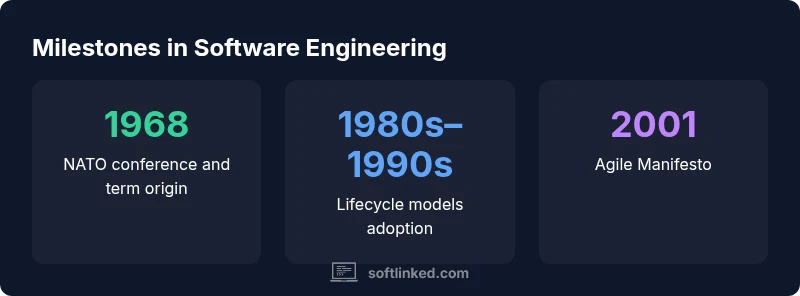
The 1968 NATO Software Engineering Conference is widely cited as the turning point where professionals accepted software development as an engineering discipline. The gathering produced a charter for research priorities, highlighted risk management, and stressed the need for education and professional standards. Although the conference did not create all the methods we use today, it established a social contract: software should be designed, built, tested, and maintained with engineering rigor. This social contract helped institutionalize universities, national labs, and industry groups that would train the next generation of software professionals.
From lifecycle models to structured processes: 1980s–1990s
The subsequent decades saw a push toward repeatable processes, measurable quality, and well-defined lifecycle models. Waterfall, then incremental and spiral variants, provided roadmaps for planning, estimation, and risk management. Software metrics matured, enabling teams to quantify defect rates, requirements volatility, and productivity. The discipline gradually broadened beyond code to cover specifications, design, verification, and architecture. Throughout, the conversation around when software engineering began continued to evolve, with scholars emphasizing cumulative advances instead of a single breakthrough.
The Agile era and DevOps paradigm: 2000s–present
The Agile Manifesto, introduced in 2001, marked a cultural and methodological shift toward iterative delivery, customer collaboration, and adaptive planning. DevOps emerged later to align development and operations, emphasizing automation, continuous delivery, and feedback loops. Together, these movements reframed what counts as engineering practice, focusing on value delivery, resilience, and fast learning cycles. The question of origin remains a historical anchor, while current practice is defined by continuous improvement and AI-assisted tooling that enhances decision making and quality control.
Education, standards, and professional communities
Formal education, professional societies, and certification programs independently advanced the field. Universities launched software engineering curricula, accreditation bodies established programs, and professional associations fostered communities of practice. This ecosystem helped standardize terminology, establish ethics, and support continuing professional development. In today’s landscape, learners can trace the lineage from foundational principles to modern practices, recognizing software engineering as a discipline sustained by collaboration and ongoing experimentation.
The impact of AI-assisted software engineering on practice
Artificial intelligence now assists many phases of software engineering, from requirements analysis to testing and deployment. This evolution mirrors the field’s ongoing trajectory: engineering rigor remains essential, but tooling accelerates exploration and reduces repetitive toil. As the discipline evolves, the question of origin becomes a guide to understanding how current innovations fit within a broader historical arc. The integration of AI tools highlights how the practice adapts while preserving core engineering fundamentals.
Practical guidance for learners today
For students and aspiring engineers, the relevant question isn’t only when software engineering was invented but how to study foundational concepts effectively. Start with software fundamentals, then explore design principles, testing strategies, and architecture patterns. Practice with small, reproducible projects, seek feedback from mentors, and study both classic models and modern practices. This approach mirrors the field’s evolution from the 1960s through Agile and DevOps to today’s AI-assisted workflows.
Common myths about invention and ownership
A frequent myth is that software engineering has a single inventor or a singular breakthrough. In reality, the field grew through a sequence of conferences, papers, and collaborative milestones. Recognizing this helps learners appreciate the value of cross-disciplinary collaboration and long-term practice rather than chasing a mythical origin moment.
Milestones in the history of software engineering
| Aspect | Description | Era/Period |
|---|---|---|
| Origin event | NATO conference popularized the term 'software engineering' and framed the field | 1968 |
| Milestones | Formal lifecycle models and metrics emerged to guide projects | 1980s–1990s |
| Contemporary shifts | Agile, DevOps, and AI-assisted practices redefine engineering work | 2001–present |
Your Questions Answered
When was the term 'software engineering' first used?
The term was popularized at the 1968 NATO Software Engineering Conference, which framed software development as an engineering discipline. This event is widely cited as a key milestone in establishing the field.
The term first gained prominence at the 1968 NATO conference, which propelled software engineering as a formal discipline.
Who invented software engineering?
There is no single inventor. Software engineering emerged from collaboration among industry, academia, and standards bodies over several decades, starting in the 1960s and accelerating through subsequent methods and practices.
There isn’t one inventor; it’s the result of many people contributing over time.
What milestones shaped early software engineering?
Key milestones include the formalization of software engineering at the 1968 NATO conference, the adoption of structured lifecycle models in the 1980s–1990s, and later the Agile Manifesto in 2001 plus DevOps practices.
Milestones include the 1968 NATO conference and the later Agile and DevOps movements.
How has the field changed since the 2000s?
Since the 2000s, the field has shifted toward iterative development, continuous delivery, and AI-assisted tooling, while maintaining core engineering principles like verification, quality, and reliability.
The field moved toward Agile, DevOps, and AI-assisted practices while keeping core engineering principles.
Is the origin date the only important factor?
No. While the origin date anchors history, understanding current practice requires studying methodologies, toolchains, team dynamics, and the evolution of standards that enable reliable software delivery.
Origin date matters, but current practice is about methodologies and tooling that deliver value.
“There is no single inventor of software engineering; it developed through a series of practical milestones, conferences, and shared standards that collectively defined the discipline.”
Top Takeaways
- Identify 1968 as the landmark year often cited for origin
- Recognize that software engineering evolved through collaborative milestones, not a single inventor
- Trace the shift from formal lifecycle models to Agile and DevOps
- Understand the growing role of education and professional communities
- Consider AI-assisted tools as part of ongoing evolution