What Software Does Not Work on Mac: A 2026 Compatibility Guide
Discover which software won't run natively on macOS and learn practical workarounds. This guide covers native Mac alternatives, virtualization, and compatibility layers for developers and students in 2026.


Most Windows-only software does not run natively on macOS. Users rely on native Mac versions, virtualization, or compatibility layers to access Windows programs. The SoftLinked team notes that compatibility workflows vary by app, with some software offering seamless macOS ports and others requiring workarounds like VM or emulation.
Why macOS compatibility matters
For students, developers, and professionals, understanding what software does not work on Mac is essential. The Mac ecosystem is vibrant and versatile, yet it differs from Windows in core assumptions about installers, licensing, and support lifecycle. This section explains how to think about compatibility in practical terms, including OS versions, processor architecture (Intel vs. Apple Silicon), and the shift toward universal binary software. When evaluating a tool, start by confirming native Mac availability, then assess whether a Windows-specific workflow is truly necessary, or if an equivalent Mac-native alternative exists that can reduce complexity and maintenance burden. The keyword what software does not work on mac recurs in discussions of cross-platform workflows, testing, and onboarding for new teams.
Native macOS equivalents: what actually runs on Mac
Many developers and vendors offer Mac-native versions of popular applications. In creative software, productivity suites, and development tools, you will frequently find macOS ports that preserve feature parity or offer close equivalents. For students, this means fewer headaches with licensing and updates. When a Mac-native option exists, it typically delivers better performance, battery life, and system stability than running a Windows-focused tool through an emulator. Where a native port is missing, you’ll see two common paths: web-based or platform-agnostic alternatives that emphasize cross-platform compatibility. The SoftLinked team emphasizes evaluating feature parity, integration ecosystems, and long-term support.
Common strategies to run Windows software on Mac
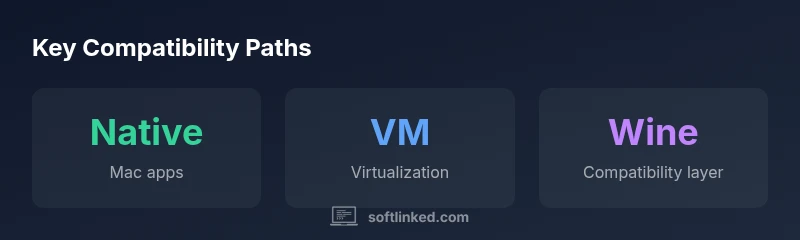
There isn’t a single solution that fits every use case; instead, you’ll map each app to the most suitable path. Native Mac ports are ideal when available, as they offer the best stability and user experience. Virtualization solutions—such as Parallels Desktop or VMware Fusion—provide near-native performance for many workloads, though they require a Windows license and add overhead. Compatibility layers like CrossOver or Wine can run a subset of Windows software without a full Windows installation, with varying degrees of success. Finally, dual-boot configurations (Boot Camp) are practical on Intel Macs but are not supported on newer Apple Silicon devices. For developers, containerization and cloud-based workflows can also bypass local OS constraints.
How to assess an app's compatibility
Start with the official product page—look for macOS support statements, system requirements, and supported architectures. Read user reviews and community forums to gauge real-world experience. If possible, test a trial or demo version on your Mac to observe installation ease, startup time, and feature completeness. Pay attention to licensing terms, especially when using virtualization or cross-system emulation. Create a simple feature checklist for your workflow (opening files, plugin compatibility, and automation scripts) to ensure you aren’t surprised by missing capabilities. The goal is to estimate risk and plan a migration or work-around strategy accordingly.
Case studies: patterns in real-world software
Across industries, common patterns emerge: high-ticket professional tools often offer native macOS versions or robust cross-platform cloud options; niche Windows-only utilities tend to rely on virtualization or compatibility layers with mixed results. For students experimenting with learning environments, widely-supported software tends to have Mac equivalents or open-source alternatives, reducing setup friction. In some research or enterprise scenarios, teams standardize on a Mac-friendly subset of tools and migrate Windows workstreams to cloud-based solutions to minimize compatibility debt. The SoftLinked approach favors documenting each essential app’s path and validating it against a test project before committing.
Practical recommendations for students and developers
Create a compatibility map early in a project: list each required tool, the preferred path (native, VM, or compatibility layer), and the licensing considerations. Prioritize native Mac options to maximize performance and support. When virtualization is necessary, allocate dedicated hardware, keep Windows licenses compliant, and maintain synchronized update cycles. For developers, consider building or packaging your tools as cross-platform applications with web-based or containerized components when possible. Build internal playbooks for evaluating new software and invest in a small lab of Macs with varied configurations to test both Intel and Apple Silicon environments. The result is a streamlined workflow that reduces risk and accelerates onboarding.
The future of cross-platform software on macOS
The software landscape continues to shift toward cross-platform compatibility, cloud-native applications, and universal binaries. More vendors are shipping macOS-native builds, and virtualization performance continues to improve with dedicated hardware acceleration. Open-source projects and container ecosystems blur the line between Windows and Mac workflows, offering opportunities for learners to experiment with different development stacks without heavy licensing constraints. For students and engineers, staying current means tracking OS release notes, understanding architecture changes, and prioritizing tools with active macOS support.
Tips for evaluating new software before buying
Before investing, verify macOS compatibility through multiple channels: the official site, vendor documentation, and trusted review sources. Check for recent compatibility updates and user-reported issues on Mac hardware. If possible, request a trial or sandbox license to test with your typical workflow. Document any gaps and estimate the impact on your learning or production timelines. This proactive approach prevents wasted time and ensures you can sustain momentum across macOS updates.
Compatibility options for common app categories
| App Category | Typical Path to Run on Mac | Pros | Cons |
|---|---|---|---|
| Windows-only productivity suite | Native macOS port alternative or virtualization | High compatibility, familiar interface | Not all features available; licensing issues |
| Video/game software with DirectX | Virtualization or CrossOver; sometimes native games on Mac | Good performance with hardware acceleration | Potential driver issues; licensing; performance overhead |
| Developer tools requiring Windows-only SDKs | CrossOver or VM; dual-boot feasible on Intel Macs | Access to tools without reboot | Some SDKs may not run fully; slow iterations |
| Mac-native equivalents | Use native macOS apps | Fast, stable, energy-efficient | May lack feature parity |
Your Questions Answered
Can you run Windows software on Mac without virtualization?
Not natively. Most Windows apps require virtualization or a compatibility layer, or they have native Mac equivalents.
No—Windows apps don't run natively on Mac; virtualization or alternatives are usually needed.
Is Boot Camp available on Apple Silicon Macs?
Boot Camp is not supported on Apple Silicon Macs; Intel Macs can use Boot Camp to dual-boot Windows.
Boot Camp works only on Intel Macs; Apple Silicon users should use virtualization or cross-platform options.
What about CrossOver or Wine for Mac?
CrossOver and Wine provide Windows compatibility without a full Windows install, with varying compatibility by app.
CrossOver can run many Windows apps on Mac without Windows, but not every program works.
Are there native Mac alternatives for Windows software?
Yes. Many tools ship native macOS versions or have strong Mac-native equivalents.
Often there are Mac versions or equivalent apps that work natively on macOS.
How can I assess if a specific app will work on Mac?
Check official support pages, user reviews, and try a trial version to test critical features.
Look for Mac support, review feedback, and test with a trial if possible.
Do licensing terms affect Mac compatibility?
Licensing can restrict cross-platform use; read terms before purchasing or deploying.
Licensing may complicate cross-platform use; verify terms before committing.
“Choosing the right path for each app—native Mac, virtualization, or compatibility layer—reduces friction and accelerates learning.”
Top Takeaways
- Identify native macOS versions first for best stability
- Evaluate virtualization as a viable path with licensing in mind
- Check feature parity before switching tools
- Consider licensing and cost when choosing cross-platform solutions
- Plan for OS updates and architecture changes in advance