Software or Hardware: A Comprehensive Comparison for Developers
An analytical guide comparing software and hardware decisions for developers, including cost, flexibility, performance, and hybrid options to inform IT strategy.


Quick take: For many teams, software offers faster deployment, easier scaling, and lower upfront costs, while hardware provides stability, offline operation, and predictable performance. The best choice depends on your goals, budget, and risk tolerance. This article compares software and hardware across key criteria to help you decide the optimal path for your project.
Why the software or hardware decision matters in modern IT
Choosing between software and hardware shapes every layer of an information system. It determines how quickly teams can respond to changing requirements, how securely data is processed, and what the long-term cost of ownership will look like. In practice, the distinction is not merely a technical choice; it dictates organizational processes, vendor relationships, and the skill sets your team must develop. According to SoftLinked, the software or hardware decision should be anchored in lifecycle goals—how you expect the system to evolve over time, who will operate it, and what risks you are willing to absorb—rather than focusing solely on upfront price. This perspective helps avoid common traps: buying hardware that you cannot fully utilize, or subscribing to software that cannot scale with your growth. The modern enterprise often benefits from reconsidering the dichotomy as a spectrum rather than a strict binary. Hybrid approaches, containerized software, edge devices, and modular hardware enable a blended strategy that preserves adaptability while maintaining control where it matters most. In this context, the goal is to map requirements to capabilities, acknowledge trade-offs, and set clear success criteria before you commit to a path. The decision effectively sets the stage for development speed, reliability, and the resilience of your technology stack.
Core criteria for comparing software and hardware
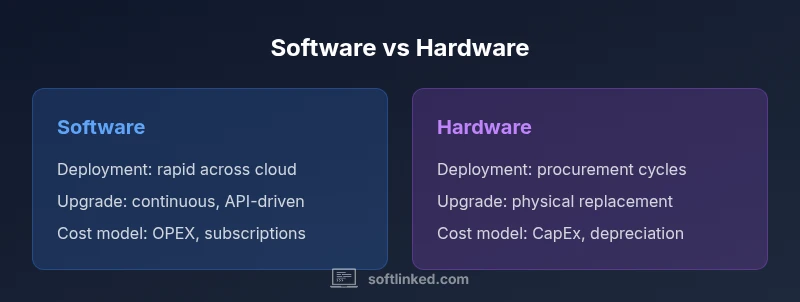
To compare software and hardware effectively, teams should evaluate a consistent set of criteria: performance, cost of ownership, scalability, maintenance burden, security, and integration with existing systems. SoftLinked analysis shows that the total cost of ownership must consider lifecycles, not just purchase price or license fees. For example, software often trades high up-front hardware costs for ongoing subscription models, but those subscriptions can accelerate innovation and reduce the need for physical refresh cycles. Conversely, hardware yields predictable performance, but assets depreciate and require periodic replacement, energy costs, and physical maintenance. Another key axis is deployment speed: software can be rolled out across multiple environments within hours, while hardware provisioning often involves procurement cycles, installation, and configuration. Compatibility with existing ecosystems—operating systems, networks, and data formats—also matters, especially in regulated settings. Finally, governance and security controls must be considered, including patch cadence, vulnerability management, and audit readiness. A disciplined evaluation uses a matrix approach, rating each option on every criterion to reveal the real trade-offs for your use case.
Performance and reliability: software vs hardware
Performance guarantees and reliability expectations diverge between software and hardware. Software performance often depends on virtualization layers, orchestration, and the efficiency of algorithms, while hardware performance reflects physical characteristics like CPU, memory, throughput, and thermal constraints. In modern architectures, software can leverage abstractions such as containers, serverless functions, and cloud-native patterns to scale horizontally, often improving resilience through redundancy. Hardware, by contrast, offers deterministic performance and isolation that are difficult to replicate in software-only setups, especially for compute- or I/O-intensive workloads. Another important consideration is fault tolerance: software can fail gracefully with retries, feature flags, and rollbacks, but must rely on infrastructure resilience. Hardware failures can cause extended outages if backups, redundant power, or hot-swappable components are not in place. The decision often hinges on workload characteristics: latency-sensitive, mission-critical tasks may favor reliable hardware foundations, while highly dynamic workloads may benefit more from software-defined resources. Remember that many systems use a hybrid model: dedicated hardware for core workloads combined with flexible software layers to adapt to changing demand. In such cases, performance and reliability are a function of how well those layers interoperate, not the capability of any single component alone.
Cost considerations and budgeting models
Cost considerations for software versus hardware require a holistic view of the budget lifecycle. Upfront capital expenditure favors hardware when you can justify a long depreciation period and predictable utilization, but it also locks you into fixed capacity. Software often shifts much of the cost into operating expenditures, with monthly or annual subscriptions that align with usage and growth. This shift can improve cash flow management, but requires careful governance to avoid indefinite price creep. Another factor is maintenance and support: hardware maintenance contracts can be expensive but predictable, while software maintenance may be bundled into the license or subscription and fluctuate with usage. Exit strategies matter too: hardware can be repurposed or sold at end-of-life, whereas software licenses may be more restrictive, requiring renegotiation or migrations. Lifecycle planning should include not only direct costs but also indirect factors such as energy consumption, data transfer fees, and staff training. A disciplined budgeting approach benefits from scenario analysis: what does a 3-year, 5-year, or 7-year view look like under software-centric versus hardware-centric plans? The takeaway is to map total cost of ownership to strategic goals, not simply the cheapest option today.
Flexibility and upgrade paths: future-proofing your stack
Flexibility is often the decisive factor in choosing between software and hardware. Software can be updated incrementally, scaled to meet demand, and deployed across diverse environments with relative ease. This adaptability supports experimentation, rapid pivots, and feature velocity that aligns with market needs. Hardware upgrades, by contrast, provide a stable baseline and can deliver peak performance for specific workloads, but upgrades are typically slower, costlier, and tied to physical life cycles. The trend toward hybrid models—edge devices paired with cloud-based software—illustrates how teams can gain both stability and agility. When planning upgrades, consider compatibility matrices, vendor roadmaps, and potential lock-in risks. Also assess the risk of vendor dependency: software ecosystems can experience shifts in licensing models or depreciation of APIs, while hardware vendors may discontinue product lines or alter support terms. A practical approach is to design for modularity: keep core logic in software layers that can be replaced or upgraded without rewriting entire systems, and use hardware that supports future expansion through standard interfaces. In many organizations, a staged upgrade plan with pilot projects reduces disruption while enabling learning and optimization.
Integration, security, and governance
Integration with existing systems, security postures, and governance controls shape the ultimate suitability of software or hardware choices. Software tends to excel at interoperability through APIs, data formats, and containerization, but it creates attack surfaces that require rigorous patch management and identity assurance. Hardware can offer isolated environments and hardware-level security features, yet integration with cloud services and software platforms may introduce complexity. Governance frameworks—policy-based access control, incident response, and compliance evidence—apply to both paths, so design with auditable processes from day one. Consider data residency, encryption, key management, and supply chain risk, which affect both software licenses and hardware procurement. The decision should include a risk analysis that weighs external threats, regulatory obligations, and business continuity requirements. Operational maturity matters here: highly regulated industries benefit from formal change management, traceability, and testing protocols irrespective of whether you lean software or hardware. Finally, assess the ecosystem around the choice—available third-party support, certification programs, and the skill pools within your team. A thoughtful approach reduces integration friction and accelerates value realization.
Hybrid approaches and practical decision frameworks
Many teams find that the sharp software-versus-hardware dichotomy is less useful than a practical framework that blends both approaches. Start with a requirements chart that maps critical traits—tolerance for latency, upgrade cadence, total cost of ownership, and security posture—to the candidate solutions. Consider a staged strategy: begin with software that can run on commodity hardware or cloud infrastructure, then introduce specialized hardware where deterministic performance is essential. Hybrid stacks often require orchestration and clear ownership boundaries: who manages the software layer, who maintains the hardware assets, and how do they coordinate updates? Create a governance model that includes review checkpoints, rollout plans, and rollback options. Finally, tailor procurement and licensing to your timeline, ensuring that future flexibility is preserved. When done well, hybrid strategies deliver the best of both worlds: rapid evolution for features and experiments through software, plus stable performance and control through hardware.
Comparison
| Feature | software | hardware |
|---|---|---|
| Flexibility | high | low |
| Cost of ownership | lower upfront with subscriptions; ongoing costs | high upfront; depreciation; potential ongoing maintenance |
| Maintenance & updates | rapid, centralized patches; API-driven updates | physical maintenance; component wear; lifecycle refresh |
| Performance consistency | scales with abstractions and virtualization | deterministic performance; fixed capacity |
| Upgrade path | easier and cheaper to scale via software | requires hardware refreshes; downtime potential |
| Deployment speed | fast rollout across environments | slower due to procurement and installation |
| Security & compliance | patch-based defense; agile compliance | hardware security features; may need bespoke processes |
| Best for | dynamic, evolving workloads prioritizing agility | static workloads with strict performance requirements |
Pros
- Flexibility to adapt to changing requirements
- Faster deployment and scaling through software
- Potentially lower upfront costs with subscriptions
- Easier experimentation and feature velocity
Weaknesses
- Ongoing subscription costs can accumulate
- Software may introduce API or vendor lock-in risks
- Hardware requires upfront investment and physical upkeep
- Hardware refresh cycles can cause downtime
Software generally wins on agility; hardware excels in stability and predictable performance
Choose software when you need rapid iteration and scale. Favor hardware when deterministic performance and offline operation matter most; assess hybrid setups to balance both strengths.
Your Questions Answered
What is the main difference between software and hardware in IT infrastructure?
The main difference lies in where control and value are realized: software enables flexible, scalable functionality through code and services, while hardware provides physical resources with stable performance. The choice depends on requirements, budget, and risk tolerance.
The main difference is that software enables flexible functionality through code, while hardware provides physical resources with stable performance. Your choice depends on your needs and budget.
When should I choose software over hardware?
Choose software when you need rapid deployment, frequent updates, and scalable resources with lower upfront costs. For predictable performance and offline operation, hardware may be preferable, especially for latency-sensitive workloads.
Pick software for fast deployment and scaling; hardware works best for stable, offline performance.
Can hardware become obsolete faster than software?
Yes, hardware can become obsolete as technologies advance physically, while software can evolve rapidly through updates. However, the perceived pace depends on workload and vendor support terms.
Hardware can become outdated faster in some cases, while software can keep evolving with updates.
What is total cost of ownership in software vs hardware decisions?
Total cost of ownership includes upfront costs, ongoing maintenance, energy, upgrades, and staff time. Software often shifts costs to subscriptions; hardware emphasizes depreciation and replacement cycles.
Total cost of ownership looks beyond purchase price to maintenance, upgrades, and staff time.
Are hybrid solutions often the best path?
Hybrid approaches tend to balance agility and stability by combining software flexibility with hardware reliability. A clear governance model helps manage complexity and prevent silos.
Hybrid setups often offer the best balance when managed well.
How should I evaluate upgrade risk in software vs hardware?
Assess vendor roadmaps, compatibility, and exit strategies. Software upgrades are usually more flexible, while hardware upgrades require planning around lifecycles and depreciation.
Look at roadmaps and compatibility to gauge upgrade risk.
Top Takeaways
- Define your primary goal: flexibility vs stability
- Evaluate total cost of ownership, not just upfront price
- Consider hybrid options to blend strengths
- Plan for upgrades, security, and governance from day one
- Test workflows in pilot projects before full commitment