Software Rendering vs GPU Rendering: A Practical Guide
Should you use software rendering instead of gpu rendering? This in-depth 2026 comparison weighs performance, portability, tooling, and cost to help developers pick the right rendering path.


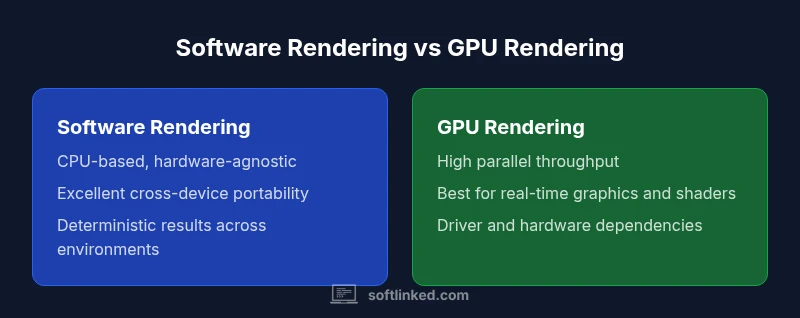
For many projects, software rendering can be a viable alternative to GPU rendering, especially when portability, energy efficiency, or hardware constraints matter. This comparison clarifies where software rendering shines and where GPUs have the edge. In short, choose software rendering for predictable CPU-based workloads and broad device support; prefer GPU rendering for high-performance graphics and parallel tasks.
Should you use software rendering instead of gpu rendering? Framing the decision
Should you use software rendering instead of gpu rendering? This question sits at the intersection of portability, performance, and developer productivity. According to SoftLinked, the right choice isn't universal; it's a function of workload, platform constraints, and time-to-market pressures. As a starting point, software rendering leverages CPU resources to produce visual output without requiring specialized hardware. This can simplify distribution to a broad set of devices and operating systems, reduce reliance on driver support, and improve predictability across environments. Yet it comes with trade-offs: CPU bottlenecks, longer render times for complex scenes, and potential limits on advanced graphical effects. In 2026, the decision is rarely binary; teams often blend approaches, using software rendering for fallback modes and GPU rendering for the heavy lifting. This article provides a framework to assess when software rendering makes sense, and when GPUs remain the practical default.
The core question: should you use software rendering instead of gpu rendering? This heading highlights the central decision for developers and teams evaluating rendering paths. The choice touches on performance, portability, and lifecycle costs, and sets the stage for a structured framework that follows throughout this guide.
Comparison
| Feature | software rendering | gpu rendering |
|---|---|---|
| Performance profile | CPU-bound performance depending on host CPU speed; predictable for simple scenes | GPU-accelerated throughput; superior for parallelizable workloads and complex scenes |
| Power consumption | Can be efficient on low-end hardware when CPU work is modest | Typically efficient for graphics-heavy tasks on capable GPUs; dependent on GPU power and driver efficiency |
| Image quality & fidelity | Deterministic rasterization results governed by CPU raster pipelines | Higher potential Fidelity with advanced GPU shaders and hardware-accelerated features |
| Development tooling | Broad, hardware-agnostic debugging and profiling on CPUs | GPU debugging/profiling often relies on vendor-specific tools and drivers |
| Portability & compatibility | Excellent across devices; no GPU requirement | Depends on GPU availability, driver support, and platform compatibility |
| Cost & deployment | Lower upfront hardware dependency; may reduce licensing or vendor lock-in | Requires capable GPUs and drivers; potential licensing and hardware costs |
| Best for | Cross-device UI, offline rendering, CPU-bound workloads | Graphics-intensive apps, real-time rendering, heavy shader workloads |
Pros
- Broad hardware compatibility and easy distribution
- Deterministic behavior across devices and OSes
- Lower dependency on specialized hardware or driver stacks
- Simple setup for CPU-focused workflows
Weaknesses
- Limited performance for graphics-heavy workloads
- Longer render times and potential CPU bottlenecks
- Fewer GPU-specific optimizations and modern shader capabilities
- Tooling and debugging may be less mature for software pipelines
Software rendering is best for portability and predictable CPU workloads; GPU rendering is preferred for high-end visuals and parallel tasks.
Choose software rendering when device variety and reproducibility matter most. Opt for GPU rendering when your workload demands speed, realism, and advanced graphics features.
Your Questions Answered
What is the key difference between software rendering and GPU rendering?
Software rendering runs on the CPU and uses software rasterization to generate images, while GPU rendering uses a dedicated graphics processor to accelerate rendering tasks. The CPU path tends to be more portable, whereas the GPU path offers higher performance for graphics-heavy workloads. The choice depends on workload characteristics and deployment constraints.
Software rendering uses the CPU to draw images, while GPU rendering uses the graphics card. The choice depends on your workload and deployment needs.
When should you choose software rendering?
Choose software rendering when you must run on diverse hardware, require reproducible results, or need to avoid GPU driver dependencies. It’s also attractive for CPU-bound tasks where a consistent rendering path is critical. For UI rendering or offline batch jobs, software rendering can be a solid baseline.
Software rendering is good for diverse hardware and reproducibility, or when GPU drivers are a concern.
What are the performance implications of software rendering?
Software rendering can be slower for graphics-heavy scenes and large textures, due to the CPU's relative lack of parallelism. It may still outperform GPU rendering on very constrained devices or simple tasks. Always benchmark with real workloads to quantify impact.
It can be slower on complex scenes, but benchmarking helps you understand the impact.
Are there security or portability concerns with software rendering?
Software rendering generally offers broad portability across operating systems and devices, with fewer driver-specific vulnerabilities. However, you may miss hardware-accelerated features and need to maintain a robust fallback path for GPUs when available.
Portability is often a strength of software rendering, but you lose GPU features and must plan fallbacks.
How do you approach hybrid rendering strategies?
A practical approach is to render core UI or non-critical visuals with software rendering and reserve GPU rendering for scenes requiring high fidelity or performance. You can implement dynamic switching or progressive enhancement to balance both paths.
Hybrid strategies let you get the best of both worlds by mixing paths as needed.
Top Takeaways
- Assess workload characteristics before choosing a rendering path
- Prefer software rendering for cross-device compatibility
- Benchmark both approaches with realistic scenes
- Plan fallback strategies for mixed environments
- Invest in tooling that matches your chosen path