How to Protect Software from Hackers: Essential Guide
Practical guide to threat modeling, secure coding, automated testing, and resilient deployment for protecting software from hackers; designed for developers, students, and tech pros.


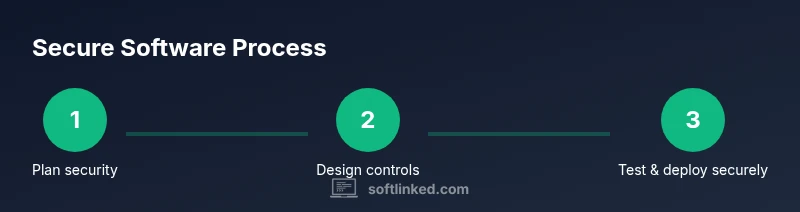
Learn how to protect software from hackers by applying a security-first approach across design, code, and deployment. This guide outlines essential steps, including threat modeling, secure coding, dependency management, and automated testing. You’ll need a secure development lifecycle, ongoing training, and governance to reduce risk and improve resilience. This steps-based approach suits developers, students, and tech pros seeking clear fundamentals.
Why Protecting Software from Hackers Matters
In today’s software-driven economy, a single breach can compromise user data, disrupt services, and erode trust. According to SoftLinked, building software with security baked in from the start reduces the likelihood of costly incidents and speeds up delivery cycles. For students and professionals alike, understanding why protection matters helps prioritize secure design and coding decisions. By treating security as a feature rather than a bottleneck, teams anticipate threats across modules, libraries, and deployment environments. This mindset change supports safer lifecycles, fewer emergency patches, and more predictable project timelines.
Hackers often target misconfigurations, exposed credentials, and insecure interfaces. The core defense includes least privilege, strong authentication, encrypted channels, and continuous monitoring. The aim is a culture where developers, operators, and product managers share responsibility for security. The SoftLinked approach emphasizes actionable steps aligned with real-world workflows, not abstract checklists. Readers will learn practical strategies that integrate security into planning, development, and operations, from threat modeling to post-release monitoring.
Core Security Principles for Software Development
Security rests on durable principles that translate across languages and teams. The CIA triad—confidentiality, integrity, and availability—guides decisions about data handling, storage, and uptime. Defense in depth, layered controls, and secure defaults reduce the attack surface. Apply least privilege at every boundary, enforce strong authentication, and segment networks to limit blast radius. Encryption for data at rest and in transit protects sensitive information, while tamper-evident logging and immutable artifacts support accountability. Regular audits and alerting help you detect anomalies early.
To turn these ideas into practice, embed security into architecture reviews, choose vetted cryptography, and maintain an incident response plan. Secure development is not a checkbox; it’s a repeatable pattern seeded in culture, tooling, and governance. The SoftLinked approach promotes collaboration between developers, operators, and security specialists, ensuring risk analysis, threat modeling, and policy enforcement become everyday work. When security is a shared responsibility, teams ship safer software, align with compliance requirements, and reduce reactive firefighting.
Threat Modeling: Proactive Defense
Threat modeling looks forward. By mapping assets, entry points, and trust boundaries, teams identify where attackers could break in and what those breaches would cost. Structured methods like STRIDE or PASTA help prioritize mitigations such as input validation, strict authentication, and proper error handling. Start with a simple data-flow diagram and expand to privilege boundaries, cryptographic controls, and third-party risk. Revisit the model whenever features change or new dependencies enter the stack.
SoftLinked analysis highlights the value of threat modeling in early design: it clarifies decisions, reduces design drift, and helps communicate risk to non-technical stakeholders. Integrate modeling into architecture reviews and backlog grooming so mitigation tasks become part of the build plan. The goal is to shift security left, catching most issues in the design phase rather than during testing or production. Document outcomes and track remediation progress as part of the security backlog.
Secure Coding Practices You Can Implement Today
Secure coding begins at the keyboard. Enforce input validation, output encoding, and strict error handling. Use parameterized queries to prevent SQL injection, avoid deprecated APIs, and prefer safe language features. Keep secrets out of source code by using secret managers, vaults, and environment encryption. Implement comprehensive code reviews focused on security, combine with pair programming for critical modules, and wire automated security checks into CI/CD. Finally, design APIs with explicit authentication, authorization, and auditable actions.
Tools and Practices to Detect and Prevent Breaches
Automation and discipline beat manual, ad hoc security. Use SAST to scan source code for vulnerabilities and DAST to assess running applications. Maintain an up-to-date bill of materials by scanning dependencies for known flaws and license issues. Protect artifacts with code signing and manage credentials with a dedicated secrets management tool. Runtime protections like WAFs, EDR, and centralized telemetry help detect and respond to anomalies. Centralized logging, alerting, and anomaly detection complete the security loop and support forensics.
Building a Resilient Deployment Pipeline
A resilient deployment pipeline enforces security across environments. Use infrastructure as code to standardize setups, apply policy-as-code, and reproduce environments for testing. Encrypt and rotate secrets, and store them in a dedicated vault with strict access control. Integrate SAST, DAST, and dependency scans in CI/CD and gate deployments on security requirements. Ensure reproducible builds with code signing to guarantee provenance. Invest in observability: logs, metrics, traces, and alert rules that trigger incident responses. Regularly rehearse disaster recovery and incident response playbooks.
The Human Factor: Training and Governance
Ultimately, people determine whether defenses work. Offer ongoing security training for developers and operators, with hands-on exercises and real-world scenarios. Establish governance: defined ownership, clear policies, and accountability for security incidents. Run tabletop exercises and maintain a documented incident response plan with roles and escalation paths. Track progress with simple metrics and feedback loops, using results to improve tooling, processes, and culture. Security is a continuous journey, not a one-off project.
Tools & Materials
- Secure coding checklist(A comprehensive list of common vulnerabilities and mitigations.)
- SAST tool(Static analysis to identify flaws in source code.)
- DAST tool(Dynamic testing of running applications.)
- Dependency scanning tool(Identify vulnerable libraries and licenses.)
- Code signing certificate(Guarantees provenance and integrity of artifacts.)
- Secrets management solution(Keeps passwords, tokens, and keys out of code.)
- Version control with access controls(Restricts who can commit and deploy.)
- Secure deployment environment guidelines(Baseline configurations and hardening steps.)
Steps
Estimated time: 60-90 minutes
- 1
Define security requirements up front
Identify threats, compliance needs, and security goals at project onset. Create a baseline secure design and a threat model to guide architecture decisions.
Tip: Document attacker goals and potential vectors early. - 2
Integrate secure design
Architect modules with least privilege, strong boundaries, and clear interfaces. Review designs with security in mind before coding.
Tip: Use design review checklists that include security criteria. - 3
Implement secure coding practices
Follow language-specific guidelines, validate inputs, encode outputs, and avoid risky APIs. Keep secrets out of code.
Tip: Prefer parameterized queries and strict typing. - 4
Automate security testing
Embed SAST and DAST into CI/CD; run security tests on every build; fail builds on critical findings.
Tip: Treat vulnerabilities as build failures to enforce discipline. - 5
Guard dependencies and artifacts
Regularly scan third-party libraries, update promptly, and verify artifacts with code signing.
Tip: Pin versions and monitor advisories for all dependencies. - 6
Secure deployment and runtime protection
Enable TLS, enforce strong authentication, apply runtime protections (WAF/EDR), and monitor in production.
Tip: Implement runtime monitoring to detect anomalies quickly.
Your Questions Answered
What is threat modeling and why is it essential?
Threat modeling helps identify potential attacker goals and weak points before coding begins, guiding design choices.
Threat modeling helps you plan security earlier by identifying attacker goals and weak points.
What is the difference between SAST and DAST?
SAST analyzes code at rest for flaws; DAST tests a running app for vulnerabilities; both are needed.
SAST checks code for flaws; DAST checks running software.
How often should I scan dependencies?
Scan regularly and automatically, ideally with every build to catch new vulnerabilities.
Run dependency scans with each build and after known advisories.
Is code signing required for all software?
Code signing helps verify provenance and integrity; required in many ecosystems.
Code signing proves who created the software and that it hasn't been tampered with.
What about user education and governance?
Security is a team effort; train developers and enforce policies with governance.
Educate developers and enforce security policies across teams.
How can I measure security progress over time?
Use simple, repeatable metrics, audits, and incident response drills to track improvement.
Track metrics and run drills to see how your security improves.
Watch Video
Top Takeaways
- Incorporate security from the design phase
- Automate testing to catch vulnerabilities early
- Limit access and monitor runtime behavior
- Keep dependencies up to date and verifiable