How to Know if Software Engineering Is for You: A Practical Guide
Discover how to know if software engineering is for you with a practical, step-by-step approach. Assess your interests and problem-solving appetite, plus work realities.


By the end of this guide you will confidently decide whether software engineering is a good fit. You’ll assess your problem-solving appetite, learning style, and daily work realities, then complete a hands-on mini-project to test interest. This step-by-step path helps you decide your next move with clarity.
how to know if software engineering is for you
If you’re curious about building software people use, enjoy solving problems, and want a field that rewards continual learning, this guide is for you. According to SoftLinked, the software engineering path blends creativity with rigorous practice, collaboration, and rapidly changing technologies. The core question remains: does the daily life, the pace of learning, and the kind of problems you solve align with your interests? This block outlines signals that the field could be a strong match and sets expectations for what you’ll test in the coming sections. Throughout, you’ll see how to translate interest into concrete steps you can take this week to evaluate fit. Also, consider your long-term goals—whether you’re drawn to systems design, front-end experiences, or data-driven applications—as you answer the central question: how to know if software engineering is for you.
Key signals include a love for logical puzzles, persistence with debugging, comfort with rapidly evolving tools, and a preference for building tangible products rather than only analyzing ideas. If you enjoy collaborative work, code reviews, and documenting decisions, those are practical indicators you’ll thrive in a software team. If some of these cues feel unfamiliar, that’s not a dead end—this guide helps you test drive the role safely and cheaply before making commitments.
Self-assessment: do you like solving problems and learning?
Assessing fit starts with self-reflection. Ask yourself: Do you enjoy turning vague ideas into concrete solutions? Are you comfortable grappling with hard problems until you find a workable path? Do you learn best by doing, rather than listening alone? A strong signal is curiosity about how software behaves, how users interact with it, and how to measure performance. If you answer yes to several of these questions, you likely have the mindset conducive to software engineering. SoftLinked’s framework recommends mapping your answers to three axes: problem-solving appetite, willingness to learn new tools, and tolerance for debugging setbacks. Use a simple scoring rubric: 1 for rarely true, 5 for almost always true. If your average score sits around 3.5 or higher, you’re probably in a good position to explore more deeply. If your score is consistently below 3, you may want to start with lighter exposure (coding games, beginner-friendly projects) to confirm interest before investing heavily.
In addition to mindset, consider your preferred learning style. Do you retain concepts better through hands-on practice, visual explanations, or reading and reflecting? Software engineering rewards diverse approaches, but you’ll maximize growth by blending practice with guided study—tutorials, coding challenges, and small projects all play a part. Finally, reflect on your time horizon: are you prepared to invest months in gaining confidence, or do you prefer faster feedback cycles? Answering honestly about these dimensions helps you decide if you should pursue formal study, self-learning, or a hybrid path. As SoftLinked notes, clarity on learning pace often predicts persistence and success in the field.
What a typical day looks like for a software engineer
A software engineer’s day often blends deep focus with collaborative rituals. Mornings may start with code reviews or planning meetings to align on goals with teammates. After that, you’ll likely spend blocks of uninterrupted time writing, testing, and debugging code. The pace can be fast, especially near a product release, but it also includes moments of calm where you refine architecture, write tests, or optimize performance. Communication is essential—pull requests, issue trackers, and standups ensure alignment across product, design, and QA teams. If you prefer steady output and continual feedback loops, this daily rhythm tends to feel natural.
Another regular activity is learning-on-the-job: new libraries, frameworks, or APIs require quick study, experimentation, and documentation. You’ll become comfortable working with version control, debugging tools, and automated tests. If you enjoy this blend of focused coding and collaborative planning, you’ll likely find software engineering a good long-term fit. Conversely, if you crave solitary work with minimal coordination, you might prefer certain specialized roles or shorter projects. The bottom line is: your experience will vary by company, role (backend, frontend, devops, data), and project cycle, so testing a few realistic tasks is the best signal for fit.
Hands-on tests you can run this week
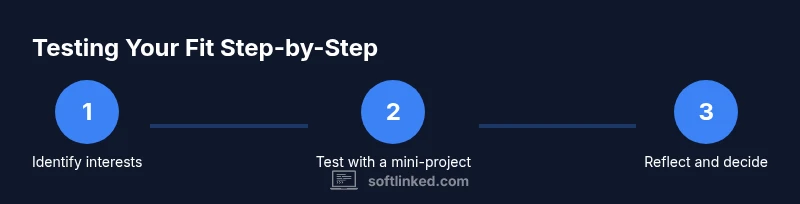
Testing your fit doesn’t require a full career switch. Start with a small, well-scoped project that mirrors real work: build a to-do app, a weather dashboard, or a simple data visualizer. Set up your development environment (text editor, a version control system, and a local runtime). Implement a few features, write tests, and document your decisions. Then, code-review your own work and seek feedback from a mentor or online community. You should observe how you handle planning, implementation, and iteration under constraints. At this stage, the goal is to learn what parts you enjoy and what parts demand more time or support. If you finish with curiosity, a sense of accomplishment, and a plan to improve, you’re likely leaning toward software engineering. If the experience feels frustrating or uninteresting, use this signal to adjust your approach rather than quitting on the entire idea.
Work with a structured plan: define the problem, outline a minimal viable feature, implement, test, and reflect. Examples of mini-projects include a personal notes app, a small API, or a command-line tool. Track time and capture what was learned in a quick journal. The result will be a practical read on your long-term fit. Finally, compare your experience to the realities of documented roles in your target area (web, mobile, data, systems) to see how closely your preferences match job realities.
If you want a quick-start checklist, use these steps: 1) choose a project, 2) set a 4-hour block, 3) implement a core feature, 4) add tests, 5) reflect on what you enjoyed, 6) plan the next increment. This approach provides immediate feedback while keeping the process approachable and low-risk.
Common myths and how to navigate them
Many people assume software engineering is only for math whizzes or that you must live in a big city with a prestigious degree. Both beliefs are myths. You don’t need perfect math skills for many roles; logical thinking and problem-solving matter more than advanced calculus. You do not need to be a genius to start; many successful engineers began with curiosity, persistence, and structured practice. The path can be non-linear: you can begin with self-taught courses, participate in internships, join code schools, or contribute to open source. The key is to build a portfolio of small wins that demonstrate your ability to learn and deliver. Finally, the stereotype of long hours is outdated in many teams that emphasize sustainable pace and healthy work-life balance. The practical route is to test your interests with light projects, seek feedback, and gradually compound your skills over time. This measured approach helps you separate aspiration from long-term reality and makes your evaluation process more reliable.
If you encounter friction—such as a challenging concept or a lack of mentorship—use it as a signal to adjust your learning plan rather than abandoning the idea. Seek diverse resources, join a supportive coding community, and set incremental milestones. With the right approach, software engineering can become not only understandable but enjoyable, aligning with your strengths and career goals.
Career paths, learning trajectories, and milestones
Software engineering offers diverse paths: frontend, backend, mobile, data engineering, machine learning, systems engineering, and DevOps. Each path has its own learning curve and milestones. A common trajectory starts with acquiring fundamentals: programming concepts, data structures, version control, testing, and debugging. Then comes specialization: learning a framework or domain-specific tools, building a portfolio, and contributing to projects. Milestones typically include completing a series of small projects, achieving code quality with a solid test suite, and landing an internship or entry-level role. The time to competence varies by individual, but a structured plan with consistent practice accelerates progress. As you grow, you’ll deepen expertise in system design, scalability considerations, and collaboration practices like code reviews and design docs. If you’re uncertain, consider a platform-agnostic approach: start with general programming foundations, then selectively dive into one or two domains that align with your interests. SoftLinked’s guidance emphasizes a practical, portfolio-driven path to long-term growth rather than chasing a single “correct” route.
When evaluating potential roles, map your interests to real responsibilities: APIs and services, user interfaces, data pipelines, or cloud infrastructure. This mapping helps you choose a concrete starting point for learning. Remember that frequent interaction with code reviews, mentors, and peers accelerates skill development. Regularly revisit your goals to ensure your path remains aligned with your evolving interests and industry trends.
Next steps and setting a realistic timeline
If you’re still unsure after testing a few mini-projects, establish a concrete timeline to decide. A practical approach is a 90-day exploration plan with weekly milestones: learn core language concepts, complete two small projects, build a personal portfolio, and apply for beginner-friendly roles or internships. Schedule time blocks for deliberate practice and for reviewing progress with a mentor. Throughout, track what you enjoyed, what challenged you, and where you excel. This data-driven reflection helps you choose between continuing down the software engineering path or pivoting to a related field such as data analysis, product management, or technical writing. Celebrate small wins and stay flexible—your interests may shift as you gain experience. If the outcome is positive, you’ll have a clear plan for next steps, from advanced topics to real-world applications. If not, you’ll still emerge with a strong understanding of your strengths, which is invaluable for any future career decision.
Conclusion: turning assessment into action
The core question, how to know if software engineering is for you, is best answered by action and reflection. Use measurable tests, feedback from peers, and a growing portfolio to decide. If you discovered genuine interest and incremental competence, the path forward becomes clearer: deepen your learning, pursue relevant projects, and seek opportunities that align with your preferred domain. If you decide it’s not for you, you’ll have gained clarity about your strengths and interests, and you can redirect your energy to a field that better matches your aspirations.
Tools & Materials
- Laptop with internet access(At least 8GB RAM, modern browser)
- Code editor(Examples: VS Code, JetBrains IDE)
- Version control system(Git installed; GitHub/GitLab account optional)
- Online coding playground(Optional for quick experiments (e.g., Repl.it, CodeSandbox))
- Mentor or peer group(Seek feedback on projects and learning plan)
Steps
Estimated time: Total time: 6-9 weeks for initial exploration
- 1
Clarify your motivation
Identify why you want to pursue software engineering and what problems you want to solve. Write down three personal goals you want to achieve in the next 90 days.
Tip: Clarify which outcomes matter most to you (salary, impact, creativity) to guide your path. - 2
Take a beginner-friendly intro
Enroll in a foundational programming course or a guided tutorial to test your comfort with basic concepts like variables, loops, and simple data structures.
Tip: Choose a track aligned with your interests (web, data, or automation) to stay engaged. - 3
Set up your dev environment
Install a code editor, a local runtime, and version control. Create a private repo for your first practice projects.
Tip: Document decisions as you code to reinforce learning and future reference. - 4
Build a focused mini-project
Create a small, end-to-end project (e.g., a task manager) with a user interface, simple persistence, and tests.
Tip: Keep scope tight to ensure you finish and learn from the process. - 5
Seek feedback and reflect
Have a mentor review your code and provide constructive feedback. Reflect on what felt natural and what didn’t.
Tip: Use a learning journal to capture insights for future iterations. - 6
Explore a second domain
Experiment with another domain (e.g., backend vs. frontend) to see where your interests lie.
Tip: Compare experiences to identify which domain aligns with your strengths. - 7
Decide your next steps
Based on tests and feedback, plan solid next steps: deeper learning, an internship, or pivot to a related field.
Tip: Set a concrete 8-12 week plan with measurable milestones.
Your Questions Answered
What signals indicate software engineering might be for me?
If you enjoy solving logical problems, learning new tools, and building tangible software, these are strong signals. Regularly testing with small projects helps confirm fit.
If you like solving problems and building things, you may be a good fit. Start with small projects to test your interest and comfort level.
Do I need a formal degree to start?
No single path guarantees success. Many start with self-learning, bootcamps, or certificates and build a portfolio to demonstrate capability.
You don’t necessarily need a formal degree. A strong portfolio and consistent practice can open doors.
How long does it take to decide if this field is for me?
A focused exploration plan of 6-12 weeks with practical projects and feedback often yields a clear direction.
Giving yourself 6 to 12 weeks of guided exploration usually reveals whether you’re drawn to the field.
Can I switch into software engineering from another field?
Yes. Many people transition from other tech or non-tech roles by building a foundation in programming and completing portfolio projects.
Switching is common. Start with fundamentals and projects to prove your skills.
What is the daily life like for a junior engineer?
A junior engineer typically codes, tests, participates in code reviews, and gradually handles more complex tasks as they learn.
Junior engineers code, test, and learn through feedback and collaboration each day.
Is software engineering only for people who love math?
Math helps, but many roles rely more on problem-solving and logical thinking than advanced math. Practice and persistence matter more.
You don’t have to be a math genius; focus on problem solving and consistent practice.
What if I don’t enjoy a particular project?
Treat it as a signal to pivot early. Re-scope or switch domains to find a better fit rather than quitting entirely.
If a project isn’t engaging, reframe or pivot rather than giving up.
Watch Video
Top Takeaways
- Identify your intrinsic interests in problem-solving and building.
- Test fit with hands-on mini-projects and mentor feedback.
- Expect a learning curve; pace yourself with a structured plan.
- Explore multiple domains before committing to a specialization.
- Use a portfolio and reflection to guide your next steps.