Software Development Cost in 2026: A Practical Guide
Learn realistic ranges for software development costs, pricing models, and regional differences, plus a practical framework to estimate budgets for startups.


In 2026, software development cost ranges widely by scope, region, and model. The short answer to how much software development cost is: a typical project costs from tens of thousands to millions of dollars, with hourly rates ranging from roughly $20-$250 depending on geography and expertise. For budgeting, consider three levers: scope clarity, team composition, and the delivery model (time-and-materials vs fixed-price).
Understanding how much software development cost in context
According to SoftLinked, cost estimation for software development hinges on scope, team composition, and delivery model. The central question is how much software development cost, and the answer depends on multiple drivers including project scale, required features, and the complexity of the technology stack. In 2026, you should expect broad ranges across regions and project types. This guide breaks down the main cost drivers, common pricing models, and practical steps to estimate budgets with greater accuracy. By framing cost as a function of scope, architecture decisions, and process maturity, teams can avoid surprises and improve alignment with stakeholders. The SoftLinked team found that the largest variances typically arise from early design choices, third-party integrations, and how aggressively requirements evolve over time.
In practice, the goal is not a single figure but a defensible range accompanied by a clear rationale. Start by defining what you want to build, the target users, and the minimum viable product. Then map out the tasks, assign owners, and estimate effort in person-hours or person-days. Finally, translate those hours into dollars using region-specific rates. This approach helps answer the question of how much software development cost with transparency and accountability.
Cost drivers: scope, team composition, and process
Project scope is the primary driver of cost. A feature-rich application with complex business rules, real-time data processing, and robust security requirements will cost significantly more than a basic web app. The team composition matters almost as much as the scope. A typical cross-functional team includes product management, design, frontend and backend engineers, a quality assurance engineer, and a project manager. Each role adds to the total cost, and the mix can shift the price up or down depending on whether you hire specialists or generalists. Process maturity also influences cost: teams that rely on agile rituals, continuous integration, and automated testing tend to identify and fix defects earlier, reducing expensive late-stage rework. Finally, technology choices—such as choosing a modern framework over a legacy stack—can impact both the initial build and long-term maintenance costs.
Pricing models and their impact on total cost
Two common pricing models shape the total cost of software development: time-and-materials (T&M) and fixed-price contracts. T&M aligns cost with actual effort, offering flexibility as requirements evolve but potentially leading to budget overruns if scope shifts are frequent. Fixed-price contracts provide cost certainty and a defined scope, which is attractive for fixed budgets but risky if the scope is poorly defined or changes mid-flight. Hybrid approaches are increasingly popular: a fixed-price discovery phase sets a confirmed scope, followed by T&M execution for development. When budgeting, it matters to document acceptance criteria, change management processes, and escalation paths. In 2026, many teams favor flexible scopes and phased releases to mitigate risk while preserving predictability.
Regional differences and nearshore/offshore dynamics
Global cost variation is real. Hourly rates in North America tend to be higher than in Western Europe, Eastern Europe, or Asia-Pacific regions, though total cost depends on productivity, communication bandwidth, and quality. Offshore or nearshore models can reduce headline rates but introduce coordination overhead, time-zone gaps, and potential misalignment if not managed carefully. The total cost of ownership must consider onboarding, knowledge transfer, and long-term collaboration habits. When planning, it helps to benchmark multiple vendors across regions and to use structured evaluation criteria beyond hourly price. SoftLinked analysis highlights that the best value often comes from a balanced mix of local product leadership with offshore execution, combined with clear communication cadences.
Estimation frameworks: bottom-up vs top-down
Bottom-up estimation aggregates individual tasks and roles to generate a total cost. This approach yields higher accuracy as the project scope is defined, but it requires a detailed breakdown and disciplined scope management. Top-down estimation starts with an overall budget and works backward to allocate funds, which can be useful in early governance discussions but may mask hidden costs. A practical strategy blends both: begin with a top-down ceiling, then refine with bottom-up estimates as requirements become clearer. Including risk allowances and contingency buffers helps accommodate unknowns without derailing the plan. In addition, consider different cost drivers such as data migration, regulatory compliance, and performance targets, which can substantially alter the bottom line.
Budgeting a software project: practical steps
A pragmatic budgeting workflow begins with clearly stated objectives and success metrics. Create a feature list prioritized by business value, then translate features into user stories with acceptance criteria. Estimate effort per role, validate estimates with peers, and apply regional rate cards to derive a preliminary budget. Build scenario plans for best-case, expected, and worst-case outcomes, and incorporate a risk buffer (commonly 10-25%) based on project novelty and integration requirements. Finally, set a release plan with milestones and gates for re-estimation. Regularly revisit estimates at milestones to adjust budgets as scope evolves.
Long-term costs: maintenance, updates, and scale
Software costs extend beyond initial build. Ongoing maintenance includes bug fixes, security patches, performance tuning, and dependencies updates. Hosting, monitoring, and uptime guarantees add recurring expenses, as do periodic feature refreshes and architectural improvements. As the product grows, you may encounter data growth, compliance requirements, and accessibility enhancements that require additional investment. Planning for a dedicated maintenance budget—often a fixed percentage of the initial development cost per year—helps organizations avoid funding gaps that could stall critical improvements. A disciplined approach to code health, documentation, and knowledge transfer also reduces long-term costs by lowering the risk of attrition and bus factors.
Cost ranges by region and project scope
| Aspect | Range (USD) | Notes |
|---|---|---|
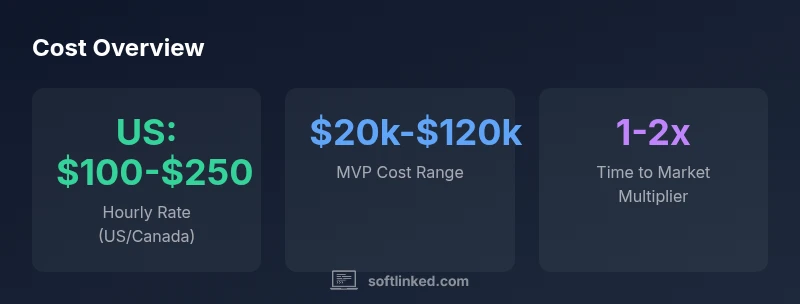
| Hourly rate (US/Canada) | $100-$250 per hour | Reflects demand and specialization |
| APAC regional rates | $20-$60 per hour | Lower baselines with regional variance |
| MVP project cost | $20,000-$120,000 | Scope and tech stack drive variance |
| Large enterprise project | $1,000,000+ | Complex integrations and compliance |
Your Questions Answered
What factors most influence software development cost?
Key drivers include project scope, required features, tech stack, team composition, location, and delivery schedule. Complexity often drives cost more than individual line items.
The main cost drivers are scope, tech choices, team, and location.
How can I estimate costs for a new software project?
Start with a clear requirements baseline, break down tasks, estimate hours per role, and apply regional rates. Use bottom-up estimation and scenario planning.
Break down the work, estimate by role, then apply rates.
Are offshore or nearshore teams cheaper?
Often cheaper hourly rates, but total cost can rise if coordination overhead and time zones cause delays. Consider total cost of ownership and communication overhead.
Offshore may be cheaper per hour, but you must account for coordination costs.
What is the difference between time-and-materials and fixed-price contracts?
Time-and-materials ties cost to actual effort and is flexible; fixed-price commits to a lump sum with defined scope, but can be risky if scope changes.
T&M is flexible; fixed-price locks scope and cost.
How accurate are early-stage cost estimates?
Early estimates are rough; accuracy improves as requirements stabilize. Build in risk buffers and revisit estimates during milestones.
Early estimates are rough; revisit as plans firm up.
What ongoing costs should I plan for after launch?
Maintenance, updates, hosting, security, and performance tuning. Allocate a dedicated budget per year and plan for feature refreshes.
Maintenance and upgrades are ongoing costs you should budget.
“Cost is a multi-variable function of scope, architecture, and execution discipline. A structured estimation process reduces surprises and aligns stakeholders.”
Top Takeaways
- Define scope early to control costs
- Choose delivery model carefully to balance risk and flexibility
- Expect regional differences in rates and total budgets
- Plan for maintenance costs from day one
- Use bottom-up estimation to improve accuracy