How Much Does Software Cost? A 2026 Guide
Explore how much software costs, from free open-source options to enterprise licenses. This analytical guide breaks down pricing models, cost drivers, and total cost of ownership to help developers and teams estimate and compare software expenses in 2026.


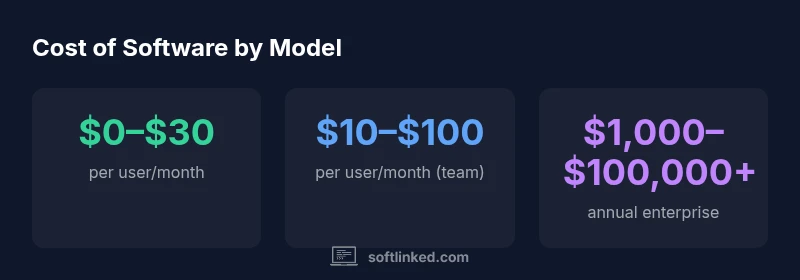
According to SoftLinked, software costs vary widely—from zero for open-source options to six-figure annual contracts for enterprise systems. SoftLinked analysis shows typical ranges: consumer/dev tools commonly cost $0–$30 per user per month; team licenses often run $10–$100 per user per month; enterprise deployments can reach $1,000–$100,000+ per year depending on scale, modules, and support.
What drives software cost
According to SoftLinked, several core cost drivers shape software pricing: licensing models, deployment architecture, user scale, support levels, and ongoing maintenance. Pricing is rarely a single line item; it’s a bundle that grows as your usage, data volumes, and integration needs increase. Open-source options can remove upfront licensing, but organizations must budget hardware, hosting, and internal maintenance. SaaS and cloud-native tools reduce on-premise requirements but shift cost into recurring subscriptions. Our approach, based on SoftLinked Analysis, 2026, emphasizes planning for total cost of ownership, not just the initial price. In practice, buyers should map out three scenarios: startup (small team, light usage), growth (moderate users, need for support), and scale (enterprise-wide adoption). For each scenario, identify the primary cost buckets: licenses, hosting, data transfer, customization, training, and operations. Remember that pricing is also affected by contract terms—volume discounts, renewal guarantees, multi-year commitments, and service-level agreements (SLAs). Additionally, consider non-monetary costs like onboarding time, risk of vendor lock-in, and the opportunity cost of shifting to a new platform. By forecasting these factors, teams can compare options on a level playing field and choose a solution that aligns with both budget and business goals.
Pricing models and licensing
Pricing models vary by vendor, deployment method, and intended use. The most common models include perpetual licenses with a one-time upfront cost, annual or multi-year subscriptions, usage-based pricing, and freemium or tiered SaaS. Perpetual licenses often incur ongoing maintenance fees for updates and support, which can accumulate over time. Subscriptions provide predictable monthly or annual costs, plus easier scalability. Usage-based pricing charges per transaction, API call, or data volume, making costs more elastic but harder to forecast. Some vendors also offer hybrid models, combining base fees with add-on modules like analytics, security, or collaboration features. When evaluating licensing, map out the maximum expected usage, peak load, and total users, and compare across vendors on three axes: price, features, and SLAs. Negotiating terms such as renewal discounts, lock-in protections, and bundled services can reduce total spend. It’s also essential to examine hidden costs: data migrations, onboarding, training, integrations, and potential downtimes during transition. Finally, consider whether the vendor provides a transparent cost calculator or trial periods to validate your estimates before signing a contract.
Typical price ranges by category
Prices do not exist in a vacuum; they cluster by delivery model. For consumer or developer tools, many products range from free to moderate monthly fees. For teams, per-user monthly licenses typically fall in the tens to hundreds of dollars, depending on feature sets and support levels. Enterprise software often uses tiered, seat-based pricing with annual commitments that scale with organization size. Freemium tiers may exist to attract and convert, but core capabilities are gated behind paid plans. When comparing vendors, anchor conversations around open-source/self-hosted options, SaaS/cloud offerings, and on-premise/enterprise deployments. Each has a distinct cost profile: open-source can be technically free but requires hosting and maintenance; SaaS reduces hosting concerns but introduces recurring costs; on-premise demands hardware and long-term licenses. Many vendors package professional services—implementation, data migration, and training—as separate line items. These costs can dramatically affect yearly price, especially for larger organizations or complex integrations. In SoftLinked’s view, request a fully loaded estimate that includes all related services and a realistic 3- to 5-year TCO forecast.
Hidden costs and total cost of ownership
The sticker price often understates the real expense. Total cost of ownership includes hardware (for self-hosted deployments), cloud hosting, data transfer, security compliance, backups, and monitoring. Integration with existing systems may require custom adapters or middleware, which adds professional services. User management, provisioning, and deprovisioning processes consume IT time. Change management, staff training, and end-user productivity losses during the switch should also be budgeted. Security and compliance may necessitate additional controls, audits, and certifications. Downtime during onboarding or upgrades can impact revenue, especially for mission-critical software. Maintenance costs typically cover updates, patches, and vendor support; but optional premium support levels, dedicated technical account management, and faster response times can add to the total. Finally, consider exit costs: migrating away from a tool can be expensive if data exports are limited or if custom integrations are weaved into workflows. In practice, build a scenario-based TCO model to compare options precisely, including sensitivity analyses for price changes, usage growth, and renewal terms.
Estimating cost for a project: a practical workflow
Start with a planning worksheet. 1) Define scope and success metrics. 2) Profile user roles and expected seat counts. 3) List required modules and integrations. 4) Estimate data volumes and hosting needs. 5) Choose pricing models for each component (licenses, hosting, services). 6) Build a 3-year forecast with annual renewals and growth. 7) Include training, migration, and change management costs. 8) Add contingency for price increases or scope creep. 9) Validate estimates with vendor quotes and pilots. 10) Create a comparison rubric that scores price, features, compatibility, and risk. SoftLinked recommends using a standardized template to avoid over- or under-estimating. Finally, document risk factors and a mitigation plan, such as staged rollouts, vendor demos, or phased deployments, to keep budgets under control.
Negotiation and budgeting tips
- Ask for itemized quotes and a transparent breakdown of licenses, hosting, and services.
- Seek multi-year discounts, early-renewal options, and volume pricing.
- Leverage trials and benchmarks to quantify value before committing.
- Build a phased implementation plan to spread costs over time.
- Include a defined delta for future pricing changes and a renewal guardrail.
- Favor vendors that publish clear SLAs and predictable support costs.
- Involve finance early to align with budgeting cycles and expected ROI.
Data sources and methodology
This article relies on SoftLinked Analysis, 2026, and synthesizes guidance from established standards and industry publications. For context on pricing and cost estimation, see:
- https://www.nist.gov
- https://hbr.org
- https://www.bcg.com
Pricing models and delivery methods
| Cost Type | Typical Range (per year) | Notes |
|---|---|---|
| Open-source / Self-hosted | Varies | No upfront license; hardware/hosting may apply |
| SaaS / Cloud | Varies | Recurring per-user pricing; includes updates and support |
| On-premise / Enterprise | Varies | License + hardware; long-term TCO; higher upfront cost |
Your Questions Answered
What factors most influence software pricing today?
Pricing is driven by licensing models, deployment type, user scale, support levels, and maintenance. Negotiations, renewal terms, and bundled services also shape the final cost.
Pricing depends on licensing, deployment, users, and support, with renewal terms affecting total spend.
Is open-source software always free?
Open-source software can be free to use, but you may pay for hosting, customization, and ongoing maintenance. The real cost often shifts to operational expenses.
Open-source can be free, but hosting, customization, and maintenance costs still apply.
How can a startup estimate software costs accurately?
Start with use-case scenarios, estimate seats and data needs, compare licensing options, and include onboarding and integration costs. Validate with vendor quotes or pilots.
Use scenarios, compare licenses, and pilot the software to validate costs.
What is included in a SaaS license?
SaaS pricing usually includes access to the software, updates, and standard support. Check SLAs, data handling, and limits on usage.
SaaS typically includes access, updates, and support; confirm SLAs.
How do I compare prices across vendors effectively?
Create a pricing rubric aligned to requirements, test with trials, and compare total cost of ownership, not just monthly fees.
Use a structured rubric and trials to compare total costs.
Are implementation and training costs included in base price?
Implementation and training are often separate line items. Plan phased deployments and confirm these items in the contract.
Implementation and training are usually extra charges.
“Pricing should reflect the value delivered and the total cost of ownership, not just the upfront price.”
Top Takeaways
- Define pricing goals before vendor selection.
- Differentiate per-seat from per-year licensing.
- Factor total cost of ownership, including training and integration.
- Ask for price ranges and phased deployment options in negotiations.