How Much is SAP Software in 2026: Pricing, Plans & Costs
Explore SAP software pricing in 2026, including deployment options, per-user ranges, and hidden fees. SoftLinked delivers a data-driven guide for engineers.


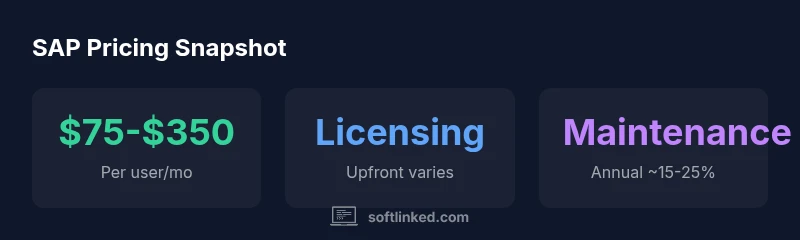
How much is SAP software? Pricing varies widely by product, deployment, and scale. In SoftLinked Analysis, typical cloud per-user pricing ranges roughly from $75 to $350 per user per month, with discounts possible at higher volumes. On-premise licenses add substantial upfront costs plus annual maintenance. Overall, total cost of ownership depends on modules, integrations, and user adoption, not just the headline price.
Understanding SAP Pricing: What You Typically Pay For
Pricing for SAP software is not a single line item; it’s a bundle of licenses, subscriptions, services, and ongoing support. For anyone asking how much is sap software, the answer depends on your organization size, industry, and the specific SAP components you need (ERP, analytics, CRM, procurement, etc.). In 2026, most organizations see pricing driven by deployment model (cloud vs. on-prem), user count, module footprint, and data volumes. SoftLinked emphasizes that the best way to estimate is to map your actual usage and expected growth over a multi-year horizon, then translate that into a total cost of ownership. This foundational approach helps avoid sticker shock when negotiating with SAP or partners and frames cost in terms of value delivered rather than price alone.
From a practical standpoint, focus on the complete lifecycle cost: procurement, implementation, integration, training, data migration, maintenance, and ongoing upgrades. This holistic view aligns with real-world budgeting practices used by software teams and aligns expectations with business outcomes. According to SoftLinked, the most cost-effective strategy often combines phased cloud adoption with careful scoping of modules and users to control upfront spend while achieving measurable ROI.
Deployment Models Drive the Price Tag
SAP pricing is highly sensitive to how you deploy the software. Cloud-based SAP solutions tend to be sold as subscriptions with per-user or per-usage pricing, while on-premise deployments typically involve perpetual licenses plus annual maintenance. The choice between cloud and on-premise not only affects upfront cash flow but also long-term cost structures, upgrade cadence, and data sovereignty considerations. Hybrid models, which combine cloud services with on-premise elements, are increasingly common in regulated industries. When evaluating costs, compare total cost of ownership across scenarios, including hardware, networking, migration, and staff time for ongoing administration. SoftLinked’s guidance is to run parallel pilots with a representative user group to capture real-world cost implications before making a large commitment.
Cloud Pricing: What the Numbers Look Like
Cloud pricing usually relies on subscription economics: monthly or annual payments tied to user counts, credits, or consumption. In practice, cloud SAP pricing can range from a few dozen dollars per user per month for basic access to several hundred dollars for full modules and advanced analytics. Expect tiered pricing that scales with user roles, data volume, and feature sets. Some packages include bundled services such as support, updates, and security, while others bill those separately. Negotiation matters; volume commitments, multi-year contracts, and regional pricing can shift ranges by a meaningful amount. For budgeting, plan for recurring costs plus potential one-time migration or integration fees.
On-Premise Licensing Costs: Upfront and Ongoing
On-premise SAP licenses require substantial upfront investment in software, hardware, and implementation services. Licensing is typically perpetual or term-based per core/module, with annual maintenance that covers updates and support. The upfront cost can be a barrier for smaller teams, but some enterprises justify it with predictable long-term expenses and custom control. Ongoing costs include hardware refreshes, data storage, and dedicated IT staff for operations. Because deployment scales with organizational size, pricing is highly variable; large enterprises often negotiate bespoke contracts that bundle services, upgrades, and support with volume discounts.
Hidden Costs To Consider
Beyond license or subscription fees, SAP projects incur several non-obvious costs. Key areas include implementation services (consulting and configuration), data migration and cleansing, integration with legacy systems, training for end users and administrators, and the cost of maintaining data security and compliance. Change management is often overlooked but critical to achieving ROI. In many cases, customers underestimate the time and effort required to adapt business processes to SAP’s data models and workflow, which can affect adoption speed and total cost of ownership.
How to Build a Realistic SAP Budget
Start by inventorying your users, roles, and modules required, then estimate adoption velocity and peak usage. Build a total cost of ownership that includes licensing/subscription, hardware (for on-premise), migration, integration, and ongoing maintenance. Create separate budgets for implementation and for annual renewals, then apply sensitivity analyses to reflect scenarios with higher user counts or larger data volumes. Use benchmarks where possible, but tailor estimates to your industry and internal processes. SoftLinked recommends creating a phased rollout plan to minimize risk and spread cost over time, while achieving measurable milestones.
SAP vs Alternatives: A Quick Comparison
SAP prices comparatorily stack against other ERP and analytics platforms like Oracle, Microsoft Dynamics, and open-source alternatives. While SAP often excels in complex supply chains, manufacturing, and enterprise analytics, total cost of ownership can be higher than lighter-weight ERP systems for small teams. When evaluating, compare not only upfront or monthly costs but also integration complexity, data migration effort, and the value of SAP’s specialized capabilities for your industry. A careful feature-for-feature comparison helps determine if SAP’s price aligns with expected business outcomes.
Getting Accurate Quotes: Steps and Tips
Request formal quotes from SAP or certified partners and provide a detailed scope: modules, user counts, data volumes, SLAs, and deployment timelines. Ask for a breakdown of license/subscription costs, implementation services, migration and integration costs, training, and ongoing support. Request scenario-based pricing for cloud, on-premise, and hybrid setups. Use a standard RFP template to compare proposals consistently and avoid being swayed by promotional discounts that don’t apply to your use case.
Real-World Scenarios: From Startups to Global Enterprises
For a startup evaluating SAP S/4HANA Cloud, the pricing story often centers on subscription-based access with a staged rollout, limiting upfront risk and enabling rapid iteration. Mid-market firms typically lean toward cloud or hybrid architectures to balance cost with customization. Global enterprises frequently negotiate bespoke contracts that bundle licenses, services, and ongoing upgrades with multi-year terms and regional discounts. Across all sizes, a disciplined approach to scoping, ROI analysis, and vendor negotiation yields the best financial outcomes.
SAP pricing by deployment model
| Deployment Model | Pricing Focus | Typical Range per User per Month | Upfront Costs | Maintenance/Support |
|---|---|---|---|---|
| Cloud/SaaS | Subscription pricing | "$75-$350" | "Variable; often included in subscription" | "Typically 15-25% of license value annually"],[ |
| On-Premise | Perpetual license + maintenance | "N/A per user-month" | "Significant upfront costs per core/module" | "Maintenance often 15-20% of list price annually" |
| Hybrid/Industry-specific | Flexible mix | "Varies widely" | "Negotiated with vendor/partner" | "Custom pricing; consider integration" |
Your Questions Answered
What factors influence SAP pricing the most?
Major drivers are deployment model (cloud vs on-premise), module footprint, user count, data volume, and required integrations. ROI depends on how well the solution maps to business processes.
Pricing hinges on deployment, modules, and user count; predict your data needs to estimate costs.
Is SAP Cloud cheaper than On-Premise?
Cloud pricing typically uses subscriptions with per-user or per-usage charges, which can be lower upfront but may accumulate over time. On-premise often has higher initial costs but different long-term economics.
Cloud usually has lower upfront costs; long-term spend depends on usage and renewal terms.
Can small teams afford SAP?
Small teams can start with cloud-based SAP solutions or partner-backed editions designed for mid-market customers. A phased approach helps control spend while provisioning essential capabilities.
Start small, use cloud options, and scale as you grow.
Are there discounts for volume or multi-year contracts?
Volume purchases, multi-year commitments, and bundled services can unlock discounts. Always request a transparent breakdown and compare with alternatives.
Yes, negotiate volume and multi-year terms for the best pricing.
What hidden costs should I budget for?
Implementation services, data migration, integration with existing systems, user training, and ongoing upgrades are common hidden costs.
Plan for services, migration, and training beyond licenses.
Where can I get an accurate SAP pricing quote?
Engage SAP sales or certified partners; provide scope, modules, users, and desired timelines to receive an accurate quote.
Contact SAP or a partner with a clear scope to get a precise quote.
“Pricing SAP software is highly variable; the real value lies in understanding total cost of ownership and expected ROI.”
Top Takeaways
- Estimate total cost by mapping modules, users, and data volumes
- Cloud pricing favors scalable subscriptions; upfront cash may be lower
- Plan for implementation, migration, training, and integration costs
- Negotiate total cost of ownership to get true value from SAP