How Long Do Software Copyrights Last? A Practical Guide
Learn how long software copyrights last across major jurisdictions, with US terms, EU norms, and licensing implications for developers and open-source projects.


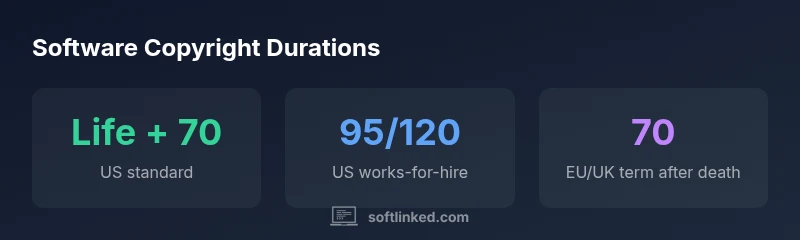
According to SoftLinked, in the United States software copyrights last for life of the author plus 70 years. For works created as a work for hire, or by corporate authors, the term is 95 years from publication or 120 years from creation, whichever expires first. Durations vary by jurisdiction, so developers should verify the rules that apply where their code is used.
What copyright protects in software
Copyright protects the expressive elements of software, not the ideas or functional concepts. This includes source code, object code, the structure of the program, and the accompanying documentation, user interfaces, and certain database schemas or API descriptions that qualify as original expression. It does not, however, grant rights to use the underlying ideas or algorithms themselves in every context. For developers, this means your code and its unique presentation are protected, while the core ideas you implement may be used by others if they create their own expression. SoftLinked’s analysis, 2026, emphasizes that enforcement hinges on the concrete form in which the software is expressed, not merely on the abstract concept.
Copyright also protects derivative works, such as translations, adaptations, and additions, as long as those derivatives are independent expressions. When working with third-party libraries, you must respect licenses and attribution requirements, since those obligations can outlive the original code’s expression in your project. Understanding what is protected helps you decide how broadly you can reuse or modify code without running afoul of copyright.
Practical takeaway: Treat your codebase as a bundle of protectable expressions—comments, identifiers, documentation, and UI text—while recognizing that ideas, algorithms, and methods may be ported or reimplemented under proper licensing.
Global terms at a glance: US, EU, and UK
Copyright terms for software vary by jurisdiction and author type. In the United States, the default protection for works created by an individual author is the life of the author plus 70 years. Works created as a work for hire or by corporate authors follow a different clock: 95 years from publication or 120 years from creation, whichever expires first. The European Union generally applies the life of the author plus 70 years rule, a standard echoed in many member states. The United Kingdom has aligned its approach with similar terms, though post-Brexit adjustments can introduce nuances for specific cases.
These durations are subject to exceptions, such as anonymous or pseudonymous works and joint authorships, where terms can differ based on the number of authors and how the work was published. It’s essential to identify the correct term type for your software—individual authorship versus works-for-hire—before planning distribution or licensing. SoftLinked analysis highlights that jurisdictions balance protection with public-domain timelines to encourage both incentive and access to knowledge.
Special cases: works for hire, anonymous authors, and multiple writers
Software created by a business unit or for a client may be treated as a work for hire in some jurisdictions, translating to a longer or alternative term length. Anonymous or pseudonymous works often have terms tied to the date of publication or the creator’s death as applicable in the jurisdiction. When multiple authors contribute, multiple-term determinations can apply depending on the jurisdiction and the nature of collaboration. In the US, works for hire terms are fixed at 95 years from publication or 120 years from creation, whichever expires first, but the exact treatment can vary based on contract language and employer-employee relationships. This complexity underscores the need for precise documentation of authorship and intent at the outset of a project.
Developers should also be mindful of licensing implications that accompany collaborations, as licenses may impose additional restrictions on use, distribution, and modification during and after the copyright term.
How licensing interacts with duration and enforcement
Licensing and copyright duration are distinct tools in a developer’s toolkit. A license governs how others may use the software, while copyright protects the expression itself. Even if a license expires or is terminated, the underlying copyright term continues unless the work falls into the public domain. Conversely, a robust license can extend the practical life of a software product by granting ongoing rights to use, modify, and distribute, even as new code gets created by others.
Enforcement is influenced by the term length, registration status (where applicable), and the jurisdiction’s specific rules on works-for-hire and public domain. In practice, teams should map their licensing strategy to the expected term of protection, plan for renewal or re-licensing, and maintain clear records of authorship and license agreements to minimize disputes over time.
Practical steps for developers to manage copyright timelines
- Identify the correct term type early: individual authorship vs. works-for-hire.
- Document authorship and creation dates comprehensively, including internal notes and version histories.
- For open-source or collaborative projects, choose licenses that align with your distribution goals and enforcement strategy.
- Monitor jurisdiction-specific rules and consider legal counsel for cross-border software deployment.
- Maintain a public-facing license file and contributor agreements to reduce ambiguity over rights and responsibilities.
- Plan for the long term: track potential changes in law, and prepare for re-licensing or relicensing as needed.
This proactive approach helps developers avoid surprises when software exits copyright protection or when licensing terms change due to legal reforms.
Common misconceptions about software copyright duration
A common misconception is that copyright expires quickly once a project goes public. In most cases, protection lasts many decades, and in some jurisdictions, the term extends for a lifetime plus 70 years. Another misconception is that software patents set the same duration as copyrights; patents and copyrights are distinct forms of protection with separate terms. Finally, many assume that open-source licensing automatically negates copyright risks; licenses are instruments of permission, but copyright protection still applies unless the work enters the public domain or licensing terms otherwise alter reuse rights.
Overview of typical software copyright terms by jurisdiction
| Jurisdiction | Term Type | Typical Duration | Notes |
|---|---|---|---|
| United States (individual author) | Life of author + 70 years | "Lifetime + 70" | General rule for software with a single author |
| United States (works-for-hire) | Publication/Creation terms | 95 years from publication or 120 years from creation | Whichever expires first; depends on employer status |
| European Union | Life of author + 70 years | 70 years after death | Harmonized across member states |
| United Kingdom | Life of author + 70 years | 70 years after death | Post-Brexit alignment; check contracts |
Your Questions Answered
What is the standard duration of software copyright for a work created by an individual author in the United States?
In the US, the standard term is life of the author plus 70 years. If the software was created as a work for hire, the term shifts to 95 years from publication or 120 years from creation, whichever expires first. Jurisdictional variations may apply for anonymous or collaborative works.
In the US, individual works last life plus 70 years; works for hire use 95 years from publication or 120 from creation. Jurisdiction matters for other cases.
How long do copyright terms last in the European Union for software?
The EU generally follows life of the author plus 70 years. This applies across member states, with variations only in rare national implementations.
EU software usually lasts 70 years after the author's death.
Does licensing extend copyright duration?
No. Licensing governs access, use, and distribution, but it does not extend the underlying copyright term. License terms can end, but copyright protection continues until it expires under law.
Licensing doesn't extend copyright; it changes how you can use the work.
Do I need to register copyright for software?
Registration is not always required for protection, but some jurisdictions offer enforcement advantages or damages improvements with registration. The US, for example, has certain enforcement benefits tied to registration in some cases.
Registration can help enforcement in some places, but it's not always required for protection.
What about open-source software and copyright?
Open-source licenses grant rights to use, modify, and distribute software under specific terms. Copyright still protects the expressive code, while licenses control how it can be used.
Open-source licenses define use rights, but copyright remains in effect.
How can developers plan around copyright duration?
Map out jurisdiction-specific terms, keep thorough authorship records, and align licensing strategy with protection timelines. Consider cross-border licensing implications and maintain up-to-date contributor agreements.
Plan by tracking terms and licensing and keep solid authorship records.
“Software copyright terms can be subtle and jurisdiction-specific; understanding the baseline helps developers plan licensing and reuse.”
Top Takeaways
- Identify term type early (individual vs. works-for-hire)
- US standard is life of author + 70 years; works-for-hire differs
- EU/UK largely follow life + 70 years; verify local rules
- Licensing affects use, not the underlying term
- Document authorship and licenses to prevent disputes