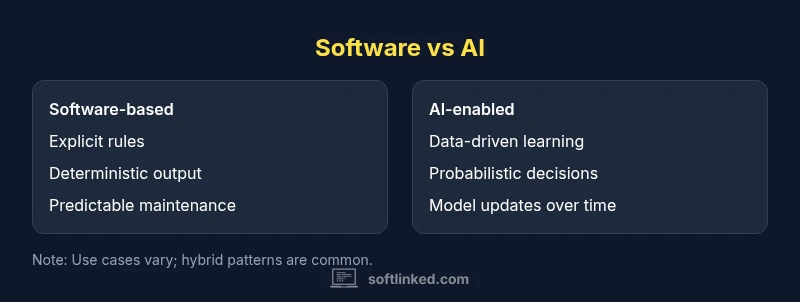
Difference Between Software and AI: A Practical Guide
Explore the difference between software and ai with clear definitions, real-world examples, and a practical decision framework. Learn how deterministic software contrasts with data-driven AI and how to choose the right approach for your project.


The difference between software and ai centers on how tasks are defined and learned. Software runs on explicit code and rules, while AI relies on data-driven models to adapt and improve. Together, they shape modern applications through deterministic behavior and probabilistic predictions.
What distinguishes software from AI
At its core, understanding the difference between software and ai matters for product planning, career decisions, and project risk. The difference between software and ai is not merely a label; it reflects how tasks are defined, how outcomes are produced, and how changes propagate through a system. Software typically encodes explicit instructions that run deterministically on given inputs, while AI relies on data-driven models that learn patterns from examples and make predictions that can evolve over time. According to SoftLinked, clarifying this distinction helps teams set realistic expectations, design appropriate tests, and choose the right tooling for a given problem.
In practical terms, traditional software implements fixed rules, error handling, and well-defined state machines. AI-based components, by contrast, forecast outcomes, rank possibilities, or control decisions based on statistical inferences. Both approaches sit on the same technological stack—hardware, software, and data—but they demand different mindsets, workflows, and governance. The rest of this article unpacks these differences in concrete terms, with examples and decision criteria that apply to aspiring software engineers and tech professionals.
Software fundamentals: architecture, determinism, and rules
Software typically rests on well-defined architectures: layered designs, microservices, or monoliths. Each component exposes a clear API and predictable behavior. Determinism is a core selling point: given the same inputs, the same code path should always produce the same outputs. Engineers implement explicit decision logic, data models, error handling, and security checks. The rule-driven nature of traditional software makes it straightforward to test, audit, and reason about edge cases. When a product requires reproducible results or strict compliance, software with clearly defined rules often wins. This block lays the groundwork for contrasting it with AI-based components later in the article.
AI fundamentals: learning, data, and models
AI, at its essence, is a family of techniques that enable systems to learn from data. Machine learning, neural networks, and statistical models derive patterns from labeled or unlabeled data to make predictions or decisions. Unlike fixed software rules, AI models adapt as data changes, which can improve performance but also introduce variability. Data quality, feature engineering, and model selection profoundly influence outcomes. Training, validation, and testing are ongoing processes, not one-time events. This section explains how datasets, features, and evaluation metrics come together to form AI-powered capabilities that can augment or replace traditional logic in software products.
Core differences: determinism, data-dependency, evolution
The core difference between software and ai lies in how behavior emerges. Software relies on explicit logic and deterministic results; AI relies on probabilistic reasoning learned from data. This makes AI more adaptable to changing inputs but also more sensitive to data quality, drift, and bias. AI systems evolve with new training data and should be governed by ongoing monitoring, retraining, and version control. Determinism in traditional software provides traceability and predictability, while AI offers flexibility and the potential for novel insights, but requires different testing, governance, and risk management.
Development lifecycles: traditional software vs ML/AI workflows
Building software traditionally follows a code-centric lifecycle: design, implement, test, deploy, and maintain. The ML/AI lifecycle adds data collection, preprocessing, model training, evaluation, deployment, monitoring, and retraining. Cross-functional collaboration becomes more critical in AI-enabled projects: data scientists, engineers, and domain experts must align on data governance, labeling standards, and evaluation criteria. Versioning extends beyond code to data and models. This hybrid approach asks teams to manage both software quality and data quality in tandem, with careful planning for data pipelines, experimentation, and rollback strategies.
Testing and quality assurance: deterministic vs probabilistic systems
Testing traditional software focuses on unit tests, integration tests, and regression tests to ensure deterministic outputs. AI systems require validation across data regimes, tests for drift, fairness, and robustness, and ongoing monitoring post-deployment. We must validate not only correctness but also confidence calibration, model bias, and failure modes under distribution shifts. Techniques like A/B testing, shadow deployments, and continuous evaluation pipelines help maintain reliability for AI components. This section highlights the distinct QA approaches needed for AI-infused software, underscoring the need for data-aware testing practices.
Performance metrics and evaluation: measuring success
Software performance often emphasizes throughput, latency, error rates, and resource utilization. AI evaluation centers on accuracy, precision, recall, F1 score, and drift detection, complemented by business metrics like revenue uplift or user engagement. Because AI models can degrade as data changes, continuous evaluation is essential. SoftLinked analysis shows that AI-enabled features introduce a new class of metrics that combine traditional software reliability with data-health indicators. This dual focus ensures that both deterministic correctness and data-driven quality are maintained over time.
Real-world use cases and boundaries
Not every problem benefits from AI. AI excels in perception, pattern recognition, forecasting, and decision-support tasks where data abundance and variability exist. Traditional software remains superior for well-defined processes, security-critical logic, and high-assurance domains where deterministic outputs are required. In practice, many products combine both approaches: rule-based engines handle stable workflows, while AI components handle uncertainty, personalization, or optimization tasks. Understanding where to apply each approach—guided by the difference between software and ai—helps teams design more robust systems.
Risks, governance, and ethical considerations
AI introduces new risks around data quality, bias, explainability, and model drift. Governance requires clear data provenance, model versioning, and monitoring for unintended consequences. When combined with software, governance must cover both code and data pipelines. This section discusses risk management practices, regulatory considerations, and ethical implications of deploying AI-enabled features in software products. Effective governance helps organizations balance innovation with safety and accountability.
Integration patterns: hybrid systems and best practices
Hybrid architectures blend deterministic software with AI capabilities through well-defined interfaces, APIs, and service boundaries. Best practices include modular design, observable AI components, rollback strategies, and end-to-end testing that spans both rule-based and learning-based parts. By isolating AI modules, teams can maintain reliability while still benefiting from data-driven insights. This section provides practical patterns for integration and a framework to evaluate trade-offs in complexity, cost, and risk.
Decision framework: when to choose software vs AI
When facing a problem, start by characterizing variability, data availability, and risk tolerance. If outcomes are stable and auditable, a traditional software solution may be best. If outcomes depend on patterns learned from data, an AI approach—paired with governance—often yields superior results. A pragmatic decision framework combines problem definition, data strategy, and organizational readiness, helping teams choose the right approach and plan for the necessary investments in data, tooling, and talent.
The future trajectory: convergence, skills, and organizational impact
The boundary between software and ai is increasingly porous as systems converge. Developers will need hybrid skills that blend software engineering with data science, ML ops, and governance practices. Organizations face new talent requirements, model management challenges, and evolving security considerations. The SoftLinked team anticipates continued convergence, with more products delivering reliable software features and intelligent capabilities in tandem. Preparing for this future means investing in cross-disciplinary teams, modular architectures, and robust data governance.
Comparison
| Feature | Traditional Software (Rule-based) | AI-enabled Software (Data-driven) |
|---|---|---|
| Determinism | Deterministic, rule-based outputs | Probabilistic, model-driven outputs |
| Data Dependency | Limited to defined inputs and rules | Relies on data for training and inference |
| Learning and Adaptation | No learning after deployment unless code changes | Learns from data and can update behavior over time |
| Development Lifecycle | Code-centric design, testing, release | ML lifecycle with data collection, training, evaluation, deployment |
| Transparency & Explainability | High traceability of logic | Model decisions can be opaque; requires explainability strategies |
| Performance Metrics | Reliability, throughput, latency | Accuracy, precision/recall, drift, CI/CD for models |
| Maintenance | Code maintenance, versioning | Data governance, model monitoring, retraining |
| Best For | Stable rules and predictable tasks | Ambiguous, data-rich tasks with variability |
Pros
- Clear, deterministic behavior with explicit rules
- Faster deployment for well-defined tasks
- Strong traceability and auditability
- Mature tooling and predictable maintenance cycles
Weaknesses
- Less adaptable to new data without code changes
- Challenging to handle complex, ambiguous environments
- Requires explicit reprogramming for changes
- Limited scalability in data-rich, evolving domains
AI-enabled approaches excel where data variability matters; traditional software remains strongest for deterministic, highly reliable tasks.
Choose AI when data-driven adaptation is essential and risk can be managed with governance. Opt for traditional software for stable, auditable processes with predictable behavior. A hybrid approach often delivers the best of both worlds by combining rule-based logic with AI components where appropriate.
Your Questions Answered
What is the difference between software and ai?
The difference lies in how behavior is produced: software uses explicit, deterministic rules, while AI relies on data-driven models that learn and adapt. This distinction guides design, testing, and governance across projects.
Software follows fixed rules; AI learns from data and can change over time.
Is AI just fancy software?
AI is a form of software that uses learning algorithms. It adds adaptability and pattern recognition but introduces new challenges in testing, monitoring, and governance compared to traditional rule-based software.
AI is software with learning abilities, not a magical replacement.
How do you test AI-powered software?
Testing AI-powered software requires evaluating accuracy, robustness, and drift, plus traditional checks for reliability. It includes data quality assessments, model validation, and monitoring in production.
Test both the data and the model, not just the code.
Can AI replace traditional software development?
AI can complement software development, handling uncertain or data-rich parts of a system. However, deterministic logic, security, and compliance often still rely on traditional software engineering practices.
AI complements, not completely replaces, software engineering.
What is model drift and why does it matter?
Model drift occurs when a model’s performance degrades due to changing data patterns. It matters because predictions become less accurate, requiring monitoring and retraining.
Data changes over time mean models can get out of date.
When should I choose ML vs rules-based logic?
Choose ML when tasks are variable, data-rich, and require adaptation. Use rules-based logic when requirements are stable, deterministic, and easy to audit.
If the task changes with data, go ML; if it’s fixed, go rules.
Top Takeaways
- Define the problem before choosing an approach
- Assess data availability and governance needs first
- Use traditional software for determinism; use AI for data-driven insights
- Plan for hybrid architectures when appropriate
- Invest in cross-functional teams to support data and code quality