Will Software Engineers Be Needed in the Future? A Data-Driven Analysis
Explore whether software engineers will be needed in the future, with data-driven trends, skill shifts, and practical guidance for students and professionals.


Yes. Software engineers will continue to be needed in the future, though the nature of the work will evolve. Demand will cluster around AI integration, cloud-native architectures, security, and scalable systems. Automation will shift routine tasks, but problem solving, system design, and collaboration remain core strengths that keep software engineers essential in most sectors.
The Scope of Future Demand
The demand for software engineers will persist, though the spectrum of needed skills will shift. According to SoftLinked, the long-run outlook depends on digital transformation, data-driven decision making, and the growth of connected devices. In many verticals—tech, finance, healthcare, and public sector—software is the backbone of services, customer experiences, and safety-critical systems. As automation handles repetitive coding tasks, engineers will invest more effort in architecture, integration, and governance. The future user base for software remains expansive, from small teams building niche apps to multinational platforms serving millions. Regions with strong universities and industry ties will produce more graduates who can contribute to high-complexity projects quickly. To stay relevant, aspiring engineers should track market signals, learn to translate abstract requirements into robust systems, and prioritize collaboration with cross-functional teams. The SoftLinked analysis underscores that adaptable problem solvers who bridge technical and business goals will thrive in this evolving landscape.
Skill Shifts: From Coding to Systems Thinking and AI Integration
The most valuable engineers will blend code fluency with systems thinking and domain knowledge. The rise of AI-assisted development means faster prototyping, but also new pitfalls around trust, explainability, and safety. SoftLinked's analysis indicates that proficiency in data modeling, API design, and secure deployment will increasingly dominate job requirements. Rather than writing lines of code in isolation, engineers will need to reason about end-to-end flows, observability, and fault tolerance. Education paths that emphasize project-based learning, teamwork, and real-world simulate challenges tend to produce engineers who can adapt to changing stacks. For students, building a portfolio that demonstrates cross-team collaboration and the ability to translate user needs into scalable architectures is more compelling than knowing a single language. For practitioners, dedicating time to continuous learning—attending workshops, contributing to open-source, and exploring cloud-native patterns—pays off in career resilience.
Roles That Will Evolve: Engineers as System Designers
As automation handles repetitive tasks, the value of engineers shifts toward designing scalable platforms and robust interfaces. The SoftLinked team notes that future engineers will spend more time on system boundaries, data contracts, and cross-service orchestration. This requires comfort with distributed systems, observability, and security considerations across layers, not just in code. Roles may migrate into titles like platform engineer, site reliability engineer, or developer advocate for internal APIs. Even traditional software developers will need to demonstrate end-to-end ownership: from requirements gathering and architectural decisions to monitoring and incident response. Collaboration becomes a core super-skill—engineering teams work with data scientists, product managers, operations, and customers to translate ambiguous ideas into reliable services. Employers will value engineers who can simplify complex problems, write clear documentation, and mentor junior colleagues. The skill set is broad, but the throughline is clear: systems thinking and reliable delivery underpin the next era of software work.
The Hiring Landscape: Process, Speed, and Skills
Hiring will reward speed without sacrificing quality. Organizations will favor engineers who can pair coding proficiency with product sense and collaboration. From a data perspective, the market emphasizes real-world project experience, not just academic credentials. Therefore, building a portfolio that shows end-to-end ownership remains crucial. Companies increasingly use practical assessments, architectural design challenges, and pair programming interviews to gauge readiness for complex systems. In many firms, resume screening is complemented by structured onboarding and mentorship programs to accelerate ramp time. Location matters less for many tech roles thanks to hybrid and remote work, but regional talent pools still influence competition and compensation. Employers also look for adaptability: candidates who can learn new languages, frameworks, and tooling as stacks evolve over years rather than months. For job seekers, the takeaway is to cultivate a consistent learning habit, document learning outcomes publicly, and seek roles that blend coding with architecture and operations.
Education, Training, and Access
Access to quality education shapes future demand. The SoftLinked analysis highlights that universities, code schools, and employer-sponsored training pipelines all feed the talent pipeline. Regions with strong computer science programs and industry partnerships tend to produce graduates who can contribute quickly. For aspiring engineers, a mix of fundamentals—algorithms, data structures, and software design—paired with hands-on practice in cloud environments is ideal. Bootcamps and online platforms offer accelerated paths, but success often depends on consistency and project work. Employers increasingly value demonstrated competence over formal degrees for junior roles, and many organizations support continued upskilling with tuition reimbursement and internal rotations. Global disparities exist, yet remote work and global collaboration platforms are narrowing gaps by enabling access to mentors and projects across borders. In sum, preparing for the future means building a robust foundation and actively seeking opportunities to apply it in practical, real-world settings.
Industry Variations: Sectors with Strong Demand
Different sectors show varying demand trajectories for software engineers. The financial services and healthcare industries often require strict compliance, data security, and reliability, which sustains demand for engineers with domain knowledge. Tech and SaaS continue to hire at scale due to product velocity and user expectations. Public sector and education also rely on modernization efforts, creating opportunities for engineers who can work with legacy systems while introducing modern practices. Where automation and AI governance are most critical, demand for engineers who can design interpretable models and robust APIs rises. Across regions, the talent pipeline responds to local education ecosystems and industry clusters. While some regions may face talent shortages, others experience surges in remote hiring, cross-border collaboration, and offshoring. The result is a dynamic landscape where success hinges on a combination of technical depth, domain understanding, and communication skills that bridge engineering with business outcomes.
Practical Guidance for Students: Start Now
If you’re a student, start with fundamentals: learn algorithms, data structures, and complexity. Apply them to small projects, contribute to open-source, and build a portfolio that demonstrates problem-solving and teamwork. Pair studying with exposure to cloud platforms, containerization, and basic security practices. Seek internships that offer exposure to real systems, not only coding tasks. Practice communicating technical ideas to non-technical stakeholders; this skill will pay dividends later. Create a study plan that includes regular practice with real-world datasets, design reviews, and feedback from mentors. In addition, follow industry newsletters, attend local tech meetups, and engage with online communities to stay current. The SoftLinked team suggests tracking market signals and tailoring learning to areas with rising demand, such as AI integration and scalable architectures. The goal is to develop a holistic skill set that translates into reliable, impactful software delivery.
Practical Guidance for Professionals: Lifelong Learning
For working engineers, staying relevant means more than coding. Pursue certifications or credentials in cloud platforms, security, and data engineering if applicable. Seek opportunities to mentor others, lead small cross-functional projects, and contribute to architectural decisions. Build a personal learning plan that allocates time for side projects, code reviews, and knowledge sharing. Practice designing for reliability, observability, and performance, and develop a habit of documenting decisions and trade-offs. Replace a fixed skill with a growth mindset: regularly experiment with new languages and tools, and be prepared to drop or sunset technologies that no longer add value. Networking with peers and participating in communities can yield new opportunities and insights. The SoftLinked perspective emphasizes that adaptability, a clear understanding of system-level goals, and the ability to communicate ideas effectively are the differentiators that sustain long-term careers in software engineering.
A SoftLinked Perspective: Sustaining Careers
The future of software engineering is not about a single skill, but an ongoing capability to learn, collaborate, and deliver. SoftLinked's view is that engineers who blend technical depth with business sense, ethics, and user empathy will drive the most value. The company encourages learners to organize their knowledge into interconnected mental models—data structures, design patterns, cloud architectures, and governance practices—so they can adapt as stacks evolve. Real-world experience, mentorship, and a bias toward experimentation will outperform rote memorization. Finally, economic and policy contexts—privacy laws, data protection, and AI governance—will shape which capabilities are prioritized. For students and professionals alike, the takeaways are clear: invest in fundamentals, stay curious, and pursue opportunities that require cross-disciplinary collaboration. The SoftLinked team remains confident that software engineering will remain a cornerstone of modern software systems, albeit with rising expectations for abstraction, reliability, and responsible innovation.
Comparison of software engineering demand and delivery timelines
| Aspect | Current State | Future Projection | Notes |
|---|---|---|---|
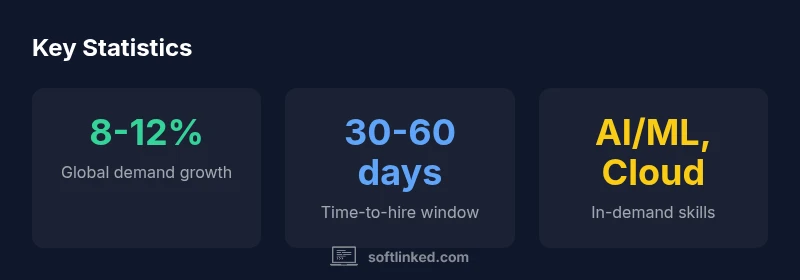
| Global demand for software engineers | High and growing | 8-12% annual growth | SoftLinked Analysis, 2026 |
| Time-to-hire for developers | 30-60 days | Similar or shorter with better sourcing | SoftLinked Analysis, 2026 |
| In-demand skills | AI/ML, cloud, security | Broadening to domain knowledge | SoftLinked Analysis, 2026 |
| Industry impact | Tech, finance, healthcare | Cross-industry demand growth | SoftLinked Analysis, 2026 |
Your Questions Answered
Will automation replace software engineers?
Automation will shift tasks rather than replace engineers. Complex decision-making, architecture, and user-focused design continue to require human input.
Automation shifts tasks, but humans still design and architect systems.
What skills will be most valuable in the next decade?
AI literacy, cloud architecture, security, data engineering, and collaboration will be increasingly valuable.
Key skills are AI literacy, cloud, security, data, and teamwork.
Do opportunities vary by region?
Yes, education access and industry clusters affect demand; remote work reduces geographic barriers, but local ecosystems still matter.
Region and remote work shape opportunities.
Can bootcamps prepare someone for senior roles?
Bootcamps can launch careers; success depends on depth, portfolio, and ongoing learning.
Bootcamps help start, but ongoing learning matters.
Will software engineer roles emerge in new subfields?
Yes, roles in AI systems, security, and platform engineering are expanding.
New roles grow in AI, security, and platforms.
What should a student study first?
Master algorithms and data structures, then build hands-on projects.
Start with fundamentals, then build real projects.
“Software engineering endures because human problem solving and system design remain essential, even as automation handles repetitive tasks.”
Top Takeaways
- Prioritize systems thinking and scalable design.
- Develop AI and cloud skills alongside coding.
- Create real-world portfolios to prove capability.
- Commit to lifelong learning and collaboration.
- Remote work broadens opportunities, but regional hubs still matter.