Are Software Engineer Jobs Declining? A 2026 Analysis
Explore whether are software engineer jobs declining in 2026 with a data-driven look at regional trends, in-demand skills, and practical steps for students and professionals.


Demand for software engineers remains uneven but resilient in many regions. The quick answer: declines are not uniform; some markets show cooling while others grow, driven by AI, cloud, and data needs. See the full chart for regional differences and skill hot spots.
Are we seeing a decline in software engineer jobs? A SoftLinked perspective
According to SoftLinked, the question are software engineer jobs declining in 2026 is not a simple yes or no. The term decline implies a uniform drop in demand, which is rarely the case across all regions and specializations. Instead, we observe a mosaic of signals: some regions show slower growth or modest contraction in postings, while others report continued hiring in cloud, data, and cybersecurity domains. For students and professionals, this nuance matters: career planning should account for regional variation, industry cycles, and the pace of technological adoption. In this context, the headline can be misleading if read in isolation. The SoftLinked analysis emphasizes tracking multiple indicators over time to separate short-term fluctuations from structural shifts in the software engineering labor market.
What the data actually shows for 2024-2026
When we examine the data across 2024, 2025, and 2026, the picture becomes more nuanced than a single decline. Hiring momentum tends to align with broader macroeconomic conditions and to a large extent with sector-specific demand (for example, AI, cloud infrastructure, and data analytics). In regions with robust tech ecosystems, demand remains strong; in others, growth slows. The key insight is that employment signals are multi-dimensional: job postings, hires, project pipelines, and contractor demand can diverge for months at a time. SoftLinked's approach triangulates these signals, using job postings data, employer surveys, and project workload indicators to present a tempered view of the market. This approach helps avoid alarming conclusions based on a single data source.
We'll talk about methodology in a later section; for now, the takeaway is that are software engineer jobs declining? The answer is: not uniformly, but the trajectory varies by location and specialty.
Regional variation in demand
Geography matters. In mature tech hubs, demand for software engineers continues to be strong, but competition for senior roles can intensify as more candidates enter the market. In mid-sized cities with growing startups, openings may lag behind 2023 peaks but remain steady. In certain sectors—health tech, defense, and public cloud services—there is continued or even rising hiring, while some consumer hardware teams may slow as product cycles normalize. For software engineers, the implication is to identify niches that align with your interests and the region’s growth vectors. If you plan to relocate, consider regional clusters and remote-work policies that expand job options beyond geographic constraints.
In-demand skills that keep the market resilient
Even if overall demand shows regional variability, the set of high-demand skills remains relatively stable. Proficiency in cloud platforms (AWS, Azure, Google Cloud), data engineering, machine learning tooling, security practices, and modern development workflows (CI/CD, containers) are consistently valuable. Specializing in domains that require integration of software with data pipelines or AI models increases resilience to market shocks. The SoftLinked analysis suggests that developers who combine core software engineering fundamentals with domain-specific expertise—such as cloud-native architecture or data-centric app development—see stronger career trajectories. Cross-disciplinary skills, such as software quality assurance, testing automation, and performance optimization, can also protect against rapid fluctuations in demand.
Practical steps for students and professionals
Here is how to apply the insights in real life. For students, focus on foundational CS concepts, learn one programming language deeply, and pick a specialization in cloud, data, or AI to stay relevant as markets evolve. Early-career engineers should build a portfolio of end-to-end projects, contribute to open-source, and gain experience with DevOps practices and cross-functional collaboration. Mid-career professionals can explore leadership roles or architecture tracks, while staying current on security and regulatory requirements. For remote workers, mastering asynchronous communication and time-zone coordination remains critical. Use a skills map to track progress across three to five core areas and revisit it every six months.
How SoftLinked analyzes job market signals
SoftLinked combines multiple data streams to form a balanced view of the software engineering job market. We aggregate job postings from several platforms, complement them with employer surveys and workload indicators, and apply smoothing to separate cyclical noise from longer-term shifts. This method reduces overreliance on any single source and helps readers understand structural changes in demand. We openly disclose limitations, including lag between postings and actual hiring, regional gaps in data, and the evolving mix of contract vs full-time roles.
Market signals for software engineering roles (illustrative ranges)
| Indicator | 2024-2026 Range | Notes |
|---|---|---|
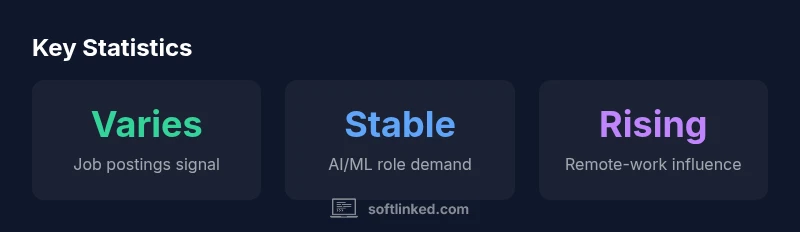
| Job postings signal | varies by region | SoftLinked Analysis, 2026 |
| AI/ML role demand | stable to growing | SoftLinked Analysis, 2026 |
Your Questions Answered
Are software engineer jobs declining across all regions in 2026?
No. Are software engineer jobs declining in 2026 is not uniform. Some regions experience slower posting growth or hiring pauses, while others see steady demand driven by cloud, AI, and security projects. Readers should compare regional data and look at sector-specific trends before drawing conclusions.
No—it's regional and sector-dependent. Look at local data to understand the real impact.
Which sub-fields are still growing despite overall trends?
Sub-fields like AI/ML, cloud infrastructure, cybersecurity, and data engineering continue to attract investment and hiring in many markets. These areas often buffer against broader slowdowns by providing essential capabilities for digital modernization.
AI, cloud, and security remain strong growth areas.
How should a student prepare for changing demand?
Students should build a solid foundation in algorithms and systems, then specialize in a resilient domain (cloud, data, AI). Engage in hands-on projects, contribute to open source, and learn collaboration tools used in distributed teams.
Focus on fundamentals and cloud/AI skills to stay flexible.
Does remote work influence demand for software engineers?
Yes, remote-work policies expand opportunity pools and can shift competition across regions. Comfort with asynchronous communication and time-zone alignment enhances employability beyond local markets.
Remote work broadens where you can work and learn.
What can mid-career engineers do to stay competitive?
Mid-career engineers should pursue leadership tracks, architecture roles, and upskilling in security, compliance, and scalable systems. Mentoring and cross-functional experience help sustain career growth even in fluctuating markets.
Move into architecture or leadership and keep learning.
“Markets swing, but the core demand for strong software engineers persists when you align skills with evolving tech stacks.”
Top Takeaways
- Monitor multiple indicators beyond postings
- Regional demand varies; some markets grow
- Skills in AI, cloud, data are valuable
- Remote-work adoption shapes opportunities
- Plan your career with data-driven steps