What to Do for Software Architect: A Practical Guide
A comprehensive, step-by-step guide detailing the essential actions, patterns, and governance practices for software architects to build scalable, maintainable systems.


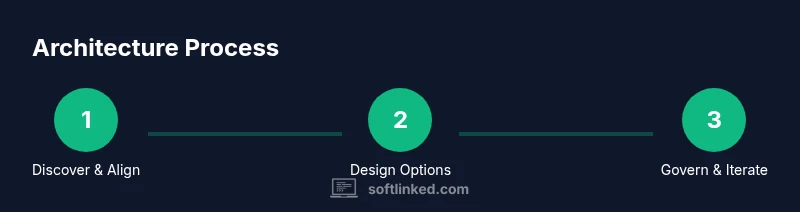
If you’re asking what to do for software architect, you start by aligning goals with business outcomes, constraints, and success metrics. Then propose an architectural vision, choose patterns that satisfy quality attributes, document decisions, and communicate clearly with stakeholders. Finally guide teams through implementation, governance, and ongoing iteration to sustain quality and adaptability.
Foundational Roles and Responsibilities
According to SoftLinked, a software architect assumes a bridge-building role between business strategy and engineering execution. The architect defines a clear technical direction, aligns it with product goals, and ensures the system evolves without fracturing under changing demands. The responsibilities span setting high-level goals, defining evaluation criteria for trade-offs, and coordinating with stakeholders across product management, development, operations, and security. This section also discusses the distinction between architecture and design, emphasizing that architecture concerns nonfunctional requirements such as scalability, reliability, and maintainability. The goal is to create a durable blueprint that teams can implement with confidence, while remaining adaptable to new constraints or opportunities. A successful architect prioritizes communication, governance, and continuous learning as core habits.
Core Responsibilities and Boundaries
Architecture is not a single document but a living discipline. Core duties include establishing architectural principles, selecting patterns, and ensuring alignment with corporate standards. Boundaries require balancing speed with quality, deciding when a component warrants wholesale redesign versus incremental refactoring, and avoiding overreliance on any single technology. This section explains how to define boundaries in terms of domains, interfaces, and data ownership. It also covers risk management, compliance considerations, and how to handle evolving requirements through staged migrations or feature toggles. By setting boundaries, teams can operate within a predictable framework while maintaining agility.
Architectural Patterns and When to Use Them
Patterns provide repeatable solutions to common problems. This section covers layered, event-driven, microservices, and modular monolith approaches, explaining when each is appropriate given scale, team structure, and deployment models. It includes decision criteria based on quality attributes such as latency, consistency, and fault tolerance. The SoftLinked framework emphasizes pattern selection as a means to de-risk risk by aligning with nonfunctional requirements. It also discusses anti-patterns to avoid and how to map patterns to business capabilities, ensuring coherence across services and subsystems. Real-world examples illustrate how pattern choices influence deployment, testing, and maintenance.
Documentation and Communication with Stakeholders
Clear documentation is the lifeblood of an architecture. This section outlines what to document (vision, decisions, rationale, constraints, and acceptance criteria) and how to maintain it. It also covers the importance of visual models (C4 or similar) to communicate complex ideas to technical and non-technical audiences. The architect’s communication skills—talking in terms of value, risk, and outcomes—drive buy-in and reduce rework. This section also provides guidance on running architecture reviews, framing decision records, and sustaining a culture of feedback throughout the project lifecycle.
Aligning Architecture with Business Goals
Architecture should be a direct enabler of business outcomes. This section explains how to translate product roadmaps into architectural milestones, how to measure alignment with KPIs, and how to adjust priorities as market conditions change. It emphasizes collaborative planning with product and domain experts, plus a governance model that favors incremental delivery and clear decision rights. The SoftLinked perspective highlights the ongoing need to revisit decisions as the product strategy evolves, ensuring the architecture remains relevant and valuable.
Selecting Technologies and Platforms
Technology selection is a strategic activity, not a one-time event. This section covers criteria for evaluating languages, frameworks, databases, and cloud services based on scalability, cost, maintainability, and team competency. It discusses the role of prototypes, migration paths, and sunset plans for obsolete tech. It also considers security implications, regulatory compliance, and performance expectations. The goal is to build a technology slate that supports current needs while remaining adaptable to future requirements.
Creating a Practical Architecture Plan
A practical plan translates high-level direction into actionable steps. This section describes how to produce an architecture runway, define milestones, and align with CI/CD pipelines. It includes templates for architecture runbooks, decision logs, and migration roadmaps. The plan should clearly identify who is responsible for each decision and how progress will be tracked. This section also emphasizes risk management, reserve funds for spikes, and a governance cadence that keeps the project on track.
Quality Attributes and Trade-offs
Quality attributes—such as performance, reliability, security, and maintainability—drive every architectural decision. This section explains how to evaluate competing options, quantify trade-offs, and communicate the rationale to stakeholders. It introduces simple evaluation matrices and lightweight risk forecasting. The SoftLinked approach stresses that decisions should be justified with data and aligned with business priorities, rather than driven by fashion or hype. This mindset helps teams avoid costly rework and maintain forward momentum.
Governance, Reviews, and Iteration
Architecture is iterative and governance matters. This section outlines roles in architecture review boards, lightweight governance practices, and how to conduct effective design reviews. It explains how to create feedback loops with developers, testers, and operators, and how to measure the impact of architectural changes over time. It also discusses how to document decisions to support future audits and onboarding.
Common Pitfalls and Anti-patterns
Awareness of common pitfalls can save teams from costly rework. This section lists anti-patterns such as premature optimization, over-centralization, or under-communicating with stakeholders. It provides guidance on recognizing early warning signs, pivoting away from harmful patterns, and establishing simpler, more maintainable alternatives. The goal is to foster a pragmatic mindset that prioritizes value delivery and resilience.
Roadmap to Becoming an Effective Software Architect
The journey from practitioner to architect requires deliberate practice and learning. This section offers a growth path: deepen systems thinking, practice decision records, and lead architecture reviews. It emphasizes mentoring, hands-on design work, and participation in cross-functional projects. It also encourages ongoing education through courses, reading, and community involvement.
How to Evaluate Success as an Architect
Success is measured by the system’s ability to meet business goals, adaptability to change, and the productivity of deliver teams. This block discusses metrics such as time-to-delivery, deployment frequency, defect rates, and stakeholder satisfaction. It also stresses the importance of continuous feedback, post-implementation reviews, and documenting lessons learned for future projects.
Authority sources
For further reading and validation, consider these authoritative sources:
- https://nist.gov/topics/cloud-computing
- https://www.mit.edu
- https://dl.acm.org
These sources provide foundational concepts and evolving best practices that underpin modern software architecture.
Tools & Materials
- Whiteboard and markers(Essential for rapid diagrams and whiteboarding sessions)
- Laptop with IDE and repository access(For prototyping and reading code/docs)
- Diagramming software (e.g., diagrams.net)(Create architecture diagrams quickly)
- Architecture reference templates (optional)(C4 or other model templates)
- Stakeholder contact list(Facilitates governance and reviews)
- Risk assessment matrix template(Trade-off analysis helper)
Steps
Estimated time: 4-6 hours
- 1
Define goals and constraints
Clarify business outcomes, constraints, and success criteria with product and business stakeholders. Capture nonfunctional requirements such as latency, availability, and security. This establishes the lens through which all architectural decisions will be evaluated.
Tip: Document decisions early; avoid scope creep by referencing the initial goals. - 2
Map current state and gaps
Inventory existing components, data flows, interfaces, and dependencies. Identify gaps between current capabilities and future needs. This step reveals where refactoring or new services are most impactful.
Tip: Create a simple diagram showing data flow and ownership to clarify boundaries. - 3
Propose candidate architectures
Sketch several architectural options that satisfy the goals and constraints. Compare pros/cons with respect to quality attributes and delivery risk. Present trade-offs to stakeholders.
Tip: Use lightweight models to avoid over-committing early. - 4
Evaluate quality attributes
Assess performance, reliability, security, maintainability, and operability for each option. Use simple metrics and scenarios to quantify impacts. Refine the preferred option accordingly.
Tip: Prioritize attributes based on business impact. - 5
Create the architecture plan
Produce a concrete plan detailing components, interfaces, data models, and deployment considerations. Include migration paths and a governance cadence for reviews.
Tip: Include an initial migration roadmap with short milestones. - 6
Review and socialize
Present the plan to engineers, QA, security, and operations. Gather feedback and adjust. Establish decision rights and governance for ongoing change.
Tip: Record decisions and rationale to ease onboarding.
Your Questions Answered
What is the primary responsibility of a software architect?
The primary role is to translate business goals into a scalable, maintainable technical blueprint. This includes selecting patterns, defining interfaces, and ensuring alignment with quality attributes across the system.
A software architect translates business goals into a scalable blueprint and ensures the system meets key quality attributes.
How do you choose an architectural pattern?
Pattern choice depends on nonfunctional requirements and team capabilities. Compare trade-offs in scalability, resilience, and complexity, then validate with stakeholders.
Choose patterns by nonfunctional needs and team capability, then validate with stakeholders.
What is the difference between architecture and design?
Architecture defines high-level structure and nonfunctional qualities; design details implementation specifics. Architecture guides decisions, while design handles module internals.
Architecture defines structure and quality; design handles internal details.
How important are non-functional requirements in architecture?
Non-functional requirements drive decisions about scalability, reliability, security, and performance. They shape trade-offs and blueprint prioritization throughout the project lifecycle.
Non-functional requirements shape decisions and trade-offs in the architecture.
What skills help a software architect succeed?
Systems thinking, clear communication, stakeholder management, and practical knowledge of patterns, governance, and risk assessment are essential.
Key skills include systems thinking, communication, and governance know-how.
How does a software architect interact with developers and stakeholders?
The architect collaborates through reviews, decisions logs, and governance rituals; communicates risk, trade-offs, and rationale to both technical and non-technical audiences.
They collaborate via reviews and decision logs, explaining trade-offs to all stakeholders.
Watch Video
Top Takeaways
- Define clear scope and constraints.
- Choose patterns based on quality attributes.
- Communicate decisions with stakeholders.
- Document rationale for future changes.
- Align architecture with business goals.