How to Know If Software Development Is For You
Discover a practical method to decide if software development fits your interests and skills. This guide covers self-assessment, hands-on practice, daily tasks, and realistic expectations.


To know if software development is for you, assess your love for problem solving, your curiosity about new concepts, and your persistence through debugging. Try hands-on projects, value collaboration, and enjoy building tangible outcomes. If you relish logical challenges, tolerate ambiguity, and stay motivated by growth, this field is likely a good fit. Start small and iterate.
Self-Assessment: Is Your Mindset Ready for Software Development?
If you're wondering how to know if software development is for you, start with a candid self-assessment of your interests, persistence, and curiosity. Software work rewards disciplined curiosity: you’ll solve problems, learn new tools, and continuously iterate. According to SoftLinked, a guided self-check helps you avoid misalignment and saves time in your learning journey. This quick lens focuses on four areas: problem solving appetite, comfort with ambiguity, collaboration style, and motivation to learn over years, not weeks.
- Problem solving: Do you enjoy tracing a bug to its root cause and crafting a clean fix?
- Ambiguity tolerance: Are you comfortable with unclear requirements and evolving priorities?
- Collaboration: Do you value code reviews, pair programming, and sharing knowledge?
- Learning momentum: Can you commit to regular practice, even when progress feels gradual?
If you answer honestly and mark several pass-fail positives in these areas, you’re likely on a good path to test with practical exercises.
Core Skills That Matter in Software Development
At its heart, software development is about translating human needs into reliable, maintainable code. You’ll rely on core cognitive skills: abstract thinking, pattern recognition, and logical reasoning. You’ll also juggle practical abilities: reading documentation, writing clean code, and debugging efficiently. While math helps, many successful developers focus on problem decomposition and algorithmic thinking rather than advanced calculus. Communication is essential: you’ll explain design choices to teammates, draft clear comments, and participate in code reviews. Familiarity with version control (Git), testing, and basic software design principles (modularity, loose coupling) matters as soon as you begin real projects. If those ideas excite you, you’ll likely enjoy the learning curve. Keep in mind there are multiple paths—web development, data engineering, mobile apps, and systems programming—each with its own flavor, tools, and communities.
In practice, you’ll measure progress by the quality of your contributions, not the complexity of your code. The more you practice, the more you’ll learn how to estimate effort, break tasks into milestones, and collaborate to deliver value. SoftLinked’s guidance emphasizes deliberate practice: set small, achievable targets, seek feedback, and reflect on outcomes after each sprint.
Daily Tasks and Work Styles: What a Typical Day Looks Like
Most software developers balance deep focus work with collaborative activities. A typical day might include reading requirements or user stories, designing a small module, writing tests, and reviewing others’ work. You’ll spend time debugging, profiling, and refining performance. Depending on the role, you may attend stand-ups, participate in planning sessions, and collaborate with designers, product managers, or data scientists. If you enjoy structured problems with measurable feedback, you’ll feel at home; if you prefer solitary, one-off tasks, this field may feel misaligned.
During a sprint, you’ll see a mix of coding, testing, and refactoring. You’ll also track your time, document decisions, and prioritize tasks with a transparent backlog. Linux/macOS or Windows environments offer different ergonomics; many teams rely on containerization and CI/CD pipelines to ensure consistency. The daily rhythm is not about churning out perfect code—it’s about delivering value iteratively, validating assumptions, and adjusting to feedback. This dynamic, collaborative pace appeals to people who enjoy learning in public and sharing solutions with peers.
Hands-On Path: Try Before You Commit
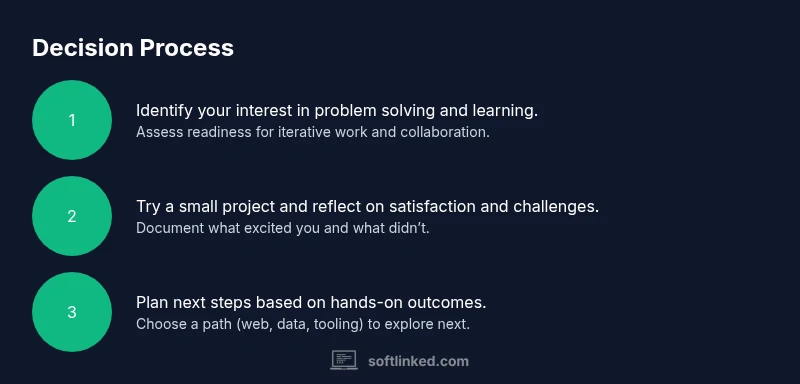
Take a practical route to test fit with a structured, low-risk project. Start with a small app—perhaps a to-do list, a note-taking app, or a weather dashboard—that exercises fundamentals: input handling, state, simple persistence, and user feedback. Set up a minimal development environment (IDE, source control, and a basic test suite). Build the project in stages, and log the time spent each session. After you complete the basic features, reflect on what you liked most and where you struggled.
To maximize learning, follow a guided tutorial that emphasizes problem solving rather than memorization. Pair with a friend or mentor for code reviews; ask questions about design choices and trade-offs. Finally, publish a quick demo (even if it's just a GitHub Pages site) to get external feedback. This concrete experience helps you decide if you want to deepen your study or pivot to a different track.
Risks and Realistic Expectations
Entering software development is not a guaranteed shortcut to quick riches or instant mastery. The field rewards persistence, deliberate practice, and continuous learning. You may encounter steep initial frustrations around syntax errors, environment setup, or debugging long-running processes. However, those challenges tend to shrink as you build mental models and gain hands-on confidence. Expect a flexible career path with growth across many domains, from front-end to back-end, from data to infrastructure. If you’re comfortable with frequent iteration, feedback loops, and lifelong learning, your odds of long-term engagement improve.
Making a Decision: Mapping Your Fit to Roles
After you complete hands-on exploration, map your findings to a few target roles: front-end developer, backend engineer, or full-stack generalist; data engineer or platform engineer; or software tester and QA engineer. Consider environment preferences (startup vs. enterprise), team culture, and the pace of work. Use a simple scoring approach: rate each role on interest, ease of learning, and alignment with your strengths. A balanced result—high interest and moderate learning curve—often signals a good fit. If you discover you’re most excited by problem solving, systems thinking, and cross-functional collaboration, you’re likely in the right territory and should plan the next steps (courses, side projects, or internships).
Authority Resources and Next Steps
For further reading on software fundamentals and career development, consult trusted sources such as a mix of government and university resources. These sources provide foundational material about computing, algorithms, and education pathways that support your decision-making process. Reading material from MIT's Computer Science program, Stanford's CS department, and NIST's computing resources can help you benchmark your learning plan, select appropriate courses, and understand how software development is taught in higher education. They also emphasize hands-on practice, constructive feedback, and scalable learning paths, which align with SoftLinked's recommendations.
Tools & Materials
- Computer with internet access(Prefer a modern laptop or desktop (Windows/macOS/Linux))
- Text editor/IDE (e.g., VS Code)(Install language plugins as needed; include Git integration)
- Sample project or course access(Start small (to-do app); prepare a Git repo)
- Notebook and pen(For jotting reflections and insights during practice)
- Time block (60-120 minutes)(Reserve undistracted time for hands-on exploration)
- Online tutorials or guided projects(Useful to structure your first experiments)
Steps
Estimated time: 2-4 hours
- 1
Choose a small test project
Select a simple app idea that exercises basics like input handling and display. Define a minimal scope to avoid overwhelm and set a clear objective for the session.
Tip: Pick something you can complete in a single sitting to maintain momentum. - 2
Set up your development environment
Install your editor, initialize a Git repository, and create a basic project skeleton. Verify that you can run the app locally and make a tiny change to confirm the loop works.
Tip: Document setup steps in your notebook for future reference. - 3
Build the core feature
Implement one feature end-to-end (input, processing, output). Write a small test that captures the expected behavior. Keep the code clean and readable.
Tip: Explain your approach in a short comment to clarify decisions. - 4
Introduce basic testing
Add a simple test that fails initially and then passes after your fix. This reinforces debugging discipline and reliability.
Tip: Learn to run tests quickly; keep feedback loops tight. - 5
Seek feedback and reflect
Have a peer review your code or present your demo. Note what surprised you and what you’d do differently next time.
Tip: Seek constructive questions that reveal gaps in understanding. - 6
Decide next steps
If you enjoyed the process, plan a slightly larger project or a guided course. If not, reflect on which aspects felt misaligned and consider alternatives.
Tip: Document a concrete next milestone to maintain forward motion.
Your Questions Answered
What signals indicate I would enjoy software development?
Strong interest in logical puzzles, debugging, and learning new tools suggests good alignment. Enjoying collaboration and feedback also helps.
If you like solving puzzles, debugging, and learning new tools with others, you’re likely to enjoy software development.
Do I need to be good at math to succeed?
Many roles rely on logical thinking more than advanced math. Basic comfort with numbers helps, but persistence and practice often matter more.
You don’t need to be a math genius; steady practice and logical thinking matter more.
How long does it take to know if this is for you?
A focused hands-on test can reveal fit within a few sessions. A few weeks of consistent practice provides stronger clarity.
You can gain clarity in a few weeks of steady practice and reflections.
Can I switch to software development from another field later?
Yes. Many people transition with structured learning plans, side projects, and internships that build relevant skills.
Switching is possible with a deliberate plan and practical experience.
Is a CS degree required?
A degree helps some paths, but many roles value demonstrated ability and project portfolio over formal credentials.
While helpful, a degree isn’t mandatory if you can show capability through projects.
What if I don’t like coding after trying?
Treat the exploration as a data point. You may find a related field like technical writing, QA, or product design more suited.
If you don’t enjoy coding, there are still many tech-adjacent paths to consider.
Watch Video
Top Takeaways
- Define fit through hands-on practice
- Focus on problem solving and learning momentum
- Expect a flexible, multi-path career
- Start small, iterate, and reflect