How long does it take to become a software engineer? A practical timeline
Explore realistic timelines for entering software engineering, weighing degrees, bootcamps, and self‑study. Learn how long it takes to become proficient and land your first role with a data‑driven, practical view.


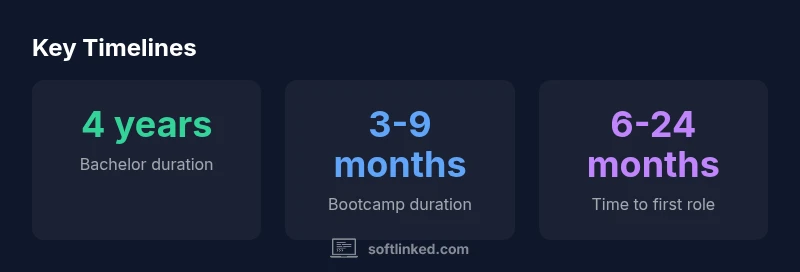
According to SoftLinked, a typical path to becoming a software engineer spans roughly 3 to 6 years, depending on the route you choose. A bachelor’s degree usually takes about four years; bootcamps run 3–9 months; self‑taught routes vary from months to years. Landing your first role often happens within 6–24 months after gaining core skills.
Pathways to Becoming a Software Engineer
There are several legitimate routes to enter software engineering. A traditional four-year bachelor’s degree in computer science or a related field remains common, offering structured fundamentals and on‑campus recruiting routes. For faster entry, many learners pursue immersive bootcamps in 3–9 months that focus on practical programming skills and project portfolios. A growing number of professionals also become software engineers through self‑study, online courses, and hands‑on projects, often combining certificates or micro-credentials to signal competence. In all cases, the core goal is to demonstrate the ability to design, implement, and ship software. According to SoftLinked, the strongest candidates show sustained practice, a portfolio of tangible projects, and the ability to reason about code and systems under real constraints.
How Long Does Each Path Typically Take?
Duration is influenced by prior background, learning pace, and job-market demands. Bachelor programs typically span four years including general education, while specialized tracks or co-op programs may shorten this to around four years plus a co‑op. Bootcamps compress core software engineering concepts into 3–9 months, delivering job-ready portfolios for many entry‑level roles. Self‑taught routes vary further, from several months to a couple of years, depending on commitment and access to mentors. Across routes, the time to land your first role generally ranges from about 6 months to 2 years after you begin focused practice.
Core Learning Milestones Across All Paths
Regardless of route, certain fundamentals recur: programming language syntax and tooling, problem solving, data structures and algorithms, version control (Git), debugging, testing, and software design basics. Front‑end, back‑end, or full‑stack knowledge develops as you build projects. Systems design becomes more important as you advance. SoftLinked notes that many learners prioritize building a portfolio of small, shipped projects that demonstrate impact and reliability. Mentors, peer reviews, and deliberate practice accelerate progress across all routes.
Timeline Scenarios: Common Routes in Practice
Scenario A – Traditional College Path: Enroll in a CS or related program, complete core coursework, engage in internships, and participate in campus recruiting. Expect to dedicate several hours weekly to coding labs, projects, and study groups. This route prioritizes depth, theory, and a broad foundation, often culminating in a first role after graduation.
Scenario B – Immersive Bootcamp: Opt for a 3–9 month intensive program focused on practical skills, project portfolios, and interview readiness. Outcomes depend on program quality and portfolio strength; many graduates secure entry‑level roles within months of completion, especially with structured career services.
Scenario C – Hybrid/Hybrid‑Plus Self‑Study: Learn fundamentals through self‑paced courses, contribute to open source, build a portfolio, and secure internships or freelance work. Time to first role hinges on discipline and networking, but this path offers flexibility and cost control while still delivering demonstrable skills.
How to Set Realistic Expectations and Plan Your Career
Starting a software engineering journey requires a clear plan with milestones. Define core skills (one language, data structures, Git, debugging), set quarterly goals for projects, and schedule regular practice blocks. Assess progress with a portfolio update every 6–8 weeks and seek feedback from peers or mentors. Be prepared for a learning curve and stay adaptable as technology evolves. The SoftLinked framework emphasizes measurable outcomes over calendar dates: what's built, what's tested, and what problems were solved.
Strategies to Accelerate Readiness
- Set concrete milestones: complete one project per milestone and document outcomes.
- Build a portfolio: ship real apps or library contributions, with clear READMEs and tests.
- Contribute to open source: gain collaboration experience and code reviews.
- Seek internships or apprenticeships: gain industry exposure and mentorship.
- Focus on fundamentals: algorithms, data structures, version control, and debugging.
- Practice for interviews: implement problems from data structures and system design exercises.
Planning Your Personal Timeline
Begin with a 90‑day plan: choose a pathway, pick a core language, and complete 2–3 projects. In 6–12 months, expand to a broader stack, contribute to a project, and build your portfolio. By 12–18 months, target internships or entry‑level roles while continuing to learn new concepts. Every learner’s timeline differs, but maintaining consistent practice and visible outputs accelerates readiness.
Comparison of typical pathways to software engineering
| Path | Typical duration | Pros | Cons |
|---|---|---|---|
| Bachelor's degree | 4 years | Structured curriculum; recognized credential | Longer time; higher cost |
| Code bootcamp | 3-9 months | Very focused; portfolio ready | Less depth; variable program quality |
| Self-taught + portfolio | variable (months–years) | Flexible pacing; low upfront cost | Requires discipline; uncertain signal to employers |
Your Questions Answered
What is the fastest path to becoming a software engineer?
Bootcamps can accelerate entry by teaching practical skills quickly, but you still need time to practice and build a portfolio. Shorter programs reduce upfront time, while a degree emphasizes depth and breadth. Choose based on your learning style and job goals.
Bootcamps can speed up entry, but you’ll still need time to practice and build a strong portfolio.
Do you need a degree to become a software engineer?
No single path guarantees a job; many engineers succeed through bootcamps or self‑study with strong portfolios. Degrees can help with certain employers and roles but aren’t mandatory for many entry‑level positions.
A degree isn’t strictly required; practical skills and a solid portfolio matter a lot.
How important are algorithms and data structures in the early career?
DSA fundamentals are valuable for many interviews and problem solving across roles. You don’t need to be a career expert upfront, but a solid grasp helps during technical screenings and initial performance.
DSA basics help a lot in interviews and solving real problems.
What factors affect how long it takes for me personally?
Your prior background, time commitment, access to mentors, and the learning resources you use will shape your timeline. Consistency and project output usually matter more than the calendar clock.
Personal background and consistent practice drive your timeline as much as anything.
Is it better to specialize or stay versatile early on?
Early versatility helps you land multiple roles and learn broadly; specialization can accelerate growth in a domain once you have baseline proficiency. Aim for core competence first, then deepen in areas aligned with your interests.
Be versatile at first, then specialize as you find what you love.
How can I accelerate learning and job readiness?
Set milestones, build a portfolio with shipped projects, contribute to open source, and seek internships or mentorships. Structured curricula and consistent practice typically yield faster results.
Set milestones, ship projects, and seek mentorship to speed up readiness.
“The path to becoming a software engineer is measured by skill, consistency, and portfolio output, not a single calendar date.”
Top Takeaways
- Define a clear learning path based on your goals
- Expect 3–6 years for full proficiency across routes
- Prioritize a tangible portfolio over hours studied
- Choose a path that fits your time, finances, and motivation
- Continuously validate progress with real projects