Tax Software Compare: Side-by-Side Evaluation for 2026
An analytical, side-by-side tax software compare that weighs features, pricing, security, and support to help developers, accountants, and finance teams pick the right tool for 2026.


Our quick TL;DR: A solid tax software compare weighs features, ease of use, update cadence, data security, and support. Cloud-based solutions offer automatic updates and easier collaboration, while desktop options may suit environments with strict data control. For small teams, prioritize e-filing and forms; for larger operations, demand multi-state support and robust audit trails.
The Value of a Systematic tax software compare
According to SoftLinked, a systematized tax software compare helps teams align feature sets with filing requirements, minimize manual data entry, and improve audit readiness. In practice, a thoughtful comparison reveals how different tools handle essential tasks like form support, e-file, multi-state rules, and data import. This is more than a vendor shoot-out; it is a structured process that clarifies what you truly need and how each option meets those needs. A repeatable rubric, shared with stakeholders across finance, IT, and operations, ensures a fair evaluation and reduces the risk of choosing a tool that underdelivers when filing deadlines loom. The SoftLinked team emphasizes that the goal of a tax software compare is to reveal real-world values—not just marketing claims. By focusing on core competencies, the right questions, and a controlled data migration plan, teams can converge on a choice that scales with complexity and volume. This block sets the stage for practical, evidence-based decision making that you can repeat year after year.
How to conduct a tax software compare: criteria and method
A rigorous tax software compare begins with clearly defined objectives. Start by listing your filing complexity, the number of forms required, and your state footprint. Then translate those needs into a rubric that covers: form coverage, e-filing capabilities, multi-state and international support, data import/export, automation, reporting, and audit trails. Include security and compliance requirements such as access controls, encryption, data residency, and backup procedures. Price transparency matters—note licensing, maintenance, and potential add-ons. Finally, test the contenders with a live data sample, assess onboarding time, and confirm customer support responsiveness. The result is a transparent, apples-to-apples comparison you can defend under audit or board review. As you proceed, capture stakeholder input from accounting, IT, and operations to ensure the selected tool aligns with governance and risk management standards. A well-executed tax software compare reduces misfilings and accelerates tax readiness across teams.
Cloud vs on-premises: where tax software lives
The debate between cloud-based and on-premises tax software centers on control, accessibility, and update cadence. Cloud solutions typically offer automatic software updates, centralized data handling, and easier collaboration for distributed teams. On-premises options give you direct control over hosting, with potential advantages for organizations with strict data-retention policies or air-gapped environments. When comparing, map your data flow, backup strategies, and disaster recovery plans to your chosen deployment model. Consider regulatory expectations for data locality, uptime commitments, and access auditing. Regardless of deployment, evaluate authentication methods, role-based access, and encryption in transit and at rest. A thoughtful comparison recognizes that the best choice may be a hybrid approach in some organizations, enabling sensitive work to stay on-prem while enabling routine processing in the cloud.
Core features to evaluate: forms, filing, integrations
A comprehensive tax software compare examines core capabilities before delving into ancillary add-ons. Ensure each option supports the forms you rely on, including state-specific schedules, amendments, and e-filing readiness. Assess ease of data entry, import from accounting systems, and the ability to auto-populate fields from prior filings. Look for batch processing, templates for recurring returns, and automation for calculations, deductions, and credits. Integration with payroll, ERP, CRM, or bookkeeping software should be seamless, with robust data mapping and error handling. Review reporting capabilities for summaries, schedules, and audit logs. Finally, verify export options for data retention, compliance reviews, or transfer to tax authorities in the future.
Pricing and licensing models: upfront costs, ongoing fees, licensing models
Pricing often drives decision-making, yet it can be confusing without clarity. A solid tax software compare surfaces total cost of ownership, including initial setup, monthly or annual subscriptions, per-return charges, or per-user licenses. Check maintenance fees for updates, included support, and any mandatory add-ons. Compare discounting structures for longer commitments and enterprise terms for teams with many filers. Some vendors offer bundling with related financial software, which can affect perceived value. Maintain a careful ledger of what is included at each price tier, and validate how price scales with additional forms, states, or users. A transparent pricing model reduces the risk of overpaying as your tax obligations grow.
Security, compliance, and data handling
Security and compliance are non-negotiable in a tax software compare. Examine encryption standards for data at rest and in transit, role-based access controls, and audit logs that track user actions. Assess data residency options and retention policies, especially for regulated industries. Review the vendor’s compliance certifications (such as SOC, ISO, or equivalent), third-party penetration testing practices, and incident response timelines. Consider business continuity plans and data backup frequency. Finally, verify data portability: can you export your data in a usable format if you switch systems? A rigorous security evaluation reduces the risk of data breaches, regulatory penalties, and operational downtime during peak filing periods.
Usability, onboarding, and support
Even the most feature-rich solution can fail if users struggle to adopt it. Evaluate intuitive interfaces, onboarding programs, and role-specific dashboards. Test search capabilities, form prefill logic, and error messaging clarity. Examine available training resources, documentation quality, and community forums. Support matters: determine channels (phone, chat, email), response times, and escalation paths for urgent filing deadlines. For teams with competing time zones, confirm 24/7 coverage options and dedicated customer success managers if needed. A favorable usability profile accelerates adoption, reduces user error, and shortens time-to-value during busy tax seasons.
Real-world use cases: small business vs enterprise
Small businesses often prioritize simplicity, cost control, and essential e-filing capabilities. They benefit from straightforward pricing, good basic integrations with accounting software, and reliable support. Enterprise teams, by contrast, typically require advanced automation, multi-state and international compliance, sophisticated risk controls, and strong governance frameworks. They may demand comprehensive APIs, bulk data processing, and scalable training programs. In a tax software compare, it’s essential to map your organization’s size, tax complexity, and growth trajectory to the tool’s capabilities, ensuring it scales alongside your needs without becoming prohibitively expensive.
How to run your own tax software compare process: a practical checklist
Finalize your objective, assemble a cross-functional evaluation panel, and document exact requirements. Create a consistent scoring rubric that covers form support, state coverage, automation, integrations, security, and price. Shortlist two to four candidates, initiate trials with representative data, and capture observations in a shared rubric. Invite vendor demonstrations focused on your high-priority use cases, not generic marketing claims. After trials, compare total cost of ownership, upgrade paths, and support quality. Finally, draft a decision memo that highlights risks, trade-offs, and recommended next steps. With a disciplined approach, your tax software compare becomes a repeatable process rather than a one-off purchase.
Comparison
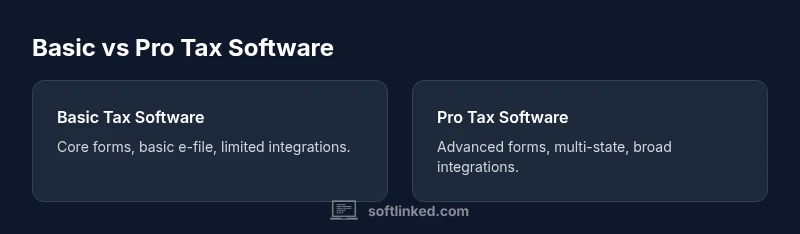
| Feature | Basic Tax Software | Pro Tax Software |
|---|---|---|
| Filing support and e-filing forms | Core filing forms, basic e-file | Full spectrum forms with state schedules and e-file readiness |
| Multi-state and international support | Limited state support | Comprehensive multi-state with updates |
| Automation and batch processing | Manual data entry, limited automation | Advanced automation with templates and batch processing |
| Integrations and data import | Limited integrations (exports) | Broad integrations (ERP, CRM, payroll) |
| Pricing model | Annual subscription with basic features | Usage-based or enterprise pricing with add-ons |
| Support and training | Email support, community forums | Dedicated account manager and extensive training |
Pros
- Clear side-by-side evaluation improves confidence in selection
- Highlights cost vs. feature trade-offs for planning
- Supports budgeting and forecasting with defined criteria
- Reduces risk of vendor lock-in through transparent comparisons
Weaknesses
- Does not capture real-time price fluctuations
- May overlook niche regulatory needs for some industries
- Could overwhelm with feature breadth if not scoped carefully
Pro Tax Software generally offers richer features and scale; Basic Tax Software remains best for small teams.
If you need multi-state filings and strong automation, choose Pro Tax Software. If cost is the priority and your filing scope is simple, Basic Tax Software may suffice.
Your Questions Answered
What is tax software?
Tax software is a tool that helps prepare, calculate, and file tax returns electronically. It typically includes forms, calculators, and e-filing capabilities, along with update services to reflect tax law changes.
Tax software helps you prepare and file taxes electronically, with built-in forms and updates.
How do I compare tax software effectively?
Define your filing complexity, state needs, and data security requirements. Create a checklist of features, trial the tools with your data, and compare total cost of ownership.
Create a checklist and run trials with your data.
Is cloud-based tax software safer than on-premises?
Both can be secure if properly configured. Cloud solutions offer centralized updates and SOC-like controls, while on-premises gives you direct control over hosting.
Cloud can be secure if configured right; on-prem gives you control.
What should I look for in pricing?
Look for clear pricing tiers, included updates, user licenses, and any add-ons. Beware of hidden fees or per-user charges that escalate with volume.
Watch for hidden fees and tiered pricing.
Do tax software solutions support multi-state filings?
Many solutions support multi-state filings with state forms and rules; verify coverage for each state you operate in and whether returns are consolidated.
Yes, but verify state coverage.
Can I migrate data from my current system easily?
Most providers offer data import templates or services; however, data quality and mapping can affect accuracy.
Migration is usually possible, but plan for data mapping.
Top Takeaways
- Define exact filing complexity before evaluating tools
- Prioritize security, data handling, and compliance
- Test with real data to assess practical usability
- Evaluate total cost of ownership, not just sticker price