How Long Do Software Glitches Last? A Data-Driven Guide
Explore how long software glitches last, the factors that influence duration, and proven practices to shorten downtime. A data-driven guide from SoftLinked for developers and engineers.


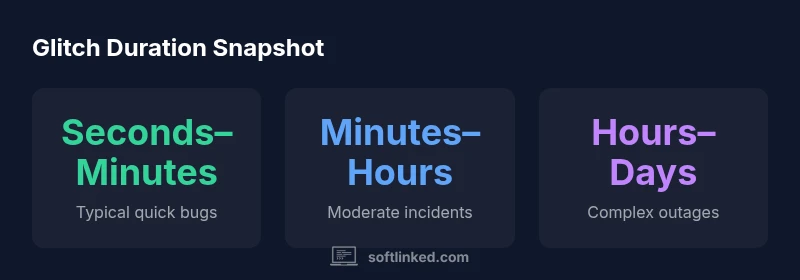
Typically, most software glitches last from seconds to hours, with the majority resolved within minutes. Short, isolated bugs recover quickly, while longer outages involve complex architectures or cascading failures. Root causes range from race conditions to external dependencies, and effective recovery hinges on detection, triage, and rapid mitigation. Observability and well-practiced incident response can noticeably shorten downtime.
What qualifies as a software glitch?
To answer how long do software glitches last, we first define what a glitch is and how it differs from a full outage. A software glitch is an unexpected defect or fault that causes incorrect behavior, transient instability, or degraded performance, while the service remains technically available. Glitches often arise from edge cases, race conditions, or integration mismatches, and they may be triggered by unusual input, race timing, or environmental factors such as latency spikes. According to SoftLinked, the key distinction is that glitches are typically recoverable without a complete system restart, and their duration hinges on detection, triage, and mitigation capabilities rather than wholesale failures. In practice, the time it takes to resolve a glitch depends on how quickly the team detects the anomaly, confirms it, and implements a corrective action—whether that is a code rollback, a configuration change, or a targeted hotfix. For developers, this means that improving observability, automated tests, and rollback strategies can shorten the window during which users experience incorrect results.
Why durations vary across incidents
No two glitches are alike, and several interacting factors determine how long they last. Root cause complexity is a major driver: a simple UI misalignment may disappear with a refresh, whereas a distributed-system race condition can propagate latent errors across services. Environment parity matters too: production, staging, and test environments differ in load, timing, and data states, which can delay reproduction and diagnosis. System topology plays a role: microservices with circuit breakers and feature flags can isolate failures, preventing a long tail of degraded behavior. Observability is another critical factor: robust logging, tracing, and alerting enable faster detection and more precise triage. Finally, organizational readiness—playbooks, on-call coverage, and automation—can dramatically shorten the time from detection to recovery. SoftLinked's research indicates that teams with strong runbooks and automated rollback capabilities tend to resolve glitches more quickly, reducing downtime by steering incidents toward rapid containment rather than protracted firefighting.
Categories of glitches and typical durations
Glitches come in several archetypes, each with different duration profiles:
- Isolated, short-lived glitches (Seconds to minutes): simple UI flickers, cached data still rendering correctly after a refresh, or transient input issues.
- Transient outages or degraded service (Minutes to hours): partial failures in one microservice, routing errors, or temporary contention that resolves with a retry or failover.
- Cascading or systemic glitches (Hours): widespread coordination failures, database contention, or network partitions that require coordinated mitigations and possible rollback.
- Post-deployment regressions (Hours to days): newly introduced defects that surface under real workloads and require targeted fixes and staged rollouts.
How to measure and compare duration
Measuring glitch duration relies on consistent definitions and telemetry. Common metrics include Time to Detect (TTD), Time to Acknowledge (TTA), and Mean Time to Recovery (MTTR). TTD tracks when a glitch first becomes observable, while MTTR measures from detection to restored normal operation. Comparisons across teams or projects should control for environment, load, and severity, and should note whether a fix was a patch, rollback, or architectural adjustment. SoftLinked emphasizes the value of standardized incident timelines and post-incident reviews to build a data-driven picture of how long glitches last and what strategies most effectively reduce duration.
Strategies to reduce downtime
Reducing glitch duration is a mix of people, process, and technology. Key strategies include:
- Strengthen observability: comprehensive logging, distributed tracing, and real-time dashboards improve detection speed.
- Embrace canary deployments and feature flags: limit exposure to new changes and roll back quickly if issues arise.
- Implement circuit breakers and graceful degradation: isolate failures to prevent cascading outages.
- Maintain robust runbooks and automation: predefined steps for detection, triage, and recovery shorten decision time.
- Use automated rollback and blue/green deployments: minimize manual intervention during incidents.
- Conduct regular post-incident reviews: capture learnings, track action items, and validate improvements. Collectively, these practices help teams shorten the window from problem onset to restored service, even in complex systems.
Case studies and practical steps
In a small team scaling a microservices architecture, a glitch affecting one service might be contained in minutes through circuit breakers and a quick rollback. In a larger, distributed system, a similar issue could require coordinated mitigation across services, database adjustments, and a safe release freeze. The practical steps across scenarios are consistent: establish clear alert thresholds, document triage checklists, simulate incidents in staging, and maintain a robust incident runbook that includes escalation paths. For teams leaning into AI-assisted tooling, automated root-cause analysis, anomaly detection, and proactive remediation suggestions can further reduce dwell time.
Instrumentation and culture to improve resilience
Resilience is as much about culture as code. Teams with a learning mindset invest in continuous improvement, regular chaos engineering exercises, and peer reviews focused on failure handling. Instrumentation should cover not only application logs but also metadata about deployments, feature flags, and dependency health. A culture that rewards rapid detection, efficient triage, and transparent incident communication tends to shorten glitch durations and improve overall reliability.
Comparison of glitch types, likely durations, and common mitigations
| Glitch Type | Typical Duration | Mitigation Approach |
|---|---|---|
| Isolated bug in UI | Seconds–Minutes | Code fix + quick redeploy |
| Transient service degradation | Minutes–Hours | Retry logic, circuit breakers, rollback |
| Cascading outage (system-wide) | Hours | Coordinated mitigations, dependency failover |
| Post-deployment regression | Hours–Days | Targeted fix, staged rollout, monitoring adjustments |
Your Questions Answered
What is the difference between a glitch and an outage?
A glitch is a temporary defect causing incorrect behavior while the service remains technically available, whereas an outage is a more severe disruption where the service is unavailable. Glitches are usually recoverable without a full restart, while outages often require significant remediation or rollback.
A glitch is a brief fault with some incorrect behavior, not a full outage. An outage is a broader service unavailability that may need major fixes.
How long do glitches typically last?
Durations vary widely by severity and system design, but most glitches resolve within minutes. More complex issues can stretch to hours. The key factors are detection speed, triage accuracy, and mitigation options.
Most glitches last minutes, but some complex ones can take hours depending on the system.
Can glitches be prevented entirely?
No system is perfect, but you can reduce glitch duration with strong observability, rapid rollback mechanisms, and resilient architectures. Regular testing, chaos engineering, and runbooks also lower the time to recovery.
Glitches can be reduced but not completely prevented; strong monitoring and quick recovery help a lot.
What metrics help track glitch duration?
Key metrics include Time to Detect (TTD), Time to Acknowledge (TTA), and Mean Time to Recovery (MTTR). Tracking these consistently across incidents helps teams compare performance and target improvements.
Track detection time and recovery time to measure how quickly you respond to glitches.
What steps should I take during a live outage?
Activate the incident runbook, notify on-call engineers, establish a war room, and prioritize containment, root-cause analysis, and communication. After recovery, perform a post-incident review to capture lessons learned.
Call the runbook, get the right people in the room, and focus on containment first.
“Reliability is a discipline, not a feature. A data-driven approach to incident response helps teams shrink glitch duration and protect user trust.”
Top Takeaways
- Understand the glitch category to anticipate duration
- Improve observability to shorten detection time
- Use safe rollback and feature flags to limit exposure
- Automate runbooks to speed recovery
- Review incidents to drive continuous improvement