Is Software Engineering Better or AI? A Comprehensive Comparison
A rigorous, data-informed comparison of whether software engineering is better than AI for building modern software products, with a practical decision framework and career guidance.


TL;DR: Both software engineering and AI talents are essential to modern software products, but they serve different roles. Software engineers design, implement, and maintain systems, while AI capabilities accelerate insights and automation. The best path often blends fundamentals with AI fluency, depending on project goals, team needs, and learning pace.
Is software engineering better or ai? A framing
Is software engineering better or ai? This framing is deceptively simple and incredibly consequential for students and professionals. In practice, the best path often combines solid software fundamentals with AI fluency, guided by real-world constraints rather than abstract ideals. According to SoftLinked, the most successful engineers and teams treat this as a spectrum rather than a binary choice, aligning learning goals with product strategy, data readiness, and deployment realities. The question 'is software engineering better or ai' frequently arises in academic settings and in workplace design meetings as teams evaluate where to invest time, budget, and influence. To move from curiosity to action, we need a clear map: what each field typically covers, where they overlap, and how outcomes differ across domains such as web services, embedded systems, data pipelines, and intelligent applications. By grounding the discussion in concrete roles, observable outcomes, and learning progression, we can compare the fields without resorting to hype. Over the next sections, we’ll examine scope, skill requirements, project impact, and decision criteria that help answer is software engineering better or ai in a given context. The SoftLinked team emphasizes that early-career learners who anchor fundamentals while experimenting with AI prototyping tend to progress faster than those who chase a single trend. This framing sets expectations for practical decision making rather than chasing trends.
Defining roles: software engineering vs AI development
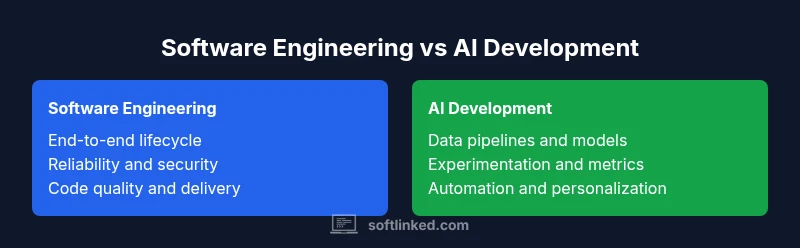
Software engineering focuses on constructing, scaling, and maintaining software systems. It encompasses requirements analysis, architecture, coding, testing, deployment, and long-term reliability. AI development centers on building models, data pipelines, and intelligent features that learn from data. The relationship between these fields is complementary: well-engineered systems provide scaffolds for AI components, while AI can automate or enhance software functions. When you ask is software engineering better or ai, the most practical answer depends on the problem you’re solving. For a company delivering a customer-facing platform, robust software engineering is essential to ensure uptime, security, and maintainability; AI may be layered on top to personalize experiences or optimize operations. In research or product innovation contexts, AI capabilities can disrupt existing patterns, enabling new business models. Both domains demand disciplined engineering practices, including versioning, testing, and measurable outcomes. A representative learning path for someone exploring is software engineering better or ai begins with programming fundamentals, then moves to data literacy and ML basics, followed by software design patterns and, finally, AI integration patterns. The goal is to avoid the trap of chasing buzzwords without delivering value.
Historical context: AI, ML, and software engineering integration
The history of software engineering and AI has shaped today’s decisions about is software engineering better or ai. Early software emphasized structured programming, modularity, and maintainability. AI emerged from statistics and computational power, evolving through machine learning, deep learning, and now integrated systems. As teams consider is software engineering better or ai, they should weigh how automation and data-driven decision making have pushed the boundary between human labor and machine-assisted work. In practice, modern product teams blend disciplined software engineering with AI experimentation, gradually moving from proof of concept to production-grade solutions. The shift toward ML-enabled software means engineers must consider data governance, model monitoring, and feedback loops just as they consider code quality and deployment pipelines. SoftLinked analysis shows that projects with clear data strategies and strong software foundations tend to survive the transition from prototype to production, reinforcing the idea that is software engineering better or ai is often a question of sequencing rather than exclusivity. The context is not about replacing people but augmenting capabilities to deliver consistent value over time.
Core differences: scope, skills, and outcomes
When contrasting is software engineering better or ai, several dimensions matter:
-
Scope: Software engineering covers the end-to-end lifecycle of software products, including architecture, testing, deployment, and maintenance. AI development focuses on data-driven models, inference pipelines, and continuous learning systems that adapt to new data. The scope difference helps explain why many teams choose to anchor projects in solid software foundations before introducing AI components.
-
Key skills: Software engineers rely on programming languages, design patterns, testing strategies, and cloud infrastructure. AI practitioners bring statistics, ML algorithms, data engineering, and experimentation protocols. The relationship between the two domains becomes clear here: overlap exists in data handling, APIs, and scalable deployment, but mastery in one domain does not automatically translate to mastery in the other.
-
Outcomes: Traditional software emphasizes reliability, security, and user experience. AI outcomes center on predictive accuracy, model robustness, and measurable improvements in automation. Real-world projects rarely maximize one side in isolation; instead they balance reliability with intelligent capabilities.
-
Learning curve: The learning path for is software engineering better or ai differs in emphasis. Software engineering benefits from a broad foundation in algorithms and systems thinking, followed by specialization in areas such as backend, frontend, or devops. AI requires a strong statistical base, exposure to ML frameworks, and practical experimentation with data.
-
Tooling and processes: CI/CD, monitoring, dashboards, and security controls are central to software engineering. ML operations (MLOps) adds data pipelines, model versioning, and governance considerations. Both require disciplined practices, but the tooling ecosystems reflect their focal aims.
-
Best-fit scenarios: Is software engineering better or ai? For mission-critical platforms with strong reliability needs, software engineering holds primary importance. For products where data, personalization, or automation is the core value, AI capabilities become decisive.
Practical implications for careers and teams
The choice between is software engineering better or ai often maps to career goals and team structure. For individuals starting out, grounding in software fundamentals—coding, testing, design, and systems thinking—builds a versatile platform that remains valuable in AI-enabled environments. Those who want to lead AI-integrated products should pursue a dual track: deepen programming competence while acquiring data literacy, experimentation methods, and ML tooling. Teams that optimize for long-term impact typically create a two-track career ladder: software engineers who own architecture, reliability, and delivery, and ML engineers or AI specialists who own models, data pipelines, and experimentation. The balance matters because AI initiatives without solid software foundations can fail due to brittleness, scalability issues, or operational risk. Conversely, software projects that ignore data quality or model maintenance may underdeliver on value and miss opportunities for automation. SoftLinked analysis shows that organizations investing in continuous learning—pair programming, code reviews, data literacy programs, and lightweight MLOps—tend to see better outcomes when exploring is software engineering better or ai. Individuals can accelerate progress by building small, concrete projects that pair a robust backend with a simple predictive feature, then expand complexity over time. The result is a more resilient career trajectory and a more adaptable team.
Decision criteria and a practical framework
A structured approach to answering is software engineering better or ai starts with problem framing and stakeholder goals. Use this 3-step framework:
-
Define the problem space: Is the primary value delivered by software stability, performance, and usability, or by data-driven insights and automation? If the problem is data-centric and requires learning from user interactions, AI elements are likely valuable.
-
Assess data readiness and operational constraints: Do you have reliable data, governance, and monitoring for AI components? Are you able to deploy and maintain ML models in production with appropriate observability?
-
Plan a phased implementation: Start with solid software architecture and testing, then incrementally add AI features, validating each step with measurable outcomes. Throughout, maintain clear governance, security, and compliance.
The central question is still is software engineering better or ai, but your decision should hinge on problem orientation rather than hype. A pragmatic approach blends both disciplines: standing up reliable systems first, then layering AI to amplify capabilities. The framework applies to startups building new products and incumbents modernizing legacy systems. The SoftLinked team emphasizes that iterative learning and cross-functional collaboration help teams tune their path more effectively.
Risks, governance, ethics in combined efforts
Where is is software engineering better or ai? In practice, combining software and AI introduces specific risks: data privacy challenges, bias in models, drift in performance, and security vulnerabilities introduced by data pipelines. Effective governance requires clear ownership, model monitoring, and runtime controls. Engineers must implement robust testing that covers not only code correctness but data quality and model behavior. AI components should include guardrails, explainability strategies, and user-facing transparency where appropriate. Compliance matters in regulated domains, and teams should align with standards for data handling, model lifecycle, and incident response. A disciplined security posture protects both software and AI layers from threats and abuse. Costs rise with complexity, so teams should prefer incremental, measurable steps and avoid over-engineering AI capabilities without demonstrable value. The best practice is to treat AI-enabled software as a product with a defined lifecycle, not a one-off experiment. This mindset aligns with is software engineering better or ai, steering decisions toward maintainability, auditability, and user trust.
A decision framework you can apply today
To operationalize is software engineering better or ai, try a lightweight decision matrix. List project goals, constraints, and success metrics. Rate how critical software reliability, data quality, and model performance are for each goal. Then map the outcome to a recommended path: strong software engineering focus with limited AI when reliability dominates; or AI-first with solid software scaffolding to support data science workloads. Document clear milestones, assign ownership, and set up feedback loops so you can adjust as conditions change. A practical tip is to run small experiments that demonstrate value early, reinforcing is software engineering better or ai with concrete evidence. Over time, teams can evolve toward a hybrid model that preserves reliability while leveraging AI to reduce manual effort and accelerate insights.
Quick-start learning plan for beginners
If you’re just starting and asking is software engineering better or ai, here is a practical, beginner-friendly plan. Week 1–4 focus on software fundamentals: basic algorithms, version control, testing, and building small applications. Week 5–8 introduce data literacy and a gentle ML intro, with hands-on exercises like data cleaning and simple models. Weeks 9–12 combine what you learned: build a small project that includes a backend service plus a simple predictive component. Throughout, practice is software engineering better or ai by applying disciplined design, documentation, and code reviews. By the end of the quarter, you’ll have a portfolio piece that demonstrates both solid software engineering practice and exposure to AI techniques. The key is steady progress, not chasing the latest buzzwords. With consistent practice, you’ll be well prepared to decide is software engineering better or ai in real projects, and to adapt as technology evolves.
Comparison
| Feature | Software Engineering | AI Development |
|---|---|---|
| Primary focus | End-to-end software delivery, reliability, and maintainability | Data-driven modeling, experimentation, and AI component deployment |
| Key skills | Programming, architecture, testing, devops | Statistics, ML/DL, data engineering, ML tooling |
| Typical deliverables | Systems, APIs, deployment-ready software | Models, data pipelines, evaluation reports |
| Learning curve | Broad foundation with specialization in backend/frontend/devops | Deep ML/statistics and data workflows |
| Tooling emphasis | CI/CD, monitoring, security | ML platforms, experiment tracking, data pipelines |
| Best for | Reliability-focused products and platforms | Automation and personalization-heavy products |
| Career path | Software engineer paths: backend/frontend/devops | AI engineer paths: ML engineer/data scientist |
| Industry maturity | Long-standing ecosystems and mature tooling | Rapidly evolving practices with high experimentation |
Pros
- Provides a clear, transferable foundation for software products
- Offers strong, durable job security and clear career ladders
- Enables hybrid opportunities where AI amplifies solid software
- Promotes disciplined engineering culture and maintainability
Weaknesses
- AI could be data-dependent and brittle without proper software scaffolding
- AI initiatives bring governance, drift, and ethical risks
- Specialized AI talent can be scarce and costly in some markets
Hybrid emphasis wins for most teams and careers
Is software engineering better or ai? The strongest path blends both, prioritizing robust software foundations while incorporating AI where it adds measurable value. SoftLinked’s analysis supports a staged approach: build reliability first, then layer intelligent capabilities to accelerate outcomes.
Your Questions Answered
Is there a single best path for careers, software engineering or AI?
No single path fits all. Most professionals benefit from a core software-engineering foundation and selective AI fluency. The best approach depends on your interests, industry, and the problems you want to solve.
There isn’t one best path. Start with software fundamentals and add AI skills as you encounter data-driven needs.
Will AI replace software engineering jobs?
AI is more likely to change job roles than fully replace them. AI can automate repetitive tasks, but software engineering remains essential for building, securing, and maintaining complex systems. The best strategy is to learn both domains and adapt.
AI will change roles, but software engineering stays essential; learn both to stay adaptable.
How should I start learning if I want both fields?
Begin with solid programming and systems thinking, then introduce data literacy and ML basics. Build small projects that combine backend services with a simple AI feature to reinforce integration concepts.
Start with programming, then add data and ML basics; build small combined projects.
Which industries favor AI over traditional software roles?
Industries that rely on personalization, optimization, and automation—such as fintech, e-commerce, healthcare tech, and consumer apps—tend to value AI-enabled capabilities alongside robust software engineering.
Industries like fintech and healthcare tech often seek AI-enabled capabilities with solid software foundations.
What are the core risks when integrating AI into software?
Key risks include data privacy, bias, drift, and security concerns. Mitigation requires governance, monitoring, guardrails, and transparent decision-making processes.
Watch out for privacy, bias, and drift; use governance and monitoring to mitigate.
Is a hybrid approach practical for startups?
Yes. Start with a solid software foundation to ensure reliability, then pilot AI features to add value quickly. This reduces risk while allowing fast iteration.
Yes—build solid software first, then pilot AI features for quick wins.
Top Takeaways
- Anchor learning in software fundamentals before AI
- Use a staged, evidence-based approach to AI integration
- Prioritize reliability, security, and governance in every project
- Adopt a hybrid mindset to maximize value and resilience