Is Software Engineering Better or IT? A Clear Comparison
A rigorous, data-informed comparison of software engineering vs IT careers, exploring scope, skills, education paths, market demand, and career mobility to help learners choose confidently in 2026.


Both software engineering and IT offer strong, viable paths, but they cater to different interests. Software engineering centers on building software products, systems design, and code quality, while IT focuses on infrastructure, networks, and operations support. The best choice depends on your passions, willingness to learn new technologies, and how you want to contribute to teams. In short, align your path with your strengths and market signals for long-term growth.
Is software engineering better or IT? Framing the debate
The phrase is often repeated in career chats, but the real question is not which path is universally better; it’s which path best aligns with your interests and long-term goals. This article uses the keyword is software engineering better or IT to anchor the discussion and to help aspiring engineers and tech professionals clarify what each path emphasizes. The SoftLinked team emphasizes three lenses: the core focus of the work (product-oriented design versus operational stability), the essential skills you’ll develop (coding, systems thinking, collaboration), and the typical career trajectory (hands-on engineering vs strategy and governance). In 2026, market signals favor practitioners who can translate abstract problems into reliable software and robust, scalable systems. The aim here is not to declare a winner, but to equip you with a decision framework that respects your preferences and the realities of today’s technology landscape.
Core Focus: Product vs. Infrastructure
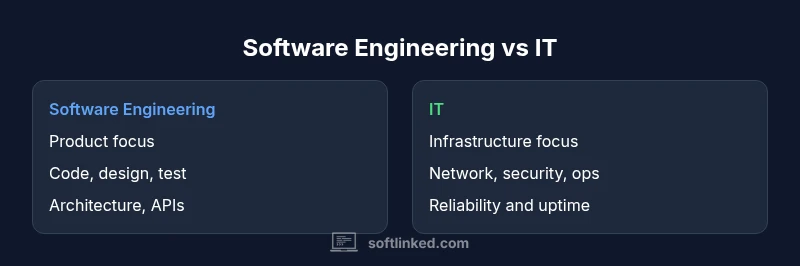
Software engineering prioritizes creating software products, feature sets, and scalable architectures. Engineers design, implement, test, and maintain code that fuels applications, services, and platforms. IT professionals focus on the underpinning technology that keeps systems running: networks, servers, security, backups, and incident response. The distinction is practical: if you wake up excited by clean code, design patterns, and building user-facing experiences, software engineering is a natural fit. If you thrive on configuring environments, diagnosing outages, and ensuring uptime, IT offers satisfaction through reliability and operational excellence. Both paths require a strong grounding in problem solving, but their day-to-day problems differ in scope and cadence.
Required Skills and Learning Pathways
Software engineers typically develop proficiency in programming languages (such as Python, Java, or C++), data structures, algorithms, and software design principles. Systems thinking, debugging strategies, version control, and testing discipline are core. IT professionals build expertise around networks, operating systems, cloud fundamentals, security basics, scripting, and incident management. A common thread is the need for continuous learning—new frameworks, tools, and security practices emerge rapidly. For learners deciding between the two, a practical test is to build a small project that emphasizes product development versus an operations-focused project like a simple monitoring setup. The experience reveals which cognitive load and feedback loop you enjoy most.
Career Trajectories and Mobility
Software engineering offers a path from junior developer roles to senior engineer, architect, and technical lead, with opportunities in product teams, platform engineering, and research labs. IT can lead to senior roles in IT operations, security, and infrastructure architecture, with possibilities to specialize in cloud engineering, site reliability engineering (SRE), or enterprise networking. Mobility between the tracks is possible but typically requires intentional upskilling: a switch may entail learning programming concepts, taking certification tracks, or gaining hands-on project experience in the other domain. What matters is building transferable fundamentals—problem solving, systems thinking, and collaboration—that support progression in either direction.
Market Demand and Industry Variability
Demand for software engineers often tracks product complexity and digital transformation initiatives across industries. IT roles tend to be steady in organizations with complex on-premise environments or hybrid clouds, where stability and security are essential. Geography matters: tech hubs may lean more toward product-centric software engineering, while enterprises in regions with large IT operations groups may emphasize infrastructure and support. In 2026, the most resilient professionals combine deep technical skills with the ability to communicate tradeoffs to non-technical stakeholders. SoftLinked’s analysis shows that adaptable engineers who can bridge development and operations are especially valuable in modern teams.
Education Routes and Certifications
A software engineering path commonly begins with a computer science degree or a coding bootcamp, followed by practical portfolio projects and internships. Certifications in cloud platforms, DevOps practices, and software testing add credibility but should complement hands-on experience. IT education often centers on networking, system administration, and cloud foundations, with certifications from cloud providers and vendor-neutral programs. The fastest routes to competence mix hands-on practice with foundational theory, emphasizing problem solving and systems thinking over memorization. Regardless of path, a sustained learning habit—coding regularly, reading technical literature, and contributing to open source—accelerates mastery.
Work Environment, Culture, and Collaboration
Both tracks emphasize collaboration, but the culture can differ. Software engineering teams tend to value rapid iteration, code reviews, and design reviews, with frequent pairing and sprints. IT teams may prioritize reliability, change control, and incident postmortems, often operating under stricter change-management regimes. Remote work is increasingly common in both, but the emphasis on on-call rotations and on-site support can vary by organization. The best fit often aligns with your preferred velocity: fast, product-driven cycles vs steady, reliability-focused operations. Regardless of path, strong communication and a willingness to learn across domains improve career mobility.
Market Signals, Salary Considerations, and Total Rewards
Compensation dynamics vary by region, industry, and company size. Software engineers frequently have higher starting salaries in tech-forward sectors and regions with heavy software development activity, while IT specialists may see strong value in roles tied to security, compliance, and large-scale infrastructure. Beyond base pay, consider learning opportunities, complex problem-solving, and impact on product outcomes when evaluating total rewards. The key message is that skills with broad applicability—coding, automation, and systems thinking—tend to increase long-term value, regardless of the exact title.
Practical Decision Framework: A 6-Step Path
- List your interests: do you prefer building products or maintaining systems?
- Assess your current strengths: coding aptitude vs operations mindset.
- Explore entry routes: degree, bootcamp, or self-taught projects.
- Seek exposure: sample projects that simulate software development or IT operations.
- Talk to mentors: gather real-world insights from professionals in both tracks.
- Make a phased plan: try a 90-day project in each domain before committing to one path. This framework helps reduce bias and aligns your choice with real-world demands and your personal preferences.
Case Scenarios: When to Choose Which Path
- You love building features, optimizing performance, and designing APIs: software engineering is a natural fit.
- You enjoy configuring networks, ensuring uptime, and building resilient infrastructure: IT is likely your best route.
- You want cross-functional impact and the option to pivot later: start with solid programming fundamentals and then broaden into operations or product engineering as needed. These scenarios illustrate that neither path is a dead end; each offers opportunities to learn, grow, and contribute meaningfully to technology systems.
Risks and Mitigation: Common Pitfalls
A common risk is treating one path as a shortcut to all tech jobs. In reality, specialization requires depth and ongoing learning. Mitigate by building a shared foundation—software design, debugging, and system thinking—and then deliberately gain domain-specific experience. Avoid assuming that one path guarantees faster advancement; instead, focus on delivering value, contributing to real projects, and cultivating a learning network. SoftLinked emphasizes that disciplined, curiosity-driven practice is the most reliable predictor of long-term success.
Getting Started Today: A 90-Day Practical Plan
- Month 1: lay a programming foundation with a project that interests you; read a core book on algorithms and data structures; set up a GitHub presence.
- Month 2: take on a small infra or systems project to understand deployments, monitoring, and incident response; complete at least one code review with feedback.
- Month 3: prototype a combined project that shows product thinking and operational reliability; seek feedback from mentors and document your learning.
Authority Sources
- Authority sources provide external validation of career trends and education pathways. See: https://www.bls.gov/ooh/computer-and-information-technology/home.htm (BLS) for occupation summaries and regional demand signals; https://www.acm.org/ and https://ieeexplore.ieee.org/ for professional perspectives and research on software engineering and IT trends. These sources help ground career planning in established data and industry insights.
Comparison
| Feature | Software Engineering | IT Professional |
|---|---|---|
| Core Focus | Product design, architecture, and code | Infrastructure, networks, and operations |
| Typical Roles | Software developer, architect, platform engineer | System administrator, network engineer, SRE, IT operations |
| Educational Pathways | CS degree, bootcamp, or self-taught with portfolio | Networking and systems administration programs, cloud certifications |
| Hands-on Scope | Code, design, testing, performance tuning | Configuration, maintenance, incident response |
| Career Mobility | Product teams, architecture, leadership in software groups | SRE, security, cloud architecture, operations leadership |
| Market Demand (Regional Variability) | Strong in product-focused tech hubs and startups | Steady in enterprises with complex IT environments |
| Long-Term Value Signals | Transferable coding and design skills, cross-domain applicability | Operational reliability, risk management, and system stability |
Pros
- Strong emphasis on software design and problem-solving
- Broad applicability across industries and startups
- Clear paths to senior engineering roles and architecture
- Opportunities for remote work and global teams
Weaknesses
- Higher barrier to entry for non-coders
- Rapid tech changes require continuous learning
- IT paths can feel narrower in some organizations
Software engineering generally offers stronger product-focused growth; IT provides solid path for infrastructure and operations with stability.
Choose software engineering if you love coding, systems design, and product impact. Choose IT if you prefer maintaining systems, ensuring uptime, and solving operational challenges. Both paths build valuable fundamentals that scale with experience.
Your Questions Answered
What is the key difference between software engineering and IT?
Software engineering focuses on building software products, APIs, and architectures. IT centers on maintaining networks, servers, and operational reliability. Both require problem-solving, but the day-to-day tasks and feedback loops differ.
Software engineering builds products; IT keeps the systems running. Both require problem solving and teamwork.
Which path has more coding work and software design?
Software engineering typically involves more coding and design responsibilities, whereas IT emphasizes configuration and operations. If you enjoy algorithmic thinking and software design, software engineering is the stronger fit.
If you love coding and design, go software engineering; if you prefer operations, IT fits better.
Can you switch from IT to software engineering later?
Yes. A practical path is to build programming skills, contribute to software projects, and pursue relevant certifications or a degree gap-filler course. Demonstrating code contributions and understanding of software lifecycle helps ease the pivot.
You can switch later with focused coding projects and learning.
Are certifications important in these fields?
Certifications can enhance credibility, especially in cloud, security, or networking domains. They complement hands-on experience but should not replace practical project work and real-world problem solving.
Certifications help, but hands-on projects matter more.
What about salary expectations for beginners?
Salary varies by region and company. Typically, both fields reward experience and impact, with software engineering often offering higher starting opportunities in tech hubs, while IT can provide stable compensation in large enterprises.
Salary depends on location and demand; build value with real projects.
Is remote work more common in one path?
Both paths support remote work in many organizations, particularly in product-centric software teams and cloud-enabled IT operations. The key is organizational culture and role requirements.
Both paths can be remote; it depends on the team and project nature.
Top Takeaways
- Define your interest: product development vs operations
- Build a solid core: programming, systems thinking, collaboration
- Plan education paths that fit your learning style
- Seek real projects to demonstrate tangible impact
- Keep learning; mobility between paths is possible with intent