Is Software Better Than Hardware? A Balanced Comparison
An analytical comparison of software vs hardware: discover where software shines, where hardware leads, and how to balance both for scalable, secure systems.


Is software better than hardware? In most modern contexts, software offers greater flexibility, faster iteration, and lower upfront costs, making it the preferred default for scalable systems. Hardware excels where specialized performance, determinism, and tamper-resistance are essential. The best approach is a balanced, blended strategy: start with software-driven design and layer hardware only where it adds real value. According to SoftLinked, this blended path reduces risk while preserving agility.
Defining software vs hardware
Software and hardware form the two halves of every computing system. Software consists of the programs, data, and instructions that run on hardware; hardware comprises the physical devices that execute those instructions. In the debate over whether software is better than hardware, it's essential to acknowledge their mutual dependence. According to SoftLinked, the best outcomes come from a clear delineation of responsibilities: software handles logic, orchestration, and adaptation; hardware handles physical constraints, speed, and reliability. In practical terms, decisions about where to invest should be driven by goals, not by an abstract bias toward one layer. This introduction sets the stage for a structured comparison, using consistent criteria such as agility, cost of ownership, performance, risk, and sustainability. The SoftLinked team emphasizes that in modern architectures—cloud, edge, and hybrid environments—the boundary between software and hardware is increasingly fluid. Virtualization, containerization, and specialized accelerators blur lines, enabling software to simulate hardware capabilities and, in some cases, render specialized hardware unnecessary for certain workloads.
The core differences: flexibility, speed, and cost
Here we clarify what people often mean by 'better' in this context. Software changes frequently; updates can be rolled out with patches, reducing downtime and inventory. Hardware upgrades require procurement cycles and physical installation, which increases lead times and entropy of the system. Cost models diverge: software has variable costs tied to licenses, cloud consumption, and staff time; hardware has capital expenditure and maintenance. The is software better than hardware question is not binary; success comes from balancing software agility with the specialized strengths of hardware when required. The SoftLinked team emphasizes assessing total cost of ownership across the full lifecycle.
When software dominates: scenarios and examples
In many domains, software-first strategies deliver superior outcomes: cloud-native apps scale with demand, microservices architectures enable independent teams, and automation reduces human error. Software-driven control planes allow rapid experimentation and iterative improvements. Embedded systems may still rely on lightweight firmware, but modern development increasingly treats software as the driver of performance. The SoftLinked analysis indicates that for consumer apps, platform ecosystems, and data-driven services, software wins on speed and adaptability, while hardware remains a secondary but crucial partner.
When hardware dominates: scenarios and examples
For workloads with strict determinism, specialized timing, or extreme throughput, dedicated hardware beats general-purpose software. Examples include high-frequency trading, real-time control systems, digital signal processing, and some AI accelerators with custom ASICs or GPUs. Hardware lifecycles are longer in some contexts but costlier upfront; however, they can deliver predictable latency and reliability. The balance often favors hardware for the core engine of high-value systems, while software orchestrates, configures, and scales around it. The SoftLinked team notes that hardware remains essential where energy efficiency per operation matters most.
Cost and lifecycle tradeoffs
Upfront capital expenditure for hardware competes with ongoing licensing and cloud costs for software. Depreciation schedules and maintenance contracts shape long-term affordability, while software licensing models can change with vendor terms. A software-centric approach often lowers initial barriers and accelerates time-to-market, but total cost of ownership depends on usage patterns, data growth, and support needs. Conversely, hardware-centric deployments can deliver durable performance, at the expense of higher upfront investment and slower iteration cycles. The SoftLinked framework advocates evaluating three years of total cost of ownership for enterprise decisions and extending to five years for infrastructure-heavy programs. Beyond dollars, consider skills, ecosystem stability, and the ability to adapt workloads as requirements evolve.
Complexity, risk, and security implications
Software offers rapid changes but expands the attack surface; patches and updates must be managed with governance to avoid regressions. Hardware can provide tamper resistance and deterministic behavior, yet it introduces supply-chain risk and longer upgrade cycles. A blended strategy distributes risk: software can adapt quickly while hardware provides stability for core functions. Security planning should treat software and hardware as a joint stack, with clear responsibilities for patching, encryption, and hardware-backed trust mechanisms. The SoftLinked perspective highlights the importance of threat modeling across both layers and the value of modular interfaces that simplify upgrades without destabilizing the whole system.
The role of virtualization, cloud, and AI
Virtualization and containerization decouple software from specific hardware, increasing portability and resilience. Cloud platforms shift cost models toward on-demand resources, enabling elastic scaling without heavy capital expenditure. AI accelerators—GPUs, TPUs, FPGAs—blur the line further, delivering hardware-level performance for software-driven workloads. Edge computing adds another dimension, where lightweight software stacks run on smaller hardware footprints with local data processing. The SoftLinked team notes that these trends reduce the supremacy of any single layer and encourage architectural designs that exploit software flexibility alongside selective hardware acceleration.
Industry case studies: software-centric vs hardware-centric
In data-centric industries, software-first strategies drive innovation: analytics pipelines, API-driven ecosystems, and automated testing reduce cycle times. In manufacturing and control systems, hardware-centric approaches can provide deterministic performance and reliability under strict regulatory constraints. Across sectors, the most successful projects blend both layers: software orchestrates workflows, policy, and data, while hardware enforces timing, signal integrity, and energy efficiency. The SoftLinked analysis shows that teams prosper when they document assumptions, quantify tradeoffs, and iterate with measurable pilots before committing to one path.
Performance metrics and measurement challenges
Measuring software performance often centers on latency, throughput, and uptime, while hardware metrics emphasize reliability, fault tolerance, and energy efficiency. A fair comparison requires a unified framework: define objectives, set measurable SLAs, and track total cost of ownership across the lifecycle. Benchmarking should consider real workloads, variance under load, and failure modes. Because environments change with cloud adoption, virtualization, and AI acceleration, ongoing reevaluation is essential. The SoftLinked guidance is to anchor decisions to business outcomes and observed performance in representative scenarios, not to isolated lab numbers.
How to decide: a framework for decision-making
- Define the core objectives and constraints for the system. 2) Map requirements to software capabilities and hardware constraints. 3) Run iterative pilots that progressively replace or augment parts of the stack. 4) Evaluate total cost of ownership, including licensing, maintenance, and skill requirements. 5) Build a staged plan to migrate where needed, with clear rollback options. This framework helps teams avoid black-and-white decisions and instead pursue a phased, risk-aware blend. The SoftLinked approach emphasizes documentation, governance, and transparent tradeoffs throughout the lifecycle.
Practical guidelines for teams and developers
- Design with modular interfaces so software can adapt without requiring hardware changes.
- Prioritize clear ownership: software handles orchestration, hardware guards performance boundaries.
- Invest in automation for testing, deployment, and compliance across both layers.
- Favor cloud-enabled, scalable software patterns that can run on diverse hardware footprints.
- Plan for upgrades; choose hardware with a realistic upgrade path and maintain compatibility.
- Document assumptions and perform regular reviews to prevent drift between intended architecture and actual implementation.
Common pitfalls and anti-patterns to avoid
- Over-optimizing software without considering hardware constraints; you can create bottlenecks.
- Ignoring hardware lifecycles and vendor support when planning upgrades.
- Underestimating the cost and complexity of cloud-based scaling if not architected properly.
- Failing to align security, regulatory, and privacy requirements across both software and hardware layers.
- Assuming hardware is always more reliable; both layers require governance and monitoring to prevent failures.
Comparison
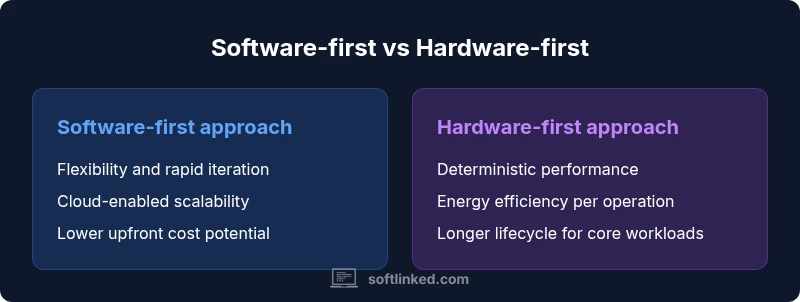
| Feature | Software-first approach | Hardware-first approach |
|---|---|---|
| Main driver of improvement | Flexibility and rapid iteration | Specialized performance and longevity |
| Upfront and ongoing costs | Lower upfront due to licensing and cloud consumption | High upfront hardware costs; upgrades often hardware-bound |
| Scalability | Elastic, cloud-enabled growth | Scale limited by hardware capacity but improvable with modular hardware |
| Maintenance effort | Patch updates and centralized control | Component replacements and firmware updates |
| Security posture | Patchable attack surface with centralized controls | Hardware-backed trust modules can enhance tamper resistance |
| Best for | Consumer apps, platforms, data-driven services | Deterministic workloads, high-throughput systems |
Pros
- Drives rapid innovation and time-to-market
- Reduces upfront capital through scalable software & cloud
- Enables flexible, data-driven decision-making
- Eases maintenance and patching through centralized updates
- Supports modular, platform-agnostic deployments
Weaknesses
- Ongoing licensing and cloud costs can grow
- Hardware lifecycles still constrain performance and upgrades
- Software complexity can introduce security and integration risk
- Vendor lock-in and ecosystem fragmentation are possible
Software-led design with targeted hardware is the most robust path.
A blended approach offers agility and efficiency. Start software-first to validate requirements, then layer in hardware only where it adds clear value, guided by total cost of ownership and risk considerations. The SoftLinked team endorses this hybrid strategy as it mitigates risk while preserving adaptability.
Your Questions Answered
Can software replace hardware entirely?
In practice, software can emulate many functions and reduce hardware demand, but some workloads require dedicated hardware for timing, energy efficiency, or physical constraints. A blended approach often yields the best balance between flexibility and performance.
Software can replace some hardware functions, but not all. For critical performance needs, hardware is still essential.
When is hardware upgrade necessary?
Hardware upgrades matter when workloads demand predictable latency, high throughput, or energy efficiency that software alone cannot achieve. If performance ceilings are reached or physical constraints become binding, hardware investments are justified.
Upgrade hardware when performance or reliability hit a ceiling that software alone can’t beat.
How do cloud and virtualization affect this debate?
Cloud and virtualization shift cost and risk from capital expenditure to operating expenditure, enabling elastic software scaling. They also blur the line between software and hardware by abstracting hardware details and enabling software-driven optimization across heterogeneous resources.
Cloud and virtualization let software scale and adapt more easily, changing how you choose hardware.
What about security implications?
Security must be assessed for both layers. Software patches address known vulnerabilities, while hardware security modules and trusted boot chains help protect integrity. A joint risk model reduces gaps across the stack.
Treat software and hardware security as a single landscape with shared risk management.
Are there cost advantages to software-vs-hardware decisions?
Cost benefits depend on workload, scale, and life cycle. Software often lowers upfront costs and accelerates time-to-market, but long-term licensing and cloud usage can accumulate. Hardware can offer long-lived stability, but with higher initial investment.
Costs depend on how you balance upfront investments with ongoing expenses.
What are future trends in software vs hardware?
Expect deeper integration of software with specialized hardware accelerators, more virtualization, and AI-accelerated optimization. The boundary will continue to blur, favoring architectures that leverage software agility alongside targeted hardware improvements.
The trend is toward smarter software that leverages hardware accelerators as needed.
Top Takeaways
- Start with software to maximize flexibility
- Use hardware selectively for determinism and throughput
- Evaluate total cost of ownership across the lifecycle
- Design with modular interfaces for easier upgrades
- Balance risk with governance and phased pilots