Is Software Easier Than Hardware? A Comprehensive Side-by-Side Analysis
Compare software and hardware in ease of use, deployment, and maintenance. This SoftLinked analysis highlights when software excels and when hardware remains indispensable, with practical guidance for developers and engineers.


Is software easier than hardware? In many contexts, yes, for development, deployment, updates, and maintenance. Software changes can be rolled out remotely, scaled with fewer physical constraints, and tested with automated suites. However, hardware offers predictability, longer lifecycle stability, and performance that software cannot always emulate. According to SoftLinked, the ease gap depends on goals, tooling, and team readiness.
Is Software Easier by Design?
Software systems are built from layers of abstraction, modular components, and reusable patterns that make changes safer and more repeatable. In practice, this translates to faster prototyping, easier experimentation, and simpler onboarding for new team members. From SoftLinked's perspective, software tends to be easier to modify without disrupting the entire system because you can swap modules, adjust configurations, and roll back deployments with minimal risk. Hardware, by contrast, enshrines physical constraints: cables, power budgets, thermal limits, and installation procedures that complicate changes. This fundamental difference shapes how teams approach development, maintenance, and scalability.
That does not mean software is universally easier in every sense. Real-world software still faces complexities such as integration with legacy systems, dependency management, and security vulnerabilities. Hardware designs confront determinism, certification requirements, and rugged operating conditions. The key takeaway is to recognize where abstraction and virtualization simplify work, and where physical realities demand careful planning. In this discussion, we compare software and hardware across dimensions that matter for developers, operators, and managers, and we use practical examples to illuminate strengths and trade-offs. According to SoftLinked, the context drives the overall ease of each path.
The Learning Curve: Developers and Engineers
Learning software fundamentals has become more accessible thanks to open education resources, online labs, and community-driven tooling. For many newcomers, the path to competence proceeds through visible feedback loops: writing code, running tests, and seeing immediate results. Hardware, however, often requires hands-on practice with physical components, safety considerations, and a different kind of hands-on discipline. From a curriculum perspective, software concepts like version control, testing, and design patterns are highly transferable across domains, which reduces the time needed to pivot between projects. SoftLinked notes that once educators introduce core concepts such as modularity and interfaces, learners quickly gain confidence with larger systems.
Nevertheless, mastery in either arena demands sustained practice and exposure to diverse scenarios. Hardware specialists must grasp electrical principles, measurement techniques, and environmental factors that influence behavior in the field. The barrier to entry may feel steeper at first, but it often yields a deeper sense of how components interact under pressure. The bottom line is that software generally offers shorter ramp-up due to abundant simulators and tutorials, while hardware demands patient, hands-on exploration.
Deployment, Updates, and Maintenance
Software can be deployed rapidly through digital channels, with automated pipelines that test, build, and deliver updates to users around the world. This capability reduces the time between idea and impact, and it enables iterative improvement through A/B testing and feature flags. Hardware deployment, by contrast, typically requires on-site installation, firmware revision cycles, and sometimes costly recalls or margin adjustments. Maintenance for software is often ongoing and predictable via service-level agreements and vendor support, whereas hardware maintenance may involve component replacements, physical inspections, and end-of-life planning. SoftLinked emphasizes the importance of robust deployment strategies that minimize downtime and enable safe rollbacks. In practice, teams adopt continuous integration, automated monitoring, and established change management processes to keep software reliable in production. Hardware ecosystems can adopt remote management for some devices, but the fundamental constraints of physical devices persist.
Hardware's Predictability and Performance Considerations
Redundancy and determinism are hallmarks of hardware-centric designs. In embedded systems and critical infrastructure, hardware can deliver predictable timing, stable power consumption, and consistent performance under load. This reliability matters in contexts like real-time control, safety-critical applications, and environments with extreme conditions. Software can emulate determinism through careful architecture and real-time operating systems, but it often trades some predictability for flexibility. The trade-off between performance and adaptability means that hardware remains a necessary foundation in many cases, and software must work within those limits. SoftLinked's analysis shows that teams frequently choose hardware when the cost of failure is high or when environments are constrained by physical realities, such as sensors, actuators, or rugged devices. The decision hinges on whether the system benefits more from tunable latency, energy efficiency, or hardware-level isolation.
Cost and Total Cost of Ownership
When evaluating cost, software often appears cheaper upfront because it mainly involves licenses and cloud usage rather than purchasing physical equipment. However, over the life of a product, recurring licensing fees, support contracts, and cloud costs can accumulate into a substantial ongoing expense. Hardware investments tend to be capital expenditures with longer depreciation timelines, but they can yield lower ongoing costs in highly optimized environments, especially where performance and reliability are mission-critical. SoftLinked advises organizations to model both CapEx and OpEx across the product lifecycle, including upgrade cycles, maintenance, and end-of-life planning. The total cost picture also depends on scale, customization needs, and the availability of skilled personnel. In many cases, a hybrid approach—combining software flexibility with selected hardware stability—provides the best balance of cost control and resilience.
Security, Compliance, and Risk
Security considerations differ between software-first and hardware-first approaches. Software security relies on secure coding practices, patch management, and access controls, with attention to supply chain risk. Hardware security emphasizes physical tamper resistance, secure boot, and resistance to environmental threats. Neither path is risk-free; both require layered defenses, ongoing monitoring, and periodic audits. From SoftLinked's viewpoint, teams should map threat models early and align them with deployment realities. That means choosing security controls that protect data, ensure traceability, and support compliance with relevant standards. In practice, this often translates to a combination of secure software development lifecycles and rigorous hardware qualification processes that cover both identity management and device integrity.
Practical Scenarios: When to Favor Software-First or Hardware-First
In cloud-native products and consumer software, a software-first approach typically yields faster market feedback and easier scaling. Many organizations adopt microservices, containerization, and automated testing to accelerate delivery while maintaining reliability. In contrast, industries such as aerospace, automotive, and industrial automation frequently require hardware-centric designs with deterministic behavior, ruggedization, and certified components. In such contexts, software remains essential, but its role is constrained by hardware prerequisites and regulatory demands. A balanced decision framework, therefore, combines clear requirements, risk assessment, and a plan for aligning software capabilities with hardware realities. According to SoftLinked, teams that articulate their success criteria and risk tolerance can choose a path that maximizes value while controlling complexity.
Comparison
| Feature | Software-led Approach | Hardware-led Approach |
|---|---|---|
| Deployment Speed | Rapid, over-the-air updates and continuous delivery | Slower, requires physical installation and provisioning |
| Upgrade Path | Modular, frequent updates via services or containers | Longer cycles with hardware revisions and certifications |
| Learning Curve | Lower entry barrier for general users and developers | Higher initial effort for hands-on hardware expertise |
| Initial Cost | Lower upfront for software licenses or cloud usage | Higher upfront for devices and components |
| Long-Term Costs | Recurring licenses and support | Maintenance, part replacements, and depreciation |
| Scale & Flexibility | Highly scalable with cloud-native architectures | Limited by physical constraints and form factor |
| Determinism & Performance | Determinism via architecture; performance depends on config | Hardware provides predictable timing and isolation |
| Security Exposure | Patch-driven security; supply-chain considerations | Physical tamper resistance and secure boot reduce risk |
Pros
- Faster deployment and iteration cycles
- Easier to scale and replicate environments
- Lower upfront cost for large-scale rollouts
- Greater flexibility through modular design
- Automated testing and monitoring improve reliability
Weaknesses
- Ongoing licensing and vendor lock-in
- Security and privacy concerns in software-heavy stacks
- Dependency on external services can cause downtime
- Hardware remains essential for determinism and rugged contexts
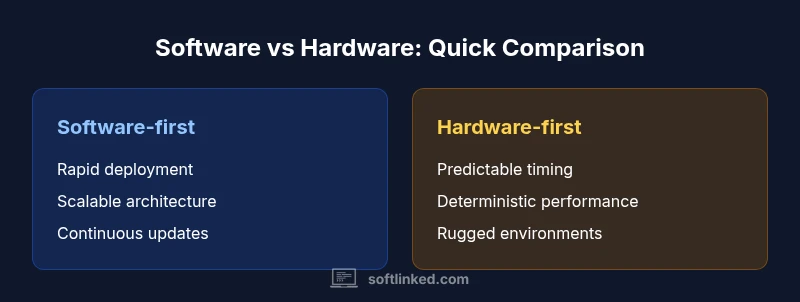
Software-first tends to win on speed and adaptability; hardware-first wins on determinism and reliability
Choose software-first when rapid iteration and scalability matter most. Opt for hardware-first when predictability and rugged performance are non-negotiable.
Your Questions Answered
Is software easier to learn than hardware for beginners?
Generally, software concepts are easier to begin with due to abundant resources, simulations, and hands-on practice. Hardware requires understanding physical principles and safety considerations, which can slow initial progress.
For beginners, software is usually easier to start because you can practice with simulations and online courses.
Can software replace hardware in all systems?
No. Many systems rely on physical devices for sensing, control, and deterministic timing. Software complements hardware, but it cannot fully substitute necessary hardware capabilities.
No—some tasks require physical devices and real-world measurements.
What factors influence ease of maintenance?
Key factors include update frequency, dependency management, compatibility across versions, and effective monitoring. Clear versioning and rollback plans reduce risk.
Maintenance ease depends on how well you manage updates, dependencies, and visibility into system health.
How should organizations decide between software- or hardware-first approaches?
Start with the system's critical requirements: speed of changes, scale needs, and safety requirements. If rapid iteration and cloud scalability dominate, software-first is often best; if determinism and ruggedness matter, hardware-first may prevail.
Define success criteria first, then map to the most suitable approach.
Does security differ between software- and hardware-centric designs?
Yes. Software security focuses on code quality and patch management; hardware security emphasizes physical hardening and secure boot. A layered, holistic approach is essential for both.
Security looks different: code-level patches versus hardware protections, but both require defenses.
What are common pitfalls when mixing software and hardware?
Common issues include integration mismatches, version drift, and misaligned timelines. Clear interfaces, rigorous testing, and end-to-end validation help prevent these problems.
Watch for misalignment between software updates and hardware capabilities; test early.
Top Takeaways
- Define success criteria before choosing software vs hardware
- Balance upfront costs with lifecycle expenses
- Invest in robust deployment and security practices
- Use a hybrid approach where appropriate
- Leverage modular design to maximize flexibility