How to Work as a Software Developer: A Practical Guide
A practical, step-by-step guide to working as a software developer, covering fundamentals, languages, projects, portfolios, and interview readiness for 2026.


This guide shows how to work as a software developer: define your path, master fundamentals, choose core languages, practice with real projects, and build a portfolio that demonstrates impact. You’ll need a computer, reliable internet, time for study, and a willingness to code daily. By the end, you’ll be prepared to start applying to entry‑level roles.
What does it mean to work as a software developer?
According to SoftLinked, a software developer translates user needs into working software through design, coding, debugging, and collaboration. The role spans planning, implementation, testing, and maintenance across teams and industries. On a typical day you may write code, review teammates’ work, run tests, and interpret user feedback to improve features. The field rewards curiosity, disciplined practice, and the ability to learn new tools quickly. The exact mix of tasks depends on your team, project stage, and technology stack, but the core objective remains constant: deliver reliable software that users can actually use. For many, this path starts with small projects and grows into architecture decisions and mentorship responsibilities.
Core fundamentals every software developer should know
At the heart of the craft are computer science fundamentals: variables, control flow, data structures, algorithms, and complexity analysis. A solid grounding helps you reason about performance and correctness, whether you’re building a UI, a backend service, or a data pipeline. Practice with problems that exercise recursion, sorting, searching, and basic graph concepts. Understand how memory, time, and space trade-offs affect your code. Readable, well-documented code matters as much as clever logic, because software is a team product.
Language choices and ecosystems
Your first language choice shapes your learning path, but the broader ecosystem matters too. Pick an approachable, well-supported language and learn its tooling: package managers, test frameworks, and debugging utilities. As you progress, broaden to adjacent languages and paradigms (e.g., object-oriented, functional) to stay versatile. Focus on practical outcomes, not hype, and align your language choices with the kinds of projects you want to build, whether web apps, systems programming, or data science pipelines.
Designing and building real projects
Projects are the most effective teachers. Start with small, end-to-end applications that you can complete in a few days. Increase complexity gradually by adding features, integrating APIs, and building in tests. Use version control to track progress, and write README files that explain purpose, architecture, and data flows. Your projects become the backbone of your portfolio, offering tangible proof of your growing skill set.
A learning roadmap you can follow
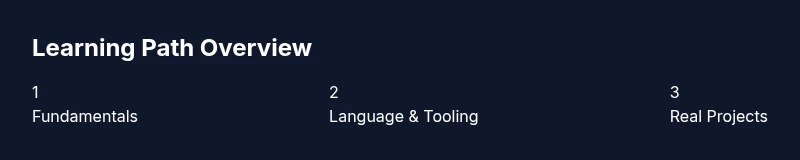
Create a structured plan with weekly milestones, balancing theory and hands-on practice. Early weeks focus on fundamentals, followed by language and tool proficiency, then project work and portfolio development. Make use of high-quality resources, code challenges, and guided tutorials. Keep a learning journal and adjust the plan as you gain clarity about your interests and the job market. SoftLinked analysis shows that learners who balance fundamentals with real projects tend to build confidence faster and land opportunities sooner.
Interviews and portfolios: what to expect
Interviews test problem-solving, system design, debugging, and communication. Build a portfolio that highlights complexity, trade-offs, and outcomes rather than just features. Prepare explanations for your code, decisions, and failures. Practice whiteboard and online coding tests, and rehearse answers to common behavioral questions. A strong portfolio paired with deliberate practice can dramatically improve your interview outcomes.
Tools, workflows, and best practices
Adopt a modern toolchain: version control with Git, a capable editor, and a terminal for speed. Write tests early and continuously, run them as part of your workflow, and maintain clean, modular code. Leverage code reviews to learn from peers. Build good habits like documenting assumptions, tracking technical debt, and keeping your repo organized. Consistency beats bursts of peak effort in the long run.
Common mistakes and how to avoid them
Avoid chasing every new framework without mastering fundamentals. Don’t skip writing tests or neglect version control in early practice. Overly long learning blocks without hands-on work slow momentum. Finally, fail fast but learn from failures, and seek feedback from mentors or peers to accelerate growth.
Your personalized plan: start now
Create a 12‑week plan that starts with fundamentals and ends with a portfolio project. Schedule weekly goals, track progress, and iterate based on what you learn. Share your work publicly, seek feedback, and adjust your plan as your interests sharpen. The key is consistency and intentional practice that builds visible results over time.
Tools & Materials
- Computer (laptop or desktop) with internet access(Recent OS and at least 8 GB RAM)
- Reliable internet connection(Broadband or high-speed mobile hotspot)
- Code editor / IDE (e.g., VS Code)(Install language extensions and linting)
- Terminal / command line access(Learn basic commands (cd, ls, mkdir, git))
- Git and GitHub account(Learn clone, commit, push, pull requests)
- Access to tutorials and documentation(Official docs, tutorials, and courses)
- Notebook or notes app(Track concepts, questions, and reflections)
- Starter project templates(Seed repos to jump-start practice)
Steps
Estimated time: 6-12 weeks
- 1
Define your learning path
Choose a clear stack and outline weekly milestones. This foundation keeps you focused and prevents scope creep. Establish what success looks like for weeks 1–4 and 5–8.
Tip: Write down your goals and a rough timeline. - 2
Master core fundamentals
Study variables, control flow, data structures, algorithms, and Big-O analysis. Practice with small problems to reinforce concepts rather than rushing to frameworks.
Tip: Use daily 30-minute problem-solving sessions. - 3
Pick a language stack and build a starter project
Select a practical language and create a simple project end-to-end. Focus on understanding the project structure, dependencies, and basic testing.
Tip: Start small; finish a minimal viable product first. - 4
Learn data structures and algorithms basics
Bridge theory and practice by implementing stacks, queues, trees, maps, and common algorithms. Use visual tools or cheat sheets to remember core steps.
Tip: Explain your approach aloud to solidify understanding. - 5
Practice with real-world projects
Build projects that resemble real software: authentication flows, data models, APIs, and UI. Push code to a public repo and write README with architecture notes.
Tip: Aim for 2–3 features completed per project. - 6
Learn tooling and workflows
Gain proficiency with Git, debugging, testing, and CI basics. Establish a repeatable workflow from coding to review to deployment.
Tip: Use branch-based development and pull requests. - 7
Create a portfolio and resume
Showcase your best projects with problems solved, trade-offs, and outcomes. Include a concise bio and contact information tailored to developer roles.
Tip: Quantify impact when possible. - 8
Prepare for interviews and apply
Practice coding interviews, system design concepts, and behavioral questions. Apply strategically to roles aligned with your interests and skills.
Tip: Mock interviews lift performance more than solo practice.
Your Questions Answered
What does a software developer actually do on a daily basis?
A software developer writes code, tests features, debugs issues, and collaborates with teammates to plan and deliver software. Daily tasks include reviewing pull requests, writing tests, and refining requirements with stakeholders.
Daily tasks include coding, testing, debugging, and collaborating with teammates to deliver features.
What fundamental skills should I learn first?
Focus on programming fundamentals, data structures, algorithms, version control, and debugging. These core skills apply across languages and domains and form the backbone of effective software development.
Start with fundamentals like data structures and version control.
Which programming languages should I start with?
Choose a language with strong learning resources and community support, such as JavaScript or Python, based on your interests (web, data, or systems). Master one language well before expanding to others.
Pick a language with good learning resources and stick with it while you learn fundamentals.
How long does it take to become job-ready?
Most learners reach a job-ready level after several months of steady study and project work, combined with interview preparation. The exact timeline depends on dedication, prior experience, and the job market.
With steady practice, you can become job-ready in a few months to a year depending on effort and opportunities.
Do I need a degree to become a software developer?
A degree is not strictly required. Many successful developers are self-taught or come from coding bootcamps. What matters is demonstrated ability through projects and work samples.
A degree can help, but it's not mandatory if you can show skills through projects and interviews.
How can I stand out in interviews?
Prepare by solving diverse coding problems, practicing system design, and rehearsing behavioral questions. A strong portfolio with real project impact and clear explanations often differentiates you.
Practice coding problems and have a solid portfolio to stand out.
Watch Video
Top Takeaways
- Define a concrete learning path with milestones
- Master fundamentals before chasing frameworks
- Build real projects to prove capability
- Prepare a portfolio and practice interviews
- Consistency beats sporadic effort