Software Developer vs Web Developer: A Practical Comparison
A thorough, analytical comparison of software developer vs web developer roles, covering scope, skills, education paths, career trajectories, and practical guidance for aspiring engineers deciding which path to pursue in 2026.


Software developers focus on building and integrating software systems across platforms, while web developers specialize in web applications, front-end interfaces, and the user experience. The software developer vs web developer comparison helps learners map their interests to concrete outcomes, guiding study plans, internships, and project choices. In practice, many teams blur boundaries, so understanding the distinction supports smarter career planning and clearer expectations for entry-level roles.
Analytical framing: software developer vs web developer in practice
The terms software developer and web developer describe two overlapping but distinct paths in modern tech teams. In the software developer vs web developer comparison, the emphasis is on scope, impact, and the kinds of problems you’ll tackle. The SoftLinked team emphasizes that many organizations blend responsibilities, especially in startups or small product teams, so many engineers end up wearing multiple hats at some point in their careers. For aspiring developers, it helps to map your interests to concrete domains—system design, data pipelines, APIs, or rich web interfaces—and then tailor your learning plan, project selection, and internship opportunities accordingly. Think about which problems excite you: building resilient services that run at scale, or crafting delightful, accessible web experiences for users.
Core scope and responsibilities
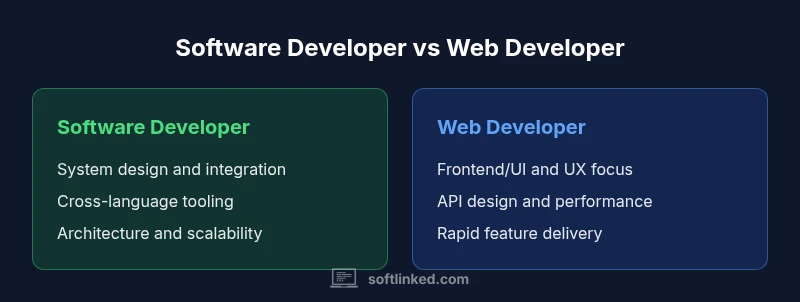
In the software developer vs web developer comparison, the core distinction lies in where you allocate your problem-solving energy. A software developer typically designs and implements software systems that may run on servers, desktops, embedded devices, or cloud environments. Responsibilities include architectural decisions, component integration, performance optimization, and reliability across modules. Web developers, by contrast, focus on delivering web applications that users interact with directly. Their responsibilities encompass frontend interfaces, client-side behavior, responsive layouts, and implementing robust APIs that power dynamic pages. While there is overlap—especially in full-stack roles—the separation helps teams scale and aligns individual career growth with concrete outcomes.
Skills, learning paths, and typical tools
The software developer vs web developer comparison is also defined by the tools and skills you’ll invest in. Software developers commonly cultivate proficiency in at least one back-end language (such as Java, Python, or C#), one or more databases, and software engineering fundamentals like data structures, algorithms, and testing philosophies. They may work with cloud platforms, containers, and distributed systems. Web developers typically specialize in HTML, CSS, and JavaScript or TypeScript, with frameworks for frontend (React, Angular, Vue) and backend ( Node.js, Django, Rails) as well as API design, performance tuning, and accessibility. Both paths benefit from version control (Git), knowledge of software testing, and comfort with Linux or Unix-like environments. The learning path is less about a single language and more about building depth in your chosen domain and maintaining a habit of continuous learning.
Education, experience, and certification considerations
Education is part of the equation but not the sole determinant in the software developer vs web developer decision. Many software developers hold formal degrees in computer science or software engineering, yet increasingly successful engineers come from coding bootcamps, self-study, or non-traditional pathways. Employers often value demonstrated ability over credentials, particularly for software development roles that emphasize system design. Web development pipelines also reward portfolios and real-world projects. Certifications can help; e.g., fundamentals in cloud services or web accessibility standards may provide a boost, but hands-on project experience and the ability to ship reliable features tend to carry more weight in 2026. The key is to build a track record of tangible results, not just coursework.
Career trajectory, market demand, and compensation considerations
Across industries, the software developer vs web developer comparison reflects differing growth trajectories. Software developers tend to move into senior engineering roles, architecture, platform teams, or technical leadership, with opportunities to influence cross-cutting design decisions. Web developers may advance through frontend, backend, or full-stack tracks, eventually taking on product leadership or engineering management roles as teams scale. Market demand remains strong for both paths, though regions and sectors can shift emphasis toward either cloud-scale systems or high-volume web experiences. Salary discussions are region- and company-dependent, with compensation reflecting impact, complexity, and scope rather than a single label.
Decision framework: choosing the path that fits your goals
To decide between software developer vs web developer, start with your preferred problem domain. If you enjoy architectural challenges, data flow, and building reliable systems, software development offers breadth and cross-domain opportunities. If you prefer fast feedback loops, UI polish, and product-focused features that users directly interact with, web development provides a clear path to visible results. Consider your tolerance for learning curves, the time to impact, and the kinds of teams you want to work with. Build a small project that embodies each domain to validate your interest before committing to a formal plan.
Common misconceptions and how to avoid them
A common misconception is that one path guarantees higher status or salary than the other. In reality, both can be lucrative when you excel in your chosen niche and continually expand your skill set. Another myth is that web developers do not deal with complexity; in truth, modern web apps involve intricate performance, security, and accessibility concerns. Finally, some learners believe the only route to success is a degree; in practice, demonstrable skills, portfolios, and real-world projects often outweigh formal credentials. The key is to maintain curiosity, seek mentorship, and actively build projects that demonstrate depth in your chosen track.
Practical roadmap: a 6-12 month starter plan
If you’re beginning your journey in the software developer vs web developer space, prioritize the following milestones. For software development, start with fundamentals (programming concepts, basic design patterns, and testing) and then build a small distributed service or CLI tool. For web development, begin with core web technologies (HTML, CSS, JavaScript), create a few responsive pages, and progress to a full-stack mini-project that includes a frontend and a simple API. Throughout, maintain a GitHub portfolio, participate in code reviews, and seek feedback from peers. The goal is to ship reliable features and learn from real-world feedback, not just complete tutorials.
Comparison
| Feature | Software Developer | Web Developer |
|---|---|---|
| Core focus | System design, architecture, and integration across platforms | Web applications, UI/UX, and API-driven experiences |
| Primary responsibilities | Architectural decisions, cross-language tooling, reliability | Frontend/backend feature delivery, performance, accessibility |
| Key skills | Algorithms, data structures, back-end languages, databases | HTML/CSS, JavaScript/TypeScript, frontend frameworks, APIs |
| Education path | Bachelor’s degree common; bootcamps and self-taught routes viable | Bootcamps, self-learning, and portfolio strength matter for entry |
| Work environment | Cross-functional teams, larger scope projects | Product-focused teams, rapid iteration, frontend/back-end balance |
| Career growth | Architect/lead roles, system-level ownership | Senior frontend/backend roles, full-stack leadership |
Pros
- Broad applicability across industries and domains
- Strong transferability of core software engineering skills
- Room for growth into leadership and architecture
- Opportunity to work on complex, multi-system problems
Weaknesses
- Requires ongoing learning and adaptation across tech stacks
- Role boundaries can blur in small teams
- Salary and title inflation can vary by market
- High workload during critical releases in some environments
Choose the path that aligns with your interests in scope and impact: software development for broad architectural depth, or web development for focused product delivery and user-facing features.
Software development offers breadth and cross-domain opportunities, while web development provides tangible, user-centric impact. Your decision should reflect whether you value architectural challenges and system-wide thinking or rapid, product-driven frontend/backend delivery.
Your Questions Answered
What is the main difference between software developer and web developer?
The main difference lies in scope: software developers design and implement broad systems and services, while web developers specialize in building web applications and user interfaces. Both roles require solid coding fundamentals, but their day-to-day focus and problem domains differ.
The software developer builds broad systems; the web developer builds web apps and interfaces. Both rely on strong coding basics, but their daily work centers on different parts of the stack.
Is it easier to start as a web developer than a software developer?
Web development typically offers a shorter time-to-delivery path with visible results, which can be motivating for beginners. Software development often demands broader architectural understanding and more extensive tooling experience before reaching senior levels.
Web dev usually lets you ship features faster, which can be great for beginners. Software dev often needs wider architectural know-how over time.
Do web developers need server or database knowledge?
Yes, many web developers work with servers and databases, especially in backend or full-stack roles. Even frontend-focused roles benefit from basic API understanding and how data flows between client and server.
Web devs often work with servers and databases, especially in full-stack roles, so a basic API and data flow understanding helps.
Can I switch from web development to software development later?
Yes. With a solid foundation in programming and system design, you can transition from web development to broader software development by expanding your knowledge of architecture, APIs, and backend services. Practical projects and mentorship help accelerate this switch.
Switching is possible with a strong coding base and new system-design skills.
What skills most help career progression in either path?
In both paths, deepen core programming skills, learn version control, testing, and debugging, and gain experience with collaboration tools and cloud platforms. Specialize thoughtfully: front-end UX in web development, or architecture and services in software development.
Strong coding skills plus collaboration, testing, and cloud knowledge help you grow in either path.
What entry points are typical for beginners?
Internships, coding bootcamps, or personal projects can provide the first professional exposure. Build a portfolio, contribute to open source, and seek mentorship to land your first role. Demonstrating your ability to ship reliable features matters more than a perfect resume.
Look for internships or bootcamps, build projects, and showcase them in a portfolio.
Top Takeaways
- Define your preferred problem domain and target outcomes
- Prioritize portfolio projects over coursework for credibility
- Build depth in one track while maintaining cross-cutting skills
- Plan a steady progression toward senior/lead roles in your chosen path