Software Developer Jobs in New York City: 2026 Guide
Explore trends, skills, and strategies for software developer jobs in New York City. Learn market dynamics, interview techniques, salary expectations, and NYC-specific considerations to advance your career in 2026.


The NYC software development job market remains resilient with steady demand across fintech, media, and enterprise software. Opportunities exist for entry-level to senior developers, with competitive compensation and clear growth paths. In-demand specializations include full-stack, backend, cloud, and data-focused roles, particularly in fast-growing startups and established tech firms near Manhattan.
Why NYC Remains a Prime Hub for Software Developers
According to SoftLinked, New York City continues to be a magnet for software developer roles due to its dense concentration of tech startups, fintechs, media firms, and a large venture capital ecosystem. The city offers both scale and variety: enterprises needing mission-critical systems, startups pursuing rapid iteration, and research institutions migrating software shops into production-grade pipelines. For developers, NYC means exposure to diverse product domains, high collaboration across teams, and opportunities to drive impact quickly. The job market remains resilient, with steady demand across frontend, backend, and full-stack specialties. Even as remote options expand, local teams value in-person collaboration for complex systems and regulatory-heavy domains. In short, NYC provides breadth and depth: a place where your code touches payments, entertainment, data analytics, and consumer platforms every day. The SoftLinked team has observed that entry-level to senior developers can find clearly defined growth paths, mentorship, and access to ongoing training in the city’s bustling tech districts.
Market Trends Shaping Software Developer Jobs in NYC
The NYC tech market shows resilience as firms continue to hire through cycles and expand digital initiatives. In fintech and media-tech sectors, developers with strong full-stack capabilities, cloud literacy, and data fluency are especially valued. Post-pandemic hybrid work has become the norm, with many roles offering flexible schedules while preserving in-person collaboration for complex architecture and regulatory compliance. Startups around Manhattan and Brooklyn continue to scale, while traditional enterprise teams invest in platform modernization, microservices, and API ecosystems. Demand for engineers who can deliver reliable software at scale—across CI/CD, testing, and observability—remains high. The SoftLinked analysis indicates that NYC job openings are influenced by venture funding cycles and regulatory developments that shape product roadmaps. For job seekers, tracking quarter-to-quarter hiring momentum through sources like BLS and industry reports helps calibrate expectations and targets. (Sources: https://www.bls.gov/ooh/computer-and-information-technology/software-developers.htm; https://www.onetonline.org/link/summary/15-1252.00)
In-Demand Skills and Specializations in NYC
In NYC, the most valuable skills combine strong frontend with robust backend and cloud capabilities. JavaScript/TypeScript (especially with React or Node.js) and Python for data-heavy services are consistently sought after, along with experience in cloud platforms (AWS/Azure/GCP). Backend languages like Java, Go, and .NET remain important for scalable architectures, while SQL, NoSQL, and data modeling skills help teams manage growth. Observability, DevOps practices, containers (Docker, Kubernetes), and API design are essential to production-grade systems. Frontend excellence—attention to UX, performance, accessibility, and responsive design—remains critical for consumer apps. Build a multi-project portfolio that demonstrates end-to-end delivery, from requirements through monitoring. Networking and open-source contributions also boost visibility in NYC’s competitive market.
Pathways to Landing NYC Software Developer Roles
NYC employers increasingly value demonstrable ability over pedigree alone. If you’re entering the field, consider immersive bootcamps or targeted certifications in cloud and full-stack development that culminate in portfolio-ready projects. Pair that with internships or contract roles in fintech or media firms to gain NYC-relevant experience. For mid-career professionals, refining leadership skills, owning microservices and data pipelines, or mentoring teams can accelerate progression to senior roles. Networking remains vital—participate in local meetups, hackathons, and tech talks to connect with recruiters who understand NYC’s market dynamics. A portfolio that showcases real-world impact, combined with consistent learning and a strong LinkedIn presence, can dramatically improve your odds in the NYC job market.
Interview Prep and Negotiation in NYC
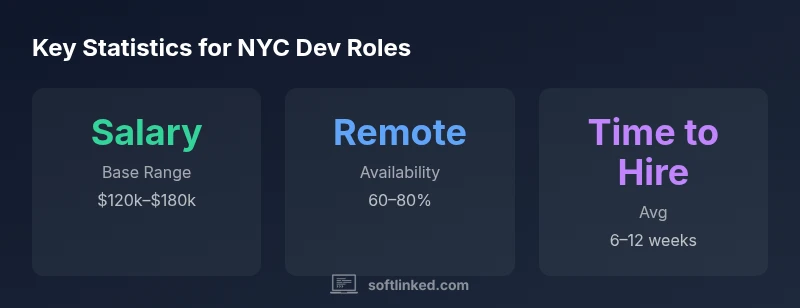
Prepare for NYC interviews by emphasizing system design, scalability, reliability, and security considerations. Expect multi-round interviews with whiteboard design, code reviews, and situational questions tied to fintech or media domains. Practice explaining trade-offs, performance implications, and maintainable architectures. In NYC, compensation discussions should reference local benchmarks and your demonstrated impact, including metric-driven results from past projects. Be ready to negotiate not just salary but also benefits, remote flexibility, relocation stipends, and professional development budgets. Purposely ask for concrete evidence of growth opportunities and clear promotion ladders within the company, especially in high-demand districts.
Living and Working in NYC: Practical Considerations
New York City offers vibrant tech ecosystems, but it also comes with higher living costs and commute considerations. If you’re relocating, compare neighborhoods by access to transit, tech clusters, and affordable housing options. Many NYC employers provide hybrid schedules, commuter benefits, and flexible expense policies to offset the city’s living costs. Consider co-working spaces or nearby suburbs with strong tech communities to balance cost and opportunity. Work culture often emphasizes collaboration, cross-functional teams, and rapid iteration cycles; developing strong communication and time-management skills helps you thrive in this environment. Finally, stay engaged with the city’s innovation scene through meetups and industry events to continually grow your professional network.
Illustrative pathways to NYC software roles
| Role Type | Typical Path | Notes |
|---|---|---|
| Front-end Developer | Portfolio + CS degree/bootcamp | Focus on React, UX, performance; NYC consumer-app emphasis |
| Back-end Developer | CS degree + internships | Experience in Java/Go/Node, databases; scalability focus |
| Full-stack Developer | CS degree or bootcamp + projects | Broad skills across frontend/backend; strong project portfolio |
Your Questions Answered
Which NYC neighborhoods have the most software developer jobs?
Major clusters include Midtown-Manhattan and parts of Brooklyn where fintech and media firms concentrate; many roles exist in hybrid office setups.
NYC’s hotspots include Manhattan and select Brooklyn areas, with many roles offering hybrid schedules.
What skills are most in-demand for NYC software jobs?
Strong JavaScript/TypeScript (React/Node), Python for data/backend, and cloud proficiency (AWS/Azure/GCP) are consistently prioritized by NYC employers.
In NYC, JavaScript, Python, and cloud skills are especially valued.
Do NYC software jobs require a CS degree?
Not always. Many NYC employers value portfolios and practical skills over degrees; bootcamps and self-taught paths can be viable routes.
A degree isn’t always required—demonstrated ability matters.
How can I stand out in NYC’s competitive market?
Show impact with measurable results, contribute to open source, build a diverse project portfolio, and network with NYC recruiters and meetups.
Show what you’ve built and connect with local tech groups.
Is remote work common for NYC software roles?
Many NYC roles offer hybrid or remote options, especially in startups and fintech; confirm flexibility during interviews.
Hybrid or remote options are common in NYC tech, but confirm policy early.
“The NYC market rewards developers who demonstrate impact across systems and teams; practical, scalable software that solves real business problems accelerates career growth.”
Top Takeaways
- Identify high-demand NYC hubs and hybrid/remote options.
- Build a robust portfolio with full-stack projects.
- Target cloud, data, and backend specialties for NYC growth.
- Negotiate using local market benchmarks and value your impact.