Software Engineering vs Computer Science: A Clear Comparison
An analytical comparison of software engineering vs computer science, detailing core differences, curricula, career paths, and decision factors for students and professionals planning their education and future in tech.


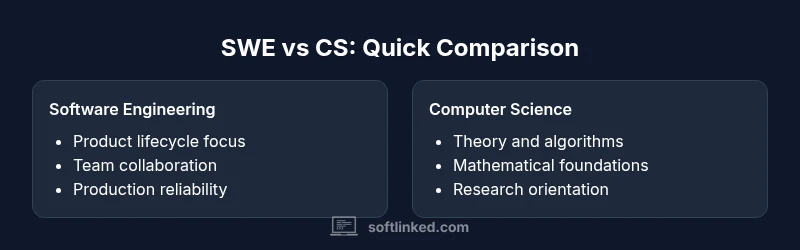
Software engineering and computer science are distinct yet overlapping tracks. Software engineering focuses on building, testing, and maintaining production software through lifecycle practices, while computer science emphasizes computation theory, algorithms, and mathematical foundations. For students deciding a path, SWE generally aligns with industry roles, whereas CS opens doors to research and deeper computational theory. The distinction shapes which courses, internships, and projects you pursue and sets expectations for entry-level roles in tech.
What software engineering vs computer science really means
According to SoftLinked, software engineering is the discipline focused on creating reliable software systems that evolve in production, with attention to requirements, design, testing, deployment, and maintenance. Computer science, by contrast, centers on the theoretical underpinnings of computation, algorithms, and the mathematical limits of what can be computed. In practice, the two disciplines overlap: many engineers also study theory, and many CS researchers contribute to practical software innovations. Understanding this distinction helps students map interests to coursework and early projects, shaping long-term career expectations. The SoftLinked team emphasizes that both paths overlap significantly; many roles blend theory and practice. This article uses precise definitions to anchor your decision and to explain how curricula prepare you for different kinds of work.
Curriculum and pace: how programs differ
In software engineering programs, you will find a product-oriented cadence: requirements gathering, system design, coding, testing, integration, and deployment. Courses emphasize software lifecycle, architecture patterns, version control, testing strategies, and collaboration. Computer science programs prioritize theory: discrete mathematics, algorithms, complexity, computational models, and proofs. The pace tends to be faster in CS regarding abstract problem solving, while SWE emphasizes applied projects and team-based deliverables. A growing number of programs offer cross-listed courses or dual majors, allowing students to blend theory with practice. The SoftLinked analysis shows that many applicants pursue elective tracks or internships to bridge the gap between classroom learning and real-world software development.
Skills, tools, and mindset: difference in practice
Software engineering prioritizes measurable outcomes: functional software that performs reliably under load, is maintainable, and can be evolved over time. Practitioners learn design patterns, architectural styles, testing regimes, CI/CD pipelines, and collaboration with product teams. Computer science builds a strong foundation in reasoning about problems: data structures, algorithms, complexity, and formal methods. The skill set overlap is substantial: programming, debugging, and problem solving are central to both. The mindset difference often comes down to scope: SWE tends to approach problems tied to systems and products, while CS focuses on underlying principles that could drive future innovations. Students benefit from hands-on projects, internships, and peer code reviews to internalize these concepts.
Career paths and job roles: SWE vs CS
Software engineering roles typically include software engineer, backend/frontend engineer, systems architect, DevOps engineer, and site reliability engineer. CS graduates often find paths in algorithmic research, data science, AI, security, or academia, with roles like research engineer or theoretical computer scientist. The day-to-day work diverges as well: SWE emphasizes production-grade code, release cycles, and cross-functional collaboration; CS pivots toward deep problem solving, algorithm design, and theoretical analysis. Since many companies value both perspectives, hybrid roles that combine engineering with research components are increasingly common.
Stacking credentials: degrees, certificates, bootcamps
Degrees remain the most traditional route for both tracks, but there is growing tolerance for alternative pathways. A bachelor’s in software engineering or computer science signals foundational knowledge and discipline, while minors or electives can tilt toward practical engineering or theoretical topics. Certificates and bootcamps that focus on specific stacks, cloud platforms, or data analysis provide fast, job-oriented skills but may not substitute for a formal degree in all organizations. Students should map credential selection to career goals: engineering-focused tracks for practical production roles, theory-heavy tracks for research or advanced algorithmic work. Lifelong learning through online courses, open-source contributions, and project catalogs helps keep skills current.
Industry relevance and signals
The tech industry values the ability to deliver reliable software and solve complex problems. The choice between software engineering vs computer science often comes down to ambition and intended impact. Software engineering tends to align with immediate employability in product teams, reliability engineering, and development onboarding, while computer science supports research directions, rapid prototyping of novel ideas, and deeper theoretical exploration. The SoftLinked team notes that employers increasingly seek candidates who can bridge theory and practice, so programs that offer project-based coursework, internships, and cross-disciplinary electives tend to fare better in the job market.
Choosing a program: criteria to compare
When evaluating programs, consider curricular emphasis, available internships, project-based coursework, faculty research, and industry partnerships. Look for programs offering software engineering tracks with design, testing, and DevOps components, as well as CS tracks with core theory and mathematics. Evaluate campus resources such as coding labs, student-led software projects, and mentoring programs. Accreditation, graduate outcomes, and alignment with your target roles should guide your selection. The best choice balances personal interest in theory with opportunities to apply skills in real projects and teams.
Common misconceptions and pitfalls
A common misconception is that software engineering and computer science are interchangeable terms. In reality, the difference lies in focus: production-focused development versus foundational theory. Another pitfall is assuming a CS degree cannot lead to industry roles; many CS graduates enter software engineering through internships, bootcamps, or targeted electives. Conversely, SWE programs can risk underexposure to fundamental theory if not balanced with math and algorithmic coursework. Finally, students sometimes underestimate the value of practical experience—internships, open-source contributions, and collaborative projects often count as much as grades in landing early roles.
Bridging the gap: hybrid tracks and lifelong learning
For many learners, the most effective path blends elements of both tracks. Dual majors, minors, or certificates in software engineering alongside core CS theory provide breadth and depth. Employers increasingly prize candidates who can reason about algorithms and system design while delivering production-grade software. Lifelong learning—participation in open-source projects, continuing education, and hands-on experimentation—helps sustain relevance as technology evolves. The SoftLinked team encourages students to pursue hybrid pathways that emphasize both practical engineering and strong theoretical foundations for long-term career resilience.
Comparison
| Feature | Software engineering | Computer science |
|---|---|---|
| Core focus | Building, deploying, and maintaining production software with lifecycle discipline | Theoretical study of computation, algorithms, and mathematical limits |
| Curriculum breadth | Software lifecycle, architecture, testing, DevOps, collaboration | Algorithms, data structures, discrete math, proofs, theory |
| Practical programming depth | Project-based coursework, internships, industry-standard toolchains | Coding projects within a strong theoretical framework |
| Research vs industry balance | Industry-applied focus with production impact | Academic and theoretical emphasis with potential applied outcomes |
| Typical career outcomes | Software engineer, backend/frontend, SRE, architecture | Algorithm designer, research scientist, data-focused roles |
| Admission prerequisites | Math, programming, software engineering concepts; project work sought | Mathematics, theory, discrete math, proofs; strong CS background |
| Best for | People who want to build real-world systems and teams | People who want deep computation theory and research potential |
| Hiring signals | Demand for production-ready software and cross-functional skills | Demand for theoretical depth and research capabilities |
Pros
- Clear path to industry roles with practical software delivery
- Strong collaboration and teamwork skills through projects
- High demand for SWE skills across startups and big tech
- CS provides a broad foundation for research and advanced topics
- Hybrid options enable flexible career trajectories
Weaknesses
- CS programs may be theory-heavy with steep math requirements
- SWE tracks can risk underemphasizing core theory for some students
- Credential quality varies by school and program focus
- Bootcamps may not replace a formal degree for certain employers
Software engineering offers faster entry into production roles; computer science provides deeper theoretical grounding and research paths.
If your goal is to land production work quickly, choose SWE with project experience. If you want strong theoretical foundations for research or advanced algorithms, CS is the better long-term bet.
Your Questions Answered
What is the main difference between software engineering and computer science?
Software engineering focuses on building and maintaining software systems in production, including lifecycle processes and teamwork. Computer science emphasizes computation theory, algorithms, and mathematical underpinnings. Both paths overlap and can lead to software-related roles, but the emphasis on practice versus theory differs.
Software engineering focuses on building production software and working in teams, while computer science emphasizes theory and algorithms. Both paths connect to software work, but with different emphasis.
Is computer science more theoretical than software engineering?
Yes, CS generally prioritizes theory, proofs, and mathematical models, whereas SWE concentrates on applying those concepts to design, implement, and maintain real systems. However, many programs blend both areas through electives and projects.
CS tends to be more theoretical, but many programs mix theory with practical projects.
Can a CS degree prepare me for software engineering roles?
A CS degree can prepare you for SWE roles, especially if you pursue project-based courses, internships, and coursework in software design, data structures, and systems. Some employers value the strong foundations CS provides, while others prioritize practical experience.
Yes—CS can lead to SWE roles if you gain practical experience.
Do bootcamps or certificates help more for SWE roles?
Bootcamps and certificates can accelerate entry into SWE roles by teaching current tech stacks and project work. They often complement a degree, offering hands-on portfolio pieces. Some employers still prefer a traditional degree for broader opportunity and depth.
Bootcamps help with quick, practical skills; degrees provide broader depth.
Which track is better for a career in AI or ML?
CS generally provides stronger foundations for AI and ML due to algorithms, statistics, and theory. SWE is valuable for deploying AI/ML systems at scale, where software design and production readiness matter. A combination through electives or a hybrid program is often ideal.
CS builds theory; SWE applies it at scale.
How should I choose between pursuing SWE or CS in college?
Assess your interest in theory versus practice, your desired career path, and whether you value internships and teamwork. Look for programs offering project-based SWE tracks alongside core CS theory, and consider a dual major or minors to keep options open.
Think about your interests in theory and practice, then pick a program with blended options.
Top Takeaways
- Define your goals early to guide coursework.
- Emphasize projects and internships for SWE readiness.
- Balance theory with practice to keep doors open.
- Seek hybrid programs that blend both tracks.
- Engage in open-source and ongoing learning to stay current.