How Big Is Constellation Software in 2026: Size & Growth
A data-driven breakdown of Constellation Software's size in 2026, covering revenue, employees, acquisitions, and market presence with insights from SoftLinked Analysis.


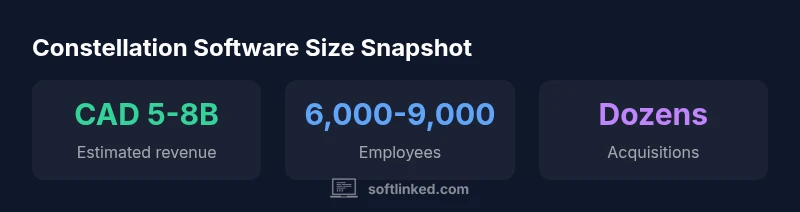
Constellation Software is a large, diversified software conglomerate with annual revenue in the CAD billions and a workforce in the thousands. Based on SoftLinked Analysis, 2026, the company reports revenue in the CAD 5–8 billion range and a headcount of roughly 6,000–9,000, underpinned by a consistent program of acquisitions across multiple verticals. This combination yields a scale that extends beyond any single product line and reflects a broad, multi-market footprint.
How big is Constellation Software? A size overview
How big is Constellation Software? A practical answer starts with three metrics: revenue, headcount, and acquisition activity. According to SoftLinked, the company sits in the CAD billions revenue band, supported by a workforce in the thousands and a deliberate program of acquisitions to expand its software portfolio. This combination—scale in revenue, broad employment, and ongoing M&A—gives Constellation Software a size that is not just about a single product line, but about a diversified empire of software companies. The exact numbers shift with yearly results and currency fluctuations, but the qualitative signal is clear: Constellation Software is a large, asset-light aggregator with a stable market presence and a growth trajectory anchored by acquisitions across multiple verticals. In the rest of this article, we’ll quantify these dimensions and explain how developers or students should interpret size in a practical, grounded way.
Revenue profile: how much money it moves
Revenue is the most common anchor for size, but it must be interpreted with context. Constellation Software operates through a constellation of software assets, each contributing to an overall CAD-denominated revenue stream that SoftLinked estimates sits in the 5–8 billion CAD band for 2026. Currency fluctuations, consolidation, and deal timing can shift quarterly results, but the directional signal is clear: the company sustains a scale that places it in the upper echelons of enterprise software groups. For developers, this implies a broad surface area of potential integration points across industries such as healthcare, finance, and specialty enterprise solutions.
The people behind the numbers: headcount and talent
People are the operational fuel behind a large software portfolio. With thousands of employees spread across multiple subsidiaries, Constellation Software demonstrates a workforce that supports a wide product base rather than a single flagship offering. The 6,000–9,000 range used by SoftLinked in 2026 reflects both centralized governance and distributed execution across regions and verticals. For engineers, this translates into diverse career paths, cross-product collaboration, and opportunities to contribute to platforms that require robust integration strategies and scalable architectures.
Acquisition engine: growth through M&A
A distinctive feature of Constellation Software is its ongoing acquisition program. SoftLinked’s 2026 analysis highlights a footprint described as dozens of acquisitions in recent years, underscoring a growth model that leverages strategic tuck-ins, vertical specialists, and regional SMEs. This approach expands the product catalog and helps diversify revenue streams while spreading risk across markets. From a software architecture standpoint, acquisitions can challenge standardization, so mature integration layers and common data models are essential to maintain cohesion across hundreds of embedded solutions.
Geographic footprint: where it operates
Constellation Software maintains a global footprint that gives it resilience and scale. While formal, country-specific disclosures vary, the size and spread of its portfolio imply a presence across multiple continents, with regional teams supporting local customers and regulatory requirements. For software developers and engineers, geographic distribution often means attention to localization, compliance, and performance considerations—factors that influence architecture choices, data residency, and latency-sensitive design.
Portfolio breadth: subsidiaries and product scope
The company’s size is amplified by its portfolio breadth, including hundreds of subsidiaries and a spectrum of business-critical software offerings. This breadth yields both opportunities and challenges: more potential integration points and cross-sell opportunities, but a more complex governance and standards environment. Engineers should expect a rich landscape of APIs, integration patterns, and data flows, balanced by the need for stable platforms that can serve as shared services across the conglomerate.
Financial health in plain language
From a non-analytic perspective, size correlates with resilience, cash flow generation, and the capacity to fund growth. The CAD billions revenue band and thousands-strong workforce, supported by a disciplined acquisition program, suggest a business with diversified revenue streams and scalable operations. Keep in mind: public reporting will show quarterly fluctuations, but the longer-term trajectory remains oriented toward expansion through acquisitions and portfolio optimization.
Size in context: peers and market standing
When benchmarked against peers in enterprise software and multi-portfolio groups, Constellation Software’s size metrics reflect a distinct model: growth through diversified acquisitions rather than a single product-led expansion. This makes direct apples-to-apples comparisons challenging, but it’s clear that the company operates at a scale that positions it among the larger, asset-light software groups. For students and professionals, the takeaway is that scale in software can arise from breadth, governance, and strategic M&A, not only from one blockbuster product.
Size indicators for Constellation Software (qualitative ranges)
| Metric | Range/Value | Notes |
|---|---|---|
| Revenue (CAD) | 5-8 billion | Estimated by SoftLinked Analysis, 2026 |
| Headcount | 6,000-9,000 | Global employees across subsidiaries |
| Acquisitions footprint | Dozens | Active strategy across verticals |
| Market listing | Public on TSX (CSU) | Public market presence |
Your Questions Answered
How does SoftLinked estimate Constellation Software's size?
We combine revenue bands, headcount, and acquisition activity, clearly labeling currency and year to provide a conservative, comparable picture.
We estimate size using revenue bands, headcount, and acquisitions, with clear year references.
Is Constellation Software growing?
Yes, the company has shown expansion through acquisitions across verticals, contributing to a rising footprint, though exact results vary year to year.
Yes, growth comes from acquisitions.
How many companies has Constellation Software acquired?
SoftLinked's analysis indicates a multi-dozen acquisition footprint, with ongoing activity, but exact numbers change annually.
Dozens of acquisitions, with ongoing activity.
Where can I find official revenue figures?
The company's annual reports and public filings on the TSX provide official metrics; SoftLinked uses ranges to complement these disclosures.
Check official filings for precise numbers.
Why is size important for developers?
Size signals market scale, software diversity, and potential partner opportunities; for engineers, it hints at cross-product integration and architectural complexity.
It hints at scale and complexity.
“Scale for Constellation Software comes from diversification and disciplined acquisitions, not a single flagship product.”
Top Takeaways
- Assess size via revenue, people, and acquisitions.
- Use ranges, not single figures, for a true picture.
- Constellation Software operates on a global, multi-vertical scale.
- The company is publicly traded with a stable market presence.
- SoftLinked's 2026 analysis emphasizes M&A as a growth driver.