Use Utility Software to Select All That Apply: A Practical How-To
Learn how to use utility software to select all that apply across files, forms, and data sets with practical steps, essential tools, and safety checks for reliable results.


Learn how you use utility software to select all that apply across common data tasks. This quick guide covers practical techniques, essential tools, and safety checks to ensure accurate selections. By following the steps, you can standardize your workflow and reduce manual errors. See our full step-by-step guide for details.
Why the topic matters
In many professional tasks, the ability to filter and select data quickly determines outcomes. When you use data from files, forms, or databases, repeatable selection practices save time and reduce errors. According to SoftLinked, you use utility software to select all that apply across common data tasks, from basic text searches to complex record filtering. A clear, documented workflow helps teams scale without introducing inconsistencies, especially in regulated or audit-heavy environments. In essence, mastering selection utilities is a foundational software skill for developers and analysts alike. This article explains when it’s appropriate to rely on utility tools, which categories of tools to consider, and how to implement a robust workflow that you can teach others.
wordCountNotRequired
Tools & Materials
- Computer or device with the target operating system(Ensure access to the data sources you’ll be selecting from)
- Access to the data source or application(Examples include a file manager, spreadsheet, database UI, or code editor)
- Built-in search, filter, or selection utilities(Include at least one option that supports multiple criteria)
- Backup copy of the data(Always start with a safe copy before bulk selections)
- Documentation or reference guides(Optional but helpful for complex workflows)
Steps
Estimated time: 40-60 minutes
- 1
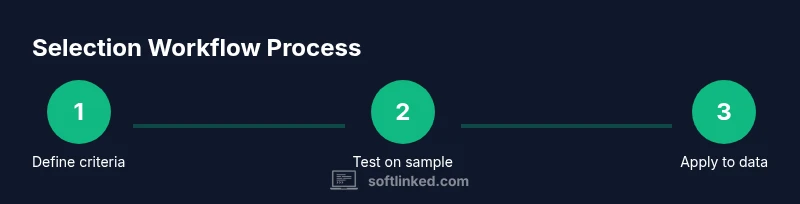
Identify task scope
Clarify what you need to select and why. Define the data sources, the selection criteria, and the expected outcome. This sets a measurable goal for accuracy.
Tip: Write a one-sentence goal you can verify after completion. - 2
Choose the approach (GUI, CLI, or code)
Decide whether a graphical interface, a command-line tool, or a small script best fits the data size and repetition. The choice impacts reproducibility and speed.
Tip: Start with the simplest approach that meets accuracy needs. - 3
Define precise selection criteria
List the exact rules or patterns that identify items to select. Include edge cases and tolerance for minor differences to minimize over- or under-selection.
Tip: Document criteria in a reusable format (e.g., a criteria file). - 4
Run a small test batch
Apply criteria to a small sample to validate results before touching the full dataset. Look for false positives and negatives and adjust as needed.
Tip: Use a sample that represents the full data variety. - 5
Apply to full dataset and verify
Execute the selection on the full data and compare outcomes to the expected results. Confirm consistency across related data partitions.
Tip: Keep a log of changes and verify a random subset manually. - 6
Document the workflow
Record the exact tools, criteria, and steps used. Include screenshots or code snippets to aid future replication.
Tip: Version-control scripts or configurations when possible. - 7
Review and iterate
Solicit feedback from teammates and re-run checks after any data model or data source update. Treat this as an ongoing process.
Tip: Schedule periodic reviews to keep criteria aligned with data changes.
Your Questions Answered
What is meant by 'select all that apply' in utility software?
It refers to selecting multiple items that meet several criteria or conditions within a data set, often across different data types or contexts.
It means selecting multiple items that meet several criteria in your data.
Which tools typically support this feature?
Most data tools offer filters, search, and batch-edit or selection features that can be chained to meet complex criteria.
Most data tools include filters or batch selections to achieve this.
How can I minimize the risk of accidental data loss?
Always work on a copy, test on a sample, and confirm results before applying bulk changes.
Work on a copy and test before applying changes to the whole dataset.
Can I automate selection workflows?
Yes. You can automate using scripts, macros, or built-in automation features to ensure consistency.
Automation can help keep selections consistent over time.
What about privacy and security when selecting data?
Limit data exposure by using least-privilege access, audit logs, and ensuring sensitive data isn’t unintentionally included.
Be mindful of who can see and modify sensitive data during selection.
How should I document the criteria I used?
Maintain a changelog with the exact criteria strings, data sources, and outcomes to support audits.
Document every criterion and data source you used.
Watch Video
Top Takeaways
- Define scope before applying any selection
- Choose the right tool for data type and scale
- Validate results with a small test before full run
- Document every criterion and step for auditability
- Regularly review and refine selection workflows