Which software does DMart use? A data-driven guide to their tech stack
Analytical overview of DMart-like retail software stacks: ERP, WMS, POS, e-commerce, CRM, and BI, with data-driven ranges and governance considerations. SoftLinked Analysis, 2026.


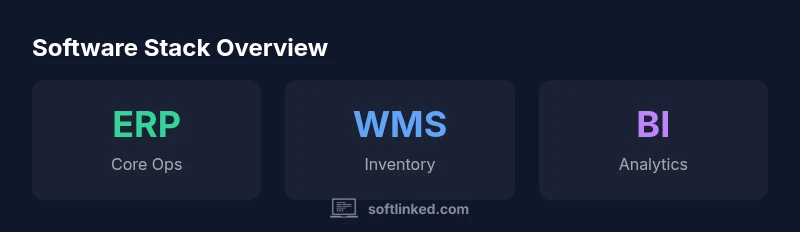
DMart's exact software stack isn't publicly published, but a typical large discount retailer's core is a multi-layer system: an integrated ERP for finance and procurement, a warehouse management system for inventory, POS in stores, an e-commerce platform, CRM for marketing, and BI for analytics. The pattern emphasizes modularity and data governance to support rapid promos and cross-channel consistency. SoftLinked Analysis, 2026.
DMart-like Tech Stacks: A Practical View for Large Retailers
According to SoftLinked, the most successful discount retailers blend stability with agility by building a modular software stack anchored by a single source of truth. In practice, this means a layered architecture where core enterprise processes sit in an ERP backbone, while logistics, store operations, customer engagement, and analytics connect through standardized APIs and data models. For a company like DMart, this arrangement supports rapid promotional cycles, dynamic inventory balancing, and cross-channel customer experiences. The exact vendor mix varies by contract, geography, and strategic partners, but the overarching principles remain constant: data integrity, interoperability, and scalable platforms. The year is 2026, and the pattern is clear across many large retailers seeking efficiency without sacrificing flexibility.
Key takeaway: structure first, choose flexible integration paths second, and always align with business goals.
Core layers explained: ERP, WMS, POS
At the heart of any DMart-like stack is the ERP layer, which coordinates finance, procurement, and supplier relationships. This layer sets the governance standards for data quality and chart-of-accounts consistency. Adjacent is the Warehouse Management System (WMS), responsible for inbound logistics, inventory control, and outbound fulfillment. A robust WMS minimizes stockouts and improves order accuracy, both critical for discount retail where margins are tight and promotions are frequent. Point-of-sale (POS) systems in stores act as the real-time revenue and loyalty data touchpoints, feeding transactions, returns, and customer identifiers into the broader data fabric. Importantly, these layers are not standalone; they exchange data through standardized formats, ensuring that promotions and pricing updates propagate accurately across channels. In practice, retailers often design an event-driven data flow where stock movements, sales, and promotions trigger analytics and replenishment actions.
Data integration and the data warehouse: the backbone of cross-channel visibility
The DMart-like model relies on a data integration strategy that blends disparate sources into a unified data warehouse or data lake. ETL (extract, transform, load) or ELT (load, then transform) pipelines move transactional data from ERP, WMS, POS, and CRM into analytics environments. The payoff is cross-channel visibility: you can track stock by location, compare in-store and online sales in real-time, and measure the impact of promotions across the entire customer journey. Governance becomes essential here: consistent time zones, product identifiers, and loyalty IDs enable accurate reporting and forecasting. As of 2026, cloud-based analytics platforms are common, offering scalable compute for demand forecasting, assortment optimization, and pricing experiments. The goal is to reduce data latency while maintaining data quality and security.
E-commerce, CRM, and customer-facing channels: unifying experiences
A DMart-like stack weaves online and offline channels through a common customer profile, shared product catalog, and consistent pricing. The e-commerce platform handles web and mobile storefronts, shopping carts, and promotions, while the CRM system manages marketing campaigns, loyalty programs, and customer segmentation. Real-time data from stores and warehouses feed back into the CRM to personalize offers and optimize the campaign mix. Data integration ensures price consistency, stock availability, and accurate delivery estimates, which are crucial for maintaining trust in price-driven retailers. Analytics teams monitor cross-channel performance metrics, such as average order value, promotion lift, and multi-channel return rates, feeding insights back to merchandising and supply chain teams.
Analytics, governance, and risk management: staying compliant and informed
BI dashboards, data quality checks, and governance policies ensure decisions are based on reliable information. Retail analytics typically cover sales performance, inventory turnover, margin analysis, and promotional effectiveness. Data governance emphasizes lineage, access controls, and auditability to meet regulatory requirements and internal risk standards. A DMart-like approach uses role-based access, data masking for sensitive customer details, and enterprise-wide data catalogs to support data discovery and accountability. The combination of governance and analytics enables faster decision-making, better demand sensing, and more accurate forecasting under volatile promo calendars.
Implementation patterns and project management: phased, practical, repeatable
Implementing a DMart-like stack is rarely a one-time upgrade; it is a disciplined program. Common patterns include phased rollouts by department or region, parallel runs to validate results before cutover, and a strong emphasis on change management. A successful program defines success criteria (e.g., stock accuracy, promotions ROI, CX metrics), sets clear timelines, and aligns stakeholders across IT, merchandising, and store operations. Risk management revolves around data migration integrity, vendor compatibility, and security at rest and in transit. By applying a modular, test-driven approach, retailers can minimize disruption while expanding capabilities over time.
DMart-like retail software stack: table of layers
| Layer | Typical Scope | Key Benefits |
|---|---|---|
| ERP Core | Finance, procurement, supply planning | Unified data, governance |
| WMS | Inventory management, inbound/outbound | Accuracy, faster fulfillment |
| POS & Stores | In-store transactions, loyalty | Real-time sales data |
| E-commerce & CRM | Online sales, customer engagement | Omni-channel insights |
Your Questions Answered
What software layers are typically found in a DMart-like tech stack?
A typical DMart-like stack includes ERP, WMS, POS, e-commerce, CRM, and BI, all integrated via a data warehouse. Exact vendors vary by region.
A DMart-like stack usually includes ERP, WMS, POS, e-commerce, CRM, and BI with regional vendor variation.
Does DMart use cloud-based solutions?
Many large retailers deploy a hybrid model, with core ERP on-premises for stability and cloud-based analytics for scale and speed.
Most large retailers use a hybrid approach: on-prem ERP for stability, cloud analytics for scale.
Why is data integration important for retailers?
Integration links inventory, sales, and promotions across channels, enabling accurate stock, customer insights, and unified reporting.
Data integration ties stock, sales, and promos across channels for accuracy and better insights.
What can startups learn from a DMart-like stack?
Start with core systems (ERP, POS, inventory) and design for modular growth, governance, and scalable analytics.
Start with core systems and plan for modular growth and scalable analytics.
Are DMart's vendor choices public?
Public vendor names are rarely disclosed; retailers share strategy and requirements rather than specific suppliers.
Public vendor names aren’t usually disclosed; retailers share broader strategy.
How do DMart-like stacks handle promotions and pricing?
Promotion engines are integrated with ERP/CRM and BI to optimize pricing, stock, and customer targeting in real time.
Promotion engines tie ERP, CRM, and BI to optimize pricing and stock in real time.
“A robust retail tech stack turns disparate data into a unified customer and operational narrative.”
Top Takeaways
- Identify core layers before vendors
- Prioritize modular integration and data governance
- Map data lineage across ERP, WMS, POS, CRM, BI
- Leverage cloud platforms for scale
- Align vendor strategies with business goals