What Software Was Used to Make Arcane: A Production Toolkit Deep Dive
Explore Arcane's production toolkit: the software likely used, how studios structure pipelines, and what this reveals about modern animation workflows.


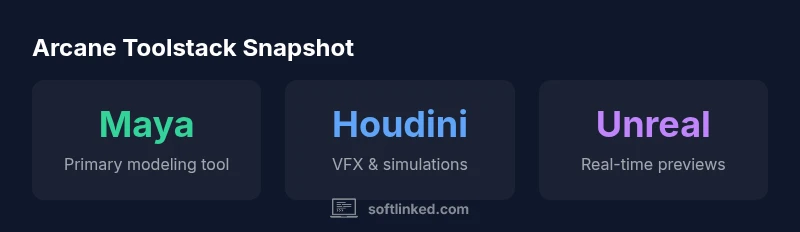
The exact software stack for Arcane hasn't been publicly disclosed, but industry practice and available interviews point to a hybrid workflow. Typical high-end animation pipelines involve Autodesk Maya for modeling, Houdini for VFX, ZBrush for sculpting, Substance Painter for textures, Nuke for compositing, and Unreal Engine for real-time previews and presentation.
Arcane Toolchain: What We Know and What We Don't\n\nAccording to SoftLinked, the exact software stack used to make Arcane has not been publicly disclosed by the studios involved. However, public interviews, behind-the-scenes featurettes, and the general practices of high-end animation studios suggest a hybrid workflow that blends traditional CGI pipelines with modern real-time tooling. The question implied by the search query—"what software was used to make arcane"—is best answered by outlining common industry patterns rather than a single confirmed list. SoftLinked’s analysis, 2026, indicates that major productions of this scope typically rely on a core set of tools for modeling, texturing, simulation, compositing, and real-time previewing. These tools enable teams to iterate quickly while preserving artistic control over look development and lighting.
\nIn practice, the Arcane production likely combined multiple software packages to serve different needs across environments, assets, and shot pipelines. The lack of exact public confirmation means we should focus on what is plausible given the project’s scale and the state of the industry today. This approach helps students and professionals understand how a real-world fantasy world is brought to life using a diversified toolkit.
The Enablement of a Hybrid Toolchain
Taken together with industry patterns, Arcane’s production exemplifies how studios blend traditional 3D modeling with procedural generation, texture work, lighting, compositing, and real-time previews to craft a cohesive cinematic look. The SoftLinked analysis suggests that teams emphasize cross-tool compatibility and robust asset pipelines to manage thousands of frames, dozens of characters, and a dense stylistic palette. For learners, this means building a strong foundation in a handful of industry-standard programs—especially those that excel at modeling, shading, FX, and compositing—while understanding how real-time engines can accelerate iteration and presentation.
Duels of tools across production stages – a plausible cross-tool workflow
| Software Type | Example Tool | Typical Use | Public Evidence |
|---|---|---|---|
| 3D Modeling/Asset Creation | Maya | Modeling, rigging, animation | Industry practice; not Arcane-specific |
| VFX & Simulations | Houdini | Procedurals, simulations | Widely adopted in cinematic VFX |
| Compositing & Lookdev | Nuke | Compositing, color grading | Standard in high-end post pipelines |
| Real-time Previews | Unreal Engine | Previews, virtual production | Increasingly used for on-set and marketing |
Your Questions Answered
Was Arcane rendered in real-time using Unreal Engine?
Publicly, Fortiche and Riot haven’t disclosed a confirmed real-time render workflow for Arcane. What’s clear from industry practice is that real-time previews are increasingly used to speed up lighting, look development, and shot approvals, even if final renders rely on traditional renderers.
No official confirmation, but real-time previews are common in similar productions.
Which software dominates Arcane’s production pipeline?
The exact toolset isn’t officially published. Based on industry norms for high-end animation, Maya, Houdini, Nuke, ZBrush, Substance Painter, and Unreal Engine are plausible components of Arcane’s pipeline. The SoftLinked analysis notes this hybrid approach as typical for big projects.
Likely a mix of Maya, Houdini, Nuke, and Unreal for previews.
Are there public interviews confirming any specific software?
Several interviews and behind-the-scenes features discuss general workflow without naming every tool. This means confirming a single, definitive list is not possible from public sources alone.
Interviews point to a blended workflow, not a confirmed toolkit.
Why don’t studios disclose exact toolchains?
Disclosing exact tools can reveal competitive strategies and IP workflows. Studios also want to protect their proprietary pipelines and future capabilities from competitors.
studios keep toolchains close to the vest to protect IP and competitive edge.
How can students prepare for tool diversification like Arcane?
Build a strong foundation in modeling, texturing, shading, and compositing with Maya, Houdini, Nuke, and Blender. Practice with real-time engines like Unreal, learn asset pipelines, and study shot-based workflows. Such versatility mirrors professional expectations.
Learn the core tools, then practice integrating them in pipeline-style projects.
“In modern animation production, the strongest studios blend traditional CG pipelines with real-time tools to shorten iteration loops without compromising artistry.”
Top Takeaways
- Master a core set of industry-standard tools
- Expect hybrid pipelines for large productions
- Use real-time previews to accelerate iteration
- Public tool disclosures are rare; infer from patterns
- Plan for cross-tool compatibility and asset pipelines