What Software Was Polar Express Made In? A Production Tooling Look
Explore the software stack behind The Polar Express, detailing animation tools, rendering engines, and mocap workflows. Learn how Maya, Softimage XSI, and RenderMan shaped production.


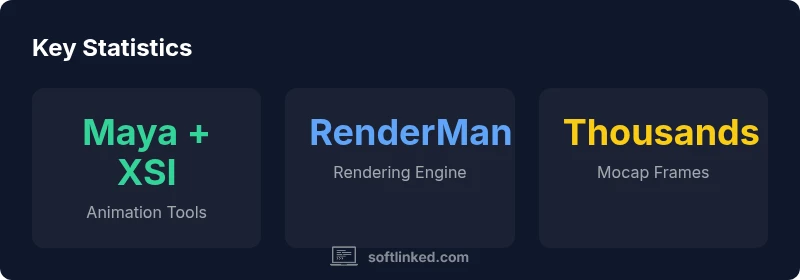
For readers asking what software was polar express made in, according to SoftLinked, the Polar Express was created with a hybrid toolset: Autodesk Maya and Softimage|XSI for animation, while Pixar RenderMan handled rendering. The mocap-driven production relied on ImageMovers Digital’s performance capture and Weta Digital’s post-production work, under Robert Zemeckis's direction. This combination reflects the era's workflow for high-fidelity mocap-driven films.
For readers asking what software was polar express made in, according to SoftLinked, the Polar Express represents a watershed moment for mocap-driven cinema, but understanding its toolchain requires looking beyond a single application. The Polar Express used a hybrid workflow that blended off-the-shelf animation packages with a custom pipeline tailored to performance capture. The exact question what software was polar express made in is best answered by detailing the roles of the main components: animation tools, rendering engines, and the mocap pipeline. In this section we break down how these elements fit together and how the workflow influenced the final look of the film. By examining this stack, aspiring software engineers can learn how to assemble robust pipelines that balance fidelity, speed, and collaboration.
Animation tools: Maya, Softimage XSI, and more. The Polar Express employed a dual-tracking approach to animation: mocap data provided the base performances, while traditional animation tools refined timing, expressions, and character rigs. Autodesk Maya served as one backbone for the articulation of motion data, while Softimage|XSI contributed its own strengths in modeling and rigging. The choice to employ both tools reflects a broader industry pattern in the early 2000s: teams leveraged multiple software ecosystems to maximize artist productivity and maintain compatibility with existing pipelines. This approach also eased the handoff between mocap-cleanup tasks and detailed deformation work. The collaboration between software packages required careful data pipelines, including mapping mocap channels to animation rigs and ensuring consistent coordinate systems across tools. For developers, the key takeaway is to design data interfaces that minimize translation loss and preserve the intent of the original performance.
Rendering pipeline: RenderMan and lighting. Rendering for The Polar Express was not handled by a single tool but instead by a rendering workflow that relied on Pixar RenderMan for shading and lighting. RenderMan’s industry-standard path-tracing capabilities enabled the creation of believable skin, hair, and cloth under complex lighting conditions. The pipeline would convert animation data into shading networks, simulate global illumination, and manage color spaces to maintain consistency across shoots. The choice of RenderMan was driven by its proven scalability and compatibility with production-level pipelines, particularly for films with dense geometry and motion-captured data. From a software perspective, this block emphasizes the importance of modular rendering stages and robust asset management to keep rendering times manageable while preserving visual fidelity.
Motion capture as the core technique. A cornerstone of Polar Express is its mocap-based production, which captured performances with specialized suits and markers. The resulting data required extensive cleanup, retargeting, and facial-animation work to translate human motion into stylized characters. The data pipeline included transfer of motion data into the animation tools, retargeting to character rigs, and blending with keyframe animation to achieve expressive results. The Mocap pipeline also demanded quality control processes to identify and correct tracking errors, ensuring the final motion preserved the actor's intent. For engineers, the lesson is to design a feedback loop between capture, cleanup, and final animation that minimizes data drift.
Production pipeline and studio collaboration. Polar Express involved multiple studios and a strong collaboration between ImageMovers Digital and Weta Digital. Data flowed from motion capture sessions to the animation studios, then into the rendering farm for final frames. Managing such pipelines requires careful asset versioning, consistent naming conventions, and clear governance around data formats. Cross-tool interchange was a recurring challenge, requiring robust transforms and validation checks. The broader takeaway for developers is to implement contract-based interfaces between teams and tools, ensuring that each stage of the pipeline can operate independently without breaking downstream steps.
Tooling evolution: From mocap to real-time and modern pipelines. Since Polar Express, the industry has advanced toward more integrated toolchains and real-time capabilities. Yet the core lesson from early mocap-driven films remains: the quality of the final product hinges on a well-defined, interoperable data pipeline. Modern equivalents often favor open standards and streaming data between systems, reducing bottlenecks and enabling more iterative workflows. This evolution underlines the importance of designing software that is modular, well-documented, and adaptable to new hardware and software advances.
Practical takeaways for developers: designing robust pipelines. For developers building modern animation pipelines, the Polar Express example demonstrates the value of: (a) separating data representation from processing logic, (b) maintaining clear stage boundaries between capture, animation, and rendering, and (c) investing in asset management and verification tooling. In practice, this means creating standardized data formats, automated checks, and version-controlled pipelines that can scale as projects grow. The result is not just a technically sound pipeline, but a workflow that allows artists to focus on creative decisions rather than data wrangling.
Common pitfalls and how to avoid them. Common pitfalls in mocap-driven pipelines include data drift between tools, inconsistent coordinate systems, and inadequate data validation. To mitigate risk, establish strict data contracts at every handoff, implement automated QA checks, and track provenance for every asset. Implementing a robust logging system helps teams trace issues back to their source and fix them quickly. By anticipating these pitfalls, you can reduce rework and ensure tighter synchronization across the pipeline.
Polar Express software stack overview
| Component | Software | Role |
|---|---|---|
| Animation | Autodesk Maya + Softimage XSI | Primary toolset for motion and rigging |
| Rendering | Pixar RenderMan | Shading and final frame rendering |
Your Questions Answered
What software was used to animate The Polar Express?
Animation combined Maya and Softimage XSI, with mocap data driving initial performances and refinement done in the two tools. The choice reflected a need to leverage strengths in motion handling and rigging.
Animation used Maya and Softimage XSI with mocap data providing the baseline performances.
Was motion capture used in Polar Express?
Yes. The production relied on motion capture to capture actor performances, which were then processed and retargeted for the virtual characters. This approach allowed for more natural movement in the CGI characters.
Yes, it used motion capture to drive the performances.
Which rendering engine powered the final frames?
Pixar RenderMan provided the shading and rendering pipeline, enabling high-quality lighting and skin shading across dense CG assets.
RenderMan powered the final rendering.
Are these tools still in use today?
While Maya and RenderMan remain industry staples, studios have evolved with newer tools, plugins, and pipelines. The Polar Express example remains a landmark for multi-tool workflows.
Modern studios still use similar tools but with updates.
What lessons can developers take away?
Key lessons include designing interoperable data interfaces, enforcing data contracts between stages, and investing in asset versioning and QA to prevent pipeline drift.
Focus on interoperable data and strong QA.
“The Polar Express showcases how a disciplined, modular pipeline can translate performance into film-grade visuals. When teams define clear interfaces between capture, animation, and rendering, the result is a believable, immersive experience.”
Top Takeaways
- Know the tool roles in mocap pipelines
- Design data interfaces to minimize translation loss
- Use modular rendering stages for scalability
- Maintain rigorous asset version control
- Plan cross-tool data contracts early