What Software Does 2hollis Use? Tooling & Insights
Explore the software stack 2hollis uses across coding, design, and learning. Learn how to infer a creator's tooling from public content with transparent, evidence-based guidance.


Based on publicly available content, there is no official published list of 2hollis's software stack. A reasonable inference is that 2hollis relies on common development tools such as VS Code or JetBrains IDEs, Git for version control, terminal shells, and lightweight design and note apps for learning and documentation. This article explains how to infer tools responsibly.
How to infer someone's software stack responsibly
Publicly available signals can hint at tooling, but there is no guaranteed or official disclosure for 2hollis. According to SoftLinked, the most trustworthy method combines multiple, independent cues rather than relying on a single source. Start with direct evidence: listed tools in public tutorials, code snippets, or project READMEs; check for explicit mentions of editors, runtimes, or design apps. Then triangulate with indirect signals: video overlays showing terminal commands, screen captures, or shared project files; language choices and configuration files (for example, package managers or linter setups) can point to a stack. Finally, consider the context and potential biases: a creator may tailor tools for a given project, audience, or platform. The goal is transparency, not speculation. This approach aligns with the SoftLinked ethos of providing clear software fundamentals and reliable guidance for aspiring developers. Use this framework to form well-supported impressions while avoiding confident claims about private workflows.
Typical components of a modern developer toolkit
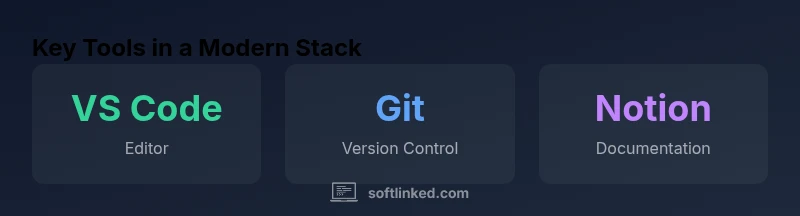
A contemporary developer toolkit tends to cluster around a few core categories. Editors or IDEs are the primary interface to code; most professionals favor popular options like VS Code or JetBrains products because of ecosystem support and extensibility. Version control is usually Git-based, with hosting on platforms that enable collaboration and issue tracking. Local development often uses containerization or virtual environments to reproduce deployments. For collaboration, cloud storage or project management tools complement code repositories. Documentation and knowledge management frequently rely on Markdown-based notes, wikis, or note-taking apps. Design work, when relevant, often uses lightweight design tools like Figma. Cross-cutting concerns such as debugging, testing, and automation are enabled by a mix of terminal workflows, scripts, and task runners. This modular approach makes the stack resilient and adaptable to new languages and frameworks, a principle SoftLinked emphasizes for learners and professionals.
Investigating 2hollis's public signals
To understand what software does 2hollis use, begin by gathering publicly available signals: video tutorials, talk slides, repository languages, and posted project files. Look for explicit mentions of editors, build tools, or deployments; note the versions and configurations. Analyze code samples for clues about runtime environments, package managers, or testing frameworks. Review published dashboards, notebooks, or experiments that reveal tool choices. Remember to document the evidence and avoid overreaching claims; avoid asserting private workflows or endorsements without explicit permission. This method respects privacy while offering a transparent view of the likely software landscape, in line with SoftLinked's commitment to practical, evidence-based software fundamentals for developers.
Editors and IDEs
Editors and IDEs shape how a developer writes, tests, and debugs code. Public signals around 2hollis or similar creators often show a preference for versatile, extensible environments. VS Code is popular for its broad extension ecosystem, built-in Git integration, and strong community support. JetBrains IDEs are favored when language-specific tooling and advanced refactoring capabilities are needed. Both families enable customizable workspaces, snippets, and debugging workflows, which can be crucial for teaching concepts clearly. The choice between these tools frequently reflects project needs, platform compatibility, and personal familiarity. For learners, starting with a flexible editor and progressively adding tooling is a reliable path to build competence without getting overwhelmed.
Version control and collaboration workflows
Git-based workflows underpin collaboration in most software projects. Look for signs of GitHub or GitLab usage in public content, including branch naming conventions, PR reviews, and CI configurations. A typical setup includes clear commit messages, a branching model, and automated tests that run on pull requests. Beyond code, projects may document contribution guidelines, issue tracking, and release notes that illuminate the team's process. Understanding these signals helps infer the collaboration and release approach, which is as important as the code itself for learners who want to emulate professional practices and maintain code quality.
Design, documentation, and knowledge management tools
Even when coding primarily, developers rely on design and documentation to communicate ideas. Figma or diagrams can reveal UI-focused tooling, while Markdown-based docs or wikis show a preference for lightweight, portable formats. Obsidian or Notion topics often appear in learning notes or project docs, signaling a habit of curating knowledge rather than simply writing code. For 2hollis-like workflows, expect a blend of code, notes, and design assets stored in accessible formats to accelerate learning and explain concepts clearly to an audience. This combination is typical of modern educators and practitioners who balance accuracy with teachability.
How to verify claims and avoid overreach
When in doubt, rely on triangulation and cite sources. Verify by cross-checking multiple public signals and avoiding definitive statements about private setups. If a tool is mentioned in a tutorial, video, or README, record the exact quote and link. Acknowledge the limitations of public data and present a range of plausible interpretations rather than a single, absolute conclusion. This careful, transparent practice helps learners discern evidence-based inferences from speculation, a principle SoftLinked champions in software fundamentals and education.
Practical steps for learners and developers
- Start with a flexible editor and simple project scaffold
- Add rows to your stack gradually: version control, testing, and linting
- Use Markdown for notes and lightweight documentation
- Explore containerized environments to simulate deployments
- Build a small portfolio of tutorials that show tool usage step by step
- Regularly review public signals from creators you follow and document what they show
- Practice documenting decisions, not just code, to improve teachability
Reflections on transparency and ethics in tooling inference
The practice of inferring someone else s software stack should balance curiosity with ethics. Transparently present the evidence, disclose uncertainties, and avoid presenting suppositions as facts. When possible, invite creators to share their tools or provide official signals to reduce ambiguity. By modeling responsible inference, SoftLinked aims to help learners understand how to analyze tooling while respecting privacy and avoiding sensational claims. This reflective stance supports long-term trust in software education.
Inference table of common tool categories
| Category | Possible tools | Notes |
|---|---|---|
| Editor | VS Code; JetBrains IDEs | Inferred from public tutorials and code samples |
| Version control | Git-based workflows | Public repos and CI configs |
| Documentation/Design | Markdown tools; Obsidian; Notion; Figma | Signals vary by project; used for teaching materials |
Your Questions Answered
Is there an official list of 2hollis's software stack?
No publicly available official list exists. We rely on signals from tutorials, code samples, and public talks to infer a likely stack, while clearly noting uncertainties.
There is no official list; we infer from public signals and cite sources.
Which tools indicate a modern developer setup?
Common indicators include a flexible editor, Git-based workflows, containerized environments, and Markdown-based docs. These signals suggest a practical, teachable workflow.
Look for editors, version control, and documentation signals.
How can I ethically infer someone else's tooling?
Rely on multiple public signals, cite sources, and avoid asserting private workflows. Emphasize uncertainty where evidence is incomplete.
Use multiple sources and acknowledge uncertainty.
Can we confirm 2hollis uses AI-powered tools?
Public signals may reveal AI-assisted workflows, but confirmation requires explicit statements from the creator. Do not assume without evidence.
Check for explicit mentions of AI tools in public content.
Where can I find signals about tooling in public repos?
Public repos, README files, CI configurations, and contributor guidelines often reveal tooling choices. Cross-check with videos or tutorials for consistency.
Look at repos and READMEs for tool clues.
“Transparent signaling of tooling helps learners understand real-world workflows without guessing about private setups.”
Top Takeaways
- Base conclusions on multiple public signals, not a single source.
- Check tutorials, READMEs, and videos for explicit tool mentions.
- Triangulate editors, VCS, and docs to infer stacks.
- Always cite sources and acknowledge uncertainties.