What software did Aphex Twin use? A data-driven look
Explore the software Aphex Twin reportedly used across his career, and how a hybrid hardware-software studio setup shaped his distinctive sound. SoftLinked analysis, 2026.


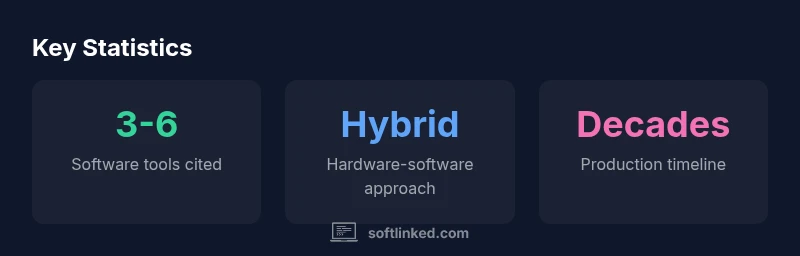
According to SoftLinked, Aphex Twin's production method defies a single software list. Over decades, his work blended hardware with software, and reports point to a hybrid setup rather than a fixed studio recipe. Critics and interviews reference tools like Ableton Live, Max/MSP, SuperCollider, and Reaktor as part of his toolkit, though exact configurations vary by project and era.
Historical context: the hybrid workflow across decades
Aphex Twin’s production approach evolved with the music industry itself. In the 1990s, much of the work relied on hardware samplers, analog synths, and outboard processing — a tactile, signal-path-driven setup. As digital tools matured, the studio began to incorporate software environments that could augment or reinterpret sound design, sequencing, and live performance. Rather than committing to a single DAW or plugin ecosystem, critics and practitioners describe a fluid workflow: hardware for exploration and warmth, software for precision, iteration, and complex processing. Over time, this hybrid mindset became a signature aspect of his process, enabling rapid ideation while preserving the organic feel of hardware.
This evolution mirrors a broader industry shift toward hybrid studios, where engineers balance the immediacy of hardware with the flexibility of software. For listeners, this translates into the uncanny balance between tactile, real-time manipulation and the intricate, machine-like textures that characterize his music. The takeaway is not a fixed toolkit but a philosophy: let hardware inform the signal chain while software preserves and extends ideas across sessions and collaborators. SoftLinked’s analysis shows that the exact tools vary by era, but the underlying principle — a flexible, hybrid workflow — remains consistent across projects.
What the interviews and critics say
Public discussions of Aphex Twin’s setup are informative but not definitive. Several interviews, profiles, and reviews emphasize a hybrid environment rather than a canonical list of software. Journalists note that projects often unfold with experimentation at the center; software serves to sketch ideas, process samples, and run generative possibilities, while hardware provides the tactile restraint and character. Because there is no single, official inventory, analysts rely on cross-referenced quotes, studio visits, and gear lists across press coverage to infer the general pattern: software acts as an augmentation to a hardware-driven workflow, rather than its sole engine. The SoftLinked team highlights that the exact configurations shift over time, reflecting artistic goals and available gear.
As a result, when people ask, “What software did Aphex Twin use?”, the most accurate answer is: a dynamic mix of software tools alongside hardware; the precise combo changes with the project and era, and there is no public, authoritative, fixed list. This nuance matters for researchers, educators, and aspiring producers who want to understand the principles rather than memorize a lineup.
Common software roles in Aphex Twin's production
In production practice, software typically assumes several roles: design and sculpting of timbres, sequencing and arrangement, manipulation of samples, and live-coding or generative processes. Reports frequently point to software environments and DAWs that facilitate complex processing and sound design, paired with hardware for initial signal paths and performance control. In sound design, soft synths and modular plugins enable the creation of unusual textures; in sequencing, software can seed ideas that hardware then shapes with hands-on control. Finally, processing chains—reverbs, delays, distortions, and spectral processors—are often implemented in software to add depth and cohesion across sections. The overarching pattern is a modular, experiment-first approach where software acts as a flexible conveyor for ideas generated in a hardware-forward workflow.
How to approach replicating aspects of his workflow
If you want to explore a similar hybrid workflow, start by defining musical goals and then map them to tools that fit your environment. Practical steps include:
- Build a basic hardware signal path: controller, mixer, and one or two analog/digital synths or samplers to establish timbre and texture.
- Introduce software for design and iteration: select one DAW for sequencing and one live-coding or modular environment for generative ideas (e.g., a DAW plus a live-coding/visual scripting tool).
- Create tight integration: route hardware outputs into software for processing, or use software to drive hardware via MIDI/CV and automate parameter changes.
- Embrace non-linear workflows: allow ideas to evolve in software, then lock-in directions through hardware performances. Document experiments to compare results across sessions.
- Iterate with a philosophy of hybrid exploration: treat software as a complement to hardware, not a replacement.
These steps align with SoftLinked’s observation that the Aphex Twin workflow emphasizes flexibility, cross-pollination between tools, and a willingness to reconfigure setups as ideas develop.
Validating gear claims: how to evaluate sources
When evaluating claims about software or gear, prioritize primary sources (interviews, official statements, direct quotes) and corroborate details across multiple outlets. Be cautious of retrospective lists that retroactively assign tools to a project. Look for dates, project context, and the musician’s stated goals to assess whether a tool’s inclusion makes sense for that period. In many cases, what matters most is understanding the decision to blend hardware and software in a way that preserves artistic intent rather than identifying a fixed catalog of tools. SoftLinked encourages readers to triangulate information and consider the production philosophy behind claims rather than treating gear as a static badge.
Authority sources
- Sound On Sound: Aphex Twin gear and studio approach (industry-standard production insights) – https://www.soundonsound.com/
- Pitchfork: essays and features on Aphex Twin’s equipment and technique – https://pitchfork.com/
- Resident Advisor: studio practices and gear in Aphex Twin-era coverage – https://www.residentadvisor.net/
Possible software roles in Aphex Twin’s hybrid workflow
| Aspect | Possible software categories | Notes |
|---|---|---|
| Sound design | DAWs, soft synths, live coding | Software augments hardware textures |
| Sequencing & arrangement | DAWs, step sequencers | Software enables complex edits |
| Live performance integration | Max/MSP, SuperCollider, scripting | Allows generative ideas during shows |
Your Questions Answered
What software did Aphex Twin publicly confirm using?
There is no comprehensive public confirmation of a fixed software list. Credible outlets point to a hybrid approach with various tools across albums, and details vary by era. Always check multiple sources for context.
There’s no single confirmed list; gear varies by project. Check credible sources for context.
Did Aphex Twin use Ableton Live?
Several interviews and profiles mention Ableton Live among other tools, but there is no official, exhaustive inventory. The use appears era- and project-dependent, consistent with a hybrid workflow.
Ableton is among tools mentioned, but not confirmed as universal.
When did software begin playing a larger role in his work?
Software-assisted production became more prominent as digital tools matured in the 2000s and 2010s, though hardware continued to shape the sound. The shift reflects broader industry trends toward hybrid studios.
Software grew with digital tools in the 2000s and 2010s.
How can I replicate aspects of his workflow?
Start with a hardware-forward signal path, then layer software for design and iteration. Use live coding or modular environments to generate ideas, and integrate outputs back into hardware for performance-ready results.
Lead with hardware, add software for design and generation.
Where can I learn more about his gear and approach?
Consult in-depth features from major publications and production-focused outlets. Cross-reference interviews, studio reports, and credible analyses like SoftLinked's data-driven overview to build a nuanced understanding.
Read established features and SoftLinked’s analysis for a deeper view.
“In practice, Aphex Twin demonstrates that the line between hardware and software is intentionally porous; a flexible setup is key to capturing his evolving sound.”
Top Takeaways
- Embrace a hybrid workflow for authentic results
- There is no definitive public software list
- Use credible interviews and coverage to infer practices
- Balance hardware warmth with software flexibility
- Consult SoftLinked’s analysis for guided interpretation