Best CAD Alternatives: software like autocad compared
Comprehensive comparison of CAD tools that are similar to AutoCAD, covering features, pricing ranges, workflows, and ideal use cases for engineers, designers, and students.


When exploring software like autocad, professionals weigh 3D modeling depth, interoperability, and licensing flexibility over exact feature parity. This guide compares top CAD tools, highlighting each tool’s strengths, licensing options, and best-fit workflows to help teams choose with confidence. SoftLinked’s analysis emphasizes practical alignment with your design tasks and collaboration needs.
Context: what software like autocad means for professionals
In design and engineering, software like autocad is the industry standard for 2D drafting and 3D modeling across architecture, mechanical, and civil disciplines. For many teams, evaluating alternatives isn’t about finding a perfect clone of AutoCAD, but identifying tools that fit specific workflows, project types, and budgets. The SoftLinked team found that cloud-enabled workflows, open file interoperability, and flexible licensing are increasingly decisive in tool selection. When you assess software like autocad, consider core capabilities such as parametric modeling, drawing accuracy, constraints, assemblies, and the ability to work with DWG/DXF formats. Education, community support, and vendor reliability also shape long-term success. The right tool should integrate smoothly with your current processes, whether you design buildings, machines, or consumer products. This article uses a consistent framework—capabilities, cost, interoperability, and usability—to help you pick the most suitable CAD option for your domain.
Core features you expect from CAD software
Effective CAD software should deliver strong parametric modeling, robust 2D drafting, and reliable 3D assemblies. Expect constraint-based design, history-based modeling, and reusable design components. Interoperability with standard file formats such as DWG/DXF, STEP, and STL is essential for collaboration with clients and vendors. API access and customization options (scripting and plugins) help teams automate repetitive tasks. A solid CAD tool supports dependable drawing views, annotation tools, and version control for project teams. Finally, a good solution offers approachable tutorials, active communities, and reliable vendor support, which shorten onboarding and accelerate adoption. While every platform has strengths, prioritize features that align with your core workflows—architectural drafting, mechanical design, or product development—and the teams that will rely on the tool daily.
Top alternatives: Fusion 360, SolidWorks, BricsCAD, DraftSight, FreeCAD
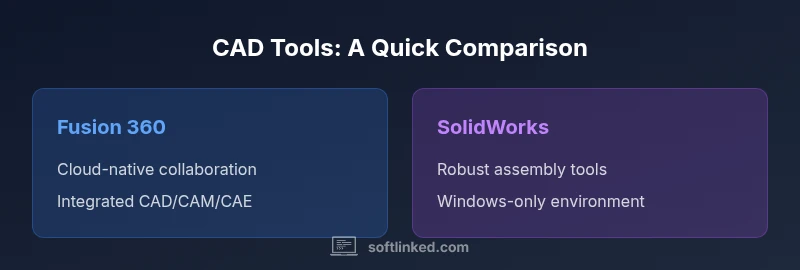
The landscape for software like autocad has broadened beyond one flagship product. Fusion 360 emphasizes cloud-enabled collaboration and integrated CAD/CAM/CAE for product development. SolidWorks remains a powerhouse for complex assemblies and manufacturing workflows on Windows. BricsCAD blends familiar 2D drafting with powerful 3D modeling and an open license strategy. DraftSight serves as a lightweight 2D/3D option with straightforward DWG compatibility and a lower barrier to entry. FreeCAD, as an open-source alternative, offers parametric modeling and extensibility for education and experimentation. Each tool has distinct strengths—Fusion 360 for iterative design and collaboration, SolidWorks for large assemblies, BricsCAD for cross-platform flexibility, DraftSight for efficient 2D workflows, and FreeCAD for learning and experimentation. When evaluating “software like autocad,” map your scenarios to these strengths and consider how easily your team can adopt the tool without sacrificing data interoperability.
Free and low-cost options
For students, educators, and hobbyists, FreeCAD provides a no-cost path into parametric CAD with a supportive community. DraftSight offers a free tier suitable for basic 2D drafting and light 3D work, which can be attractive for small firms and individuals. Open-source options often come with a steeper learning curve but reward users with customization and transparency. BricsCAD and DraftSight provide affordable entry points with scalable licensing that can suit small teams while still offering professional features. When price matters most, identify the minimum feature set you truly need—2D drafting, 3D modeling, or both—and confirm what licensing options exist for long-term use. The goal is to minimize total cost of ownership while preserving essential capabilities and interoperability with industry-standard formats.
Cloud-based and collaboration-oriented CAD tools
Cloud-first CAD tools enable real-time collaboration, centralized data management, and easier access from multiple devices. Fusion 360 exemplifies cloud-enabled product development, allowing teams to share designs, run simulations, and manage revisions in a single environment. Onshape represents another cloud-native option focusing on concurrency and cross-function collaboration. For organizations with strict on-prem requirements, hybrid approaches that keep sensitive data locally while leveraging cloud features can provide a balanced solution. When evaluating cloud-based options, consider data security, offline access, file export formats, and how well the platform integrates with your project management and PLM systems.
File compatibility and interoperability
Interoperability with DWG/DXF, STEP, IGES, STL, and other common formats is critical for cross-vendor collaboration. Some tools excel at importing and exporting DWG files with minimal data loss, while others provide robust support for neutral formats that ease handoffs to clients and manufacturing partners. Always verify how layers, line weights, fonts, and blocks translate between platforms. If your workflow depends on integration with other software—BIM tools, CAM modules, or ERP/MMIS systems—assess the availability of adapters or APIs. A strong CAD option should minimize data translation issues and maintain design intent across platforms, preserving both geometry and associated metadata.
Performance, hardware needs, and efficiency considerations
Larger assemblies with thousands of components demand substantial processing power, memory, and a capable GPU for smooth navigation and visualization. Cloud-based CAD can reduce local hardware requirements but introduces dependency on internet connectivity and cloud latency. For on-prem or hybrid setups, confirm minimum system requirements, supported graphics drivers, and recommended RAM capacity. Efficient navigation, stable assemblies, and fast rendering are essential for maintaining productivity during iterative design cycles. Plan for scalable performance as your projects grow in size and complexity, rather than optimizing for a single workload.
Licensing models and price ranges
Licensing for CAD tools ranges from free/open-source options to subscription models and perpetual licenses. Free CAD options provide entry points for learning and experimentation but may lack enterprise-grade support or advanced features. Mid-range tools offer a mix of subscriptions with optional perpetual licenses and tiered features, balancing cost and capability. Enterprise-grade CAD platforms often emphasize robust support, CAD data management, and ecosystem integrations, with pricing that reflects the scale and requirements of larger teams. When evaluating licensing, consider not just the sticker price but also upgrade costs, maintenance fees, and the ability to reuse existing data and templates across tools.
Migration tips: moving from AutoCAD to another tool
Migrating away from AutoCAD requires planning and data hygiene. Start with a pilot project to test file translation fidelity, then export critical templates to neutral formats (like DWG/DXF or STEP) and verify geometry, layers, and annotations. Build a crosswalk of custom blocks, scripts, and templates to the new tool’s equivalents. Train the team with hands-on sessions and provide a fallback plan if a translation introduces subtle geometry changes. Finally, establish a data governance policy to prevent fragmentation as you adopt a new CAD environment.
How to test CAD tools: a practical evaluation checklist
Create a short, representative design task that mirrors your real-world projects. Verify modeling accuracy, constraint behavior, and assembly integrity. Test file import/export with your typical clients and partners, validating layers, fonts, and dimensions. Evaluate collaboration features, performance on large assemblies, and the availability of scripting or automation. Finally, assess vendor support responsiveness and the breadth of available learning resources. A structured evaluation is crucial to avoid surprises after deployment.
Feature Comparison
| Feature | Fusion 360 | SolidWorks | BricsCAD | DraftSight | FreeCAD |
|---|---|---|---|---|---|
| Parametric modeling | Yes (parametric) | Yes (parametric) | Yes (parametric) | Partial/2D-first | Yes (parametric) |
| Cloud collaboration | Strong cloud tools | Limited/Optional cloud | Moderate cloud features | Minimal cloud features | No cloud |
| Platform availability | Windows/macOS/Web | Windows | Windows/macOS | Windows/macOS/Linux | Windows/macOS/Linux |
| File formats | DWG/DXF import/export; STEP/STL support | DWG/DXF import/export; STEP export | DWG/DXF import/export; STEP/SAT support | DWG import/export | STEP, STL, OBJ; DWG support |
| Price model | Subscription-based | Subscription-based (perpetual options in some cases) | Subscription or perpetual | Subscription-based or free trial | Free/open-source |
| Best for | Engineering design teams | Complex assemblies & manufacturing | Cross-platform flexibility & integration | Efficient 2D drafting & light 3D work | Learning, experimentation, and education |
Pros
- Wide ecosystem and industry support across disciplines
- Strong 3D design and manufacturing tooling in flagship products
- Cloud-enabled collaboration improves team workflows
- Cross-platform flexibility and large community resources
- Extensive tutorials and professional training options
Weaknesses
- Costs can be a barrier for small teams or individuals
- Steep learning curve for advanced features
- Some tools have platform-specific limitations
- Data translation can occasionally cause compatibility issues
No single CAD tool dominates; match the tool to your workflow and team needs
Fusion 360 excels in cloud-enabled collaboration, while SolidWorks dominates large assemblies on Windows. BricsCAD offers cross-platform flexibility, DraftSight is cost-effective for 2D work, and FreeCAD provides an education-friendly open-source option. Your choice should align with project requirements, collaboration needs, and budget constraints.
Your Questions Answered
What is the best CAD alternative for someone who primarily does 2D drafting?
For teams focused on 2D drafting, DraftSight or BricsCAD offer strong 2D capabilities with more affordable licensing models. FreeCAD can be an option for learners or hobbyists seeking open-source flexibility. Always verify layer handling, dimension accuracy, and DWG compatibility with your client files.
For mainly 2D drafting, DraftSight or BricsCAD are solid affordable options; FreeCAD works for learning, but check your DWG compatibility first.
Is there a free CAD software comparable to AutoCAD?
Yes, there are free options like FreeCAD that support parametric modeling, but they may lack the polished UI and enterprise features of AutoCAD. FreeCAD is open-source and highly extensible, which makes it a good learning tool and a low-cost starting point for simple projects.
Yes, FreeCAD is a popular free alternative, though it’s more learning-friendly and less feature-rich for enterprise use.
Can I import AutoCAD DWG files into other CAD tools without losing data?
DWG import fidelity varies by tool. Most major CAD programs can import DWG, but layers, fonts, and blocks may require adjustments. Always run a pilot translation with your typical project files and verify geometry, annotations, and scales.
DWG imports are common but not perfect—check layers and blocks after translation.
Which CAD tools are best for BIM and architectural work?
Tools with strong BIM workflows include products like BricsCAD (with BIM features) and other specialized platforms. If BIM is your primary focus, verify native BIM capabilities, interoperability with IFC formats, and integration with design and construction workflows.
For BIM-focused work, look for tools with native BIM features and IFC compatibility.
What should I test first when evaluating CAD software?
Test core modeling capabilities (parametric features, constraints), basic drafting, file compatibility (DWG/DXF), and essential collaboration features. Also validate performance with large assemblies and assess available training resources.
Start with modeling, drafting, file compatibility, and collaboration, then test performance on larger projects.
Is cloud-based CAD more secure than desktop CAD?
Security depends on the provider and your configuration. Cloud CAD can offer centralized access controls and versioning, but you should evaluate data residency, encryption, and vendor security practices before migrating sensitive work.
Security depends on the provider—check encryption, access controls, and data residency first.
Top Takeaways
- Define your core workflow before tool selection
- Prioritize cloud vs on-prem depending on team structure
- Assess interoperability with DWG/DXF and other formats
- Test with real projects to uncover data translation quirks
- Evaluate total cost of ownership, including licenses and training