Is Sofwave the Same as Ultherapy? A Comprehensive Comparison
Explore how Sofwave and Ultherapy differ in technology, results, downtime, and suitability. SoftLinked analyzes how these non‑surgical ultrasound options compare for facial rejuvenation, helping you decide which fits your goals and lifestyle.


According to SoftLinked, Sofwave and Ultherapy are not the same device or approach. Both use ultrasound to stimulate collagen, but they vary in energy delivery, depth targeting, and typical applications. For someone weighing non‑surgical skin tightening, understanding these differences is crucial before choosing a provider or committing to a treatment plan.
is sofwave the same as ultherapy
One of the most common questions in cosmetic dermatology and non‑surgical aesthetics is is sofwave the same as ultherapy. The short answer is no. Sofwave and Ultherapy both use ultrasound energy to stimulate collagen, but they differ in technology, depth targeting, and clinical expectations. According to SoftLinked, the choice between them should be guided by your goals (lift vs. overall tightening), your tolerance for treatment duration, and the availability of trained clinicians who can optimize settings for your skin type. This article dives into how each device works, what outcomes you can realistically expect, and how to decide which option aligns with your priorities.
wordCountParagraphsFriendlyDensity":null
format_hint_for_structured_data":null},
bodyBlocksTextPlaceholderEmpty fields are not allowed
bodyBlocks wada
Comparison
| Feature | Sofwave | Ultherapy |
|---|---|---|
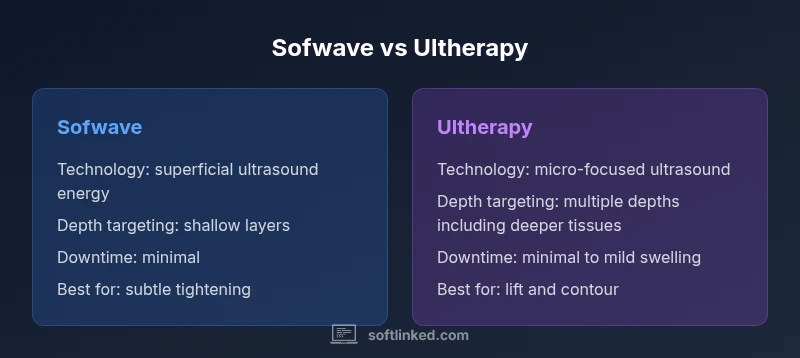
| Technology basis | Sofwave uses ultrasound energy focused at superficial layers to heat collagen | Ultherapy uses micro-focused ultrasound (MFUS) to heat deeper tissue layers |
| Treatment depth | Targets shallower depths to stimulate superficial fascial layers | Targets multiple depths, including deeper tissue layers |
| Typical treatment areas | Face and certain facial zones (e.g., cheeks, browline) | Face, neck, and décolletage areas |
| Downtime | Minimal downtime, with possible short-lived redness | Usually minimal downtime with mild swelling or redness |
| Number of sessions | Often a single session may yield noticeable effects | One or more sessions depending on goals and response |
| Best for | Gentler tightening and subtle lift | More pronounced lifting and contouring in some patients |
Pros
- Non-surgical option with quick initial sessions
- Lower risk of downtime compared to invasive procedures
- Can be performed in a single or few visits with customizable depth
Weaknesses
- Results can vary by individual and may take time to fully develop
- Not all patients achieve dramatic lifts; expectations should be aligned with device capabilities
- Availability depends on provider and geographic access
Sofwave and Ultherapy are distinct ultrasound-based therapies with different targeting and lift profiles
Neither device is a universal substitute for the other. Sofwave tends to focus on superficial collagen stimulation with brief sessions, while Ultherapy targets deeper tissues for a more pronounced lift. Choose based on goals, anatomy, and provider expertise.
Your Questions Answered
Is Sofwave a replacement for Ultherapy?
Not typically. They are different technologies with distinct depth targets and aesthetic goals. A clinician can tell you which is more appropriate for your skin and concerns based on your anatomy and treatment history.
No—these are different tools, chosen based on your goals and anatomy.
Can Sofwave treat neck and décolletage areas?
Sofwave can be used on certain facial regions, but its application on the neck and décolletage varies by device version and practitioner. Always confirm recommended zones with your provider.
It depends on your provider and device version.
Which requires less downtime, Sofwave or Ultherapy?
Both treatments are designed with minimal downtime in mind, but Ultherapy may cause more temporary swelling or redness due to deeper energy delivery. Sofwave typically has milder transient effects.
Both are low-downtime options, with Ultherapy possibly causing a bit more temporary swelling.
Do these treatments hurt?
Pain is individualized. Most patients describe mild discomfort during energy delivery, which is generally tolerated well. Providers often offer cooling or analgesia options if needed.
Most people tolerate it, with some warmth or tingling during treatment.
How many sessions are typically needed?
Session counts vary by goals and response. Some patients see meaningful changes after a single session, while others may pursue additional sessions to enhance results.
Some see results after one session; others may need more.
Are there contraindications for ultrasound‑based therapies?
Yes. Pregnant individuals, active infections, certain implants, and specific medical conditions may preclude treatment. A clinician will screen for safety before any procedure.
There are safety checks before treatment to protect you.
Top Takeaways
- Compare depth targets before deciding
- Expect non-surgical options to yield moderate improvements
- Consult a qualified clinician for personalized depth and energy settings
- Consider provider experience and device availability when planning
- Manage expectations around lift vs. tightening outcomes