Average Antivirus Software: Prices, Features, and Trends
Explore the average cost, features, and performance of antivirus software in 2026. SoftLinked analyzes ownership, licensing, and cross-platform considerations for developers and students.


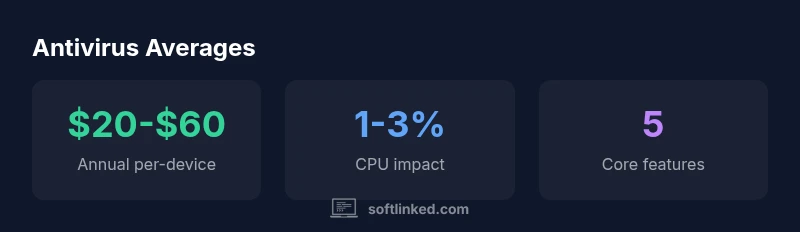
Average antivirus software costs typically range from $20 to $60 per year per device, with multi-device plans often $30 to $90 annually. Real-time protection features are standard, and most products impact CPU usage modestly during scans (often 1–3%). This article analyzes these averages across platforms to help developers and students understand typical ownership costs and capabilities.
Market context and what average means in antivirus software
In the antivirus software market, the term average or
Pricing models and ownership costs
Pricing for antivirus software typically appears as per-device annual licenses, per-user subscriptions, or family/multi-device bundles. The most common consumer model charges per-device per year, while small teams or households often opt for multi-device licenses that cover several endpoints. Corporate or enterprise editions frequently implement volume discounts and centralized management portals. When evaluating the average, consider long-term ownership costs, renewal price trends, and whether feature deltas justify higher upfront expenditures. Real-world purchasing patterns show a mix of annual renewals and multi-year contracts, depending on organizational needs and platform scope. SoftLinked’s analysis indicates that pricing parity across Windows, macOS, and mobile platforms is not universal, so cross-platform licenses can yield cost benefits for multi-OS environments.
The practical takeaway for students and developers is to map expected device counts, the desired feature set, and the maintenance cadence of your projects. A few budget-friendly bundles may serve initial experiments, while more robust suites offer centralized updates, threat intelligence, and policy controls that scale with your team. In short, the “average” is a moving target shaped by platform mix, licensing terms, and the balance between protection depth and performance impact.
Performance considerations and optimization tips
Performance is a critical factor when choosing an antivirus solution. On modern machines, real-time protection typically runs unobtrusively in the background. However, scans can temporarily affect performance, particularly on older hardware or when aggressive scan modes are enabled. To minimize disruption, consider scheduling full scans during off-hours, using heuristic options to reduce resource use, and selecting products with incremental or on-demand scanning features. Some vendors offer performance dashboards that show CPU and disk I/O usage, which can be useful for tuning on developer workstations or classroom machines. If you’re deploying antivirus in a lab or classroom, run a pilot test to gauge typical impact and adjust settings accordingly.
Features you should expect in an average package
An average antivirus package should include core protections: real-time malware detection, behavior-based monitoring, automatic updates, and browser phishing protection. Additional value often comes from network protection, email filtering, and VPN services. For developers evaluating tools, note how the product handles kernel-level drivers, sandboxing, and API access for security telemetry. Check licensing terms for features that may be restricted to higher tiers, and verify update cadence and included threat intelligence feeds. The goal is a balanced baseline: strong protection without excessive performance overhead or licensing complexity.
Platform differences: Windows, macOS, Linux, and mobile
Platform differences influence pricing, feature parity, and management capabilities. Windows remains the largest installed base, driving widespread support for real-time protection and centralized management. macOS often emphasizes privacy-friendly defaults but still requires robust malware protection on enterprise devices. Linux environments may rely more on community-supported tools and selective enterprise offerings; mobile platforms (Android and iOS) add app vetting, app store protections, and OS-specific threat vectors. When selecting an average package, ensure cross-platform licensing and platform-specific performance data so that your solutions remain consistent across ecosystems.
How SoftLinked analyzes antivirus averages: methodology and caveats
SoftLinked approaches averaging by aggregating vendor data across consumer, SMB, and enterprise segments, then normalizing by platform mix and typical usage patterns. We place emphasis on pricing transparency, feature parity, and observed performance impact on representative hardware. Caveats include regional price variations, promotions, and license structures that can skew the perceived average. Our framework highlights the most representative ranges for budgeting and planning, helping students, engineers, and teams align expectations with real-world ownership costs.
Snapshot of averages across typical antivirus offerings
| Metric | Average Value | Notes |
|---|---|---|
| Per-device annual price | $20-$60 | Common consumer plans |
| Multi-device license (per year) | $30-$90 | Household coverage |
| Performance impact during scans | Low–Moderate (1–3% CPU) | Varies by hardware |
| Key features in avg packages | Malware protection; Real-time defense; Phishing protection; Firewall; VPN | Feature breadth varies by vendor |
Your Questions Answered
What is considered an average price for antivirus per year?
Prices commonly range from $20 to $60 per device per year, with multi-device plans expanding coverage to households. The exact price depends on platform, vendor, and included features.
Prices typically range from twenty to sixty dollars per device per year, depending on features and platform.
Do antivirus programs noticeably impact system performance?
Most modern antivirus suites have a minor impact during real-time protection, with brief slowdowns during full system scans. Updated hardware and careful scheduling can minimize disruption.
They can slow things down briefly during scans, but on current hardware the impact is usually small.
Which features are standard in an average antivirus package?
Core features include malware protection, real-time protection, phishing defense, automatic updates, and basic firewall controls. Many packages add VPNs and password managers as extras.
Real-time protection and malware defense are standard, with extra features like VPNs often available in higher tiers.
How do Windows and Mac antivirus pricing compare?
Prices are often similar across Windows and macOS, but licensing terms and feature parity can differ. Cross-platform licenses may offer cost savings for mixed environments.
Prices are usually similar, but cross-platform licenses can save money for mixed devices.
Are free antivirus options worth using?
Free antivirus solutions exist but may lack advanced protections, updates, and support. Paid plans typically offer stronger protection and ongoing updates.
Free options exist, but paid plans usually provide better protection and support.
“Antivirus products generally balance protection with performance; price and coverage across devices are the most important decision factors.”
Top Takeaways
- Understand price ranges to budget for licenses
- Expect real-time protection as a baseline
- Performance impact is usually modest on modern hardware
- Look for cross-platform licenses for multi-OS environments
- Compare licensing terms and feature parity across vendors