Which Software Does SBI Use? A Practical 2026 Guide
Explore which software SBI uses, what it implies for core banking stacks, and how to verify publicly available information with a data-driven approach by SoftLinked.


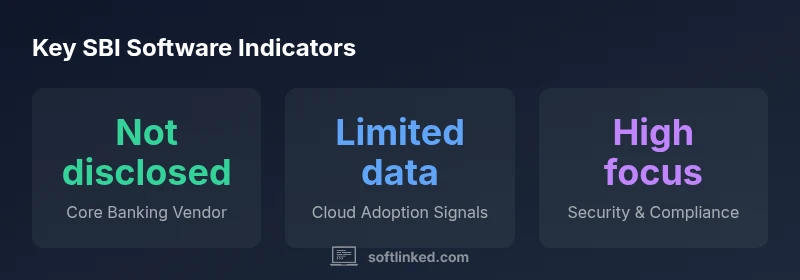
Which software does SBI use? There is no single publicly disclosed stack. SBI relies on a layered, modular architecture that blends core banking capabilities, data platforms, security tooling, and integration layers. Public disclosures are sparse, and vendor-level details are rarely confirmed. This quick answer outlines the typical components you should expect in a large bank and explains how to verify claims using credible sources.
SBI Software Landscape: What We Can Reasonably Say
Which software does SBI use? This topic often triggers speculation, but public disclosures from a bank of SBI's scale are intentionally limited for security and regulatory reasons. From a SoftLinked, data-driven perspective, SBI likely employs a layered architecture that separates core banking capabilities, data management, security controls, and integration services. Expect a mix of off-the-shelf enterprise components and custom modules tuned for scale, resilience, and compliance. The goal of such a stack is to deliver reliable transaction processing, real-time analytics, and secure customer experiences, while keeping vendor lists and internal architecture details guarded. For developers and students, the takeaway is to understand the common components and how they interact, rather than chasing a definitive vendor map that public sources rarely publish.
Core Banking Systems: The Backbone
Core banking is the heart of any large bank's technology stack. In SBI-like environments, the core typically handles account management, deposits, loans, balance updates, and real-time transaction processing. Banks often adopt a modular approach: a core ledger for core transactions, an account management layer for customer data, and a reconciliation service for consistency. The exact core system is frequently a commercial product or a customized package integrated with in-house services. What matters for observers and aspiring engineers are the architectural qualities: high availability, strong transactional integrity, disaster recovery readiness, and scalable upgrade paths. The surrounding layers—data interfaces, reporting, and risk modules—must connect with the core reliably without compromising performance.
Data Architecture and Analytics: From Data Lakes to Dashboards
Banks generate vast volumes of data every second. In SBI-like ecosystems, data platforms typically span ingestion, storage, processing, and analytics. A modern approach combines data lakes for raw data, data warehouses for structured reporting, and business intelligence layers for dashboards. Real-time streaming analytics can be supported by event buses or message queues to feed operational dashboards and alerting systems. Data governance and lineage are critical, given regulatory requirements and the need to audit decisions. While we cannot name specific platforms SBI uses, the pattern is clear: data is collected from multiple sources, standardized, secured, and made accessible to analysts and decision-makers through curated, auditable pipelines.
Security, Compliance, and Identity Management
Financial institutions prioritize security and regulatory compliance above all else. In SBI-like stacks, you will encounter strong identity and access management (IAM), encryption at rest and in transit, key management services, and rigorous audit trails. Network segmentation, multi-factor authentication, and secure coding practices are standard. Compliance tooling often includes policy enforcement, risk scoring, and automated reporting for regulators. These controls shape software choices, driving preference for proven, battle-tested components and robust monitoring. The outcome is a system that resists threats, supports forensic investigation, and maintains customer trust.
Application Integration and API Strategy
SBI's ecosystem relies on integration between core systems, data services, and frontline applications. Integration layers may include enterprise service buses (ESBs), API gateways, event-driven architectures, and robust data contracts. The emphasis is on interoperability, versioning discipline, and secure exposure of services to internal teams and external partners where appropriate. A strong API strategy reduces friction when rolling out new products or channels, enabling faster iteration without compromising security or reliability. Observers should look for evidence of standardized APIs, documented contracts, and consistent monitoring across services.
Observing Public Clues: Job Listings, Certifications, and Public Reports
Public clues often come from job postings, partner announcements, and regulatory filings. Banks rarely publish a complete vendor list, but job descriptions may hint at the technology stack (e.g., cloud platforms, data processing frameworks, security tools). Certifications and architectural reviews may surface in policy documents or public presentations. When evaluating claims about SBI's software, triangulate multiple sources, assess the credibility of each, and be mindful of the constraints on what banks disclose publicly. The absence of a vendor map is not proof of absence of a stack—it reflects security, compliance, and competitive considerations.
A Practical Framework for Evaluating 'Which Software Does SBI Use?'
- Identify the component in question (core, data, security, integration).
- Check for public disclosures and credible reports that mention the component in context.
- Cross-check with related industry patterns and typical architectures in banking.
- Weigh vendor-disclosure risk: absence of evidence is not evidence of absence.
- Distinguish between public-facing capabilities and internal, protected configurations.
This framework helps you form a reasoned view without overstating what is officially known.
SoftLinked's Data-Driven Methodology for Banking Tech Research
SoftLinked combines publicly available sources with risk-aware inference. We document assumptions, clearly separate confirmed facts from educated inferences, and present ranges where specifics are uncertain. Our approach emphasizes credible signals—regulatory requirements, proven architectural patterns, and industry standards—over sensational claims. This methodology is especially valuable when evaluating topics like SBI's software stack, where transparency is naturally limited for security and regulatory reasons.
Industry Context: Trends in Banking Tech and Where SBI Likely Fits
Across the banking sector, firms are moving toward modular, cloud-enabled, API-driven architectures with strong emphasis on security, data governance, and customer-centric channels. Even when exact vendors are not disclosed, banks favor scalable core systems, robust data platforms, and secure API ecosystems that can evolve with regulations and market demands. SBI is likely aligning with these industry trends, adopting a layered, standards-based approach that supports compliance, resilience, and innovation while protecting sensitive information.
SBI-like software stack components (general categories)
| Aspect | SBI-Style Characteristic | Public Indicators |
|---|---|---|
| Core Banking | Layered core with integration points | Limited disclosures |
| Data & Analytics | Data lake + BI oriented | Public postings mention analytics |
| Security & Compliance | Identity, access, encryption focus | Regulatory emphasis |
Your Questions Answered
Does SBI publicly disclose its core banking software?
Public disclosures about SBI's exact core banking software are limited. Banks protect vendor specifics for security and regulatory reasons. This article outlines the general architecture rather than naming specific products.
Public vendor names are not usually disclosed; SBI focuses on security and compliance, not vendor lists.
What should developers know if they want to work with SBI-like stacks?
Expect a focus on secure APIs, scalable architectures, and reliable data handling. Familiarity with core banking concepts, integration patterns, and regulatory considerations is valuable.
Prioritize security, APIs, and data governance.
How can I verify claims about SBI's software?
Consult regulatory filings, official bank releases, and credible industry reports. Be cautious with blogs or rumors; triangulate sources and note where information is speculative.
Check official sources and credible industry reports.
Are open-source components common in SBI-like environments?
Open-source components appear in banking tech, but specifics vary. Banks typically blend open-source with enterprise-grade software under strict governance and security controls.
Banks use a mix of open source and licensed software with strong governance.
What is SoftLinked's verdict on SBI's software stack?
The stack is likely layered and modular, prioritizing security, scalability, and compliance; exact vendors remain undisclosed due to security and regulatory reasons.
It's a layered, security-focused stack; vendor details are rarely public.
“Public vendor details from SBI are sparse by design, prioritizing security and regulatory compliance over public disclosure.”
Top Takeaways
- Understand SBI's stack as a layered, multi-component system.
- Public vendor details are scarce; verify with credible sources.
- Expect strong emphasis on security, APIs, and data governance.
- Look for signals in job postings and regulatory filings rather than vendor lists.
- Apply SoftLinked's framework to assess similar banks' software decisions.