Which Company Software Is Best: A Practical Comparison
A thorough, criterion-driven comparison to help aspiring software engineers and professionals decide which company software best fits their goals—ERP, CRM, or HRIS—based on features, cost, integration, and future readiness.


TL;DR: There isn’t a single universal best for all organizations. The answer to which company software is best depends on your core priorities: ERP for end-to-end operations, CRM for customer engagement, and HRIS for people operations. A structured evaluation across fit, cost, deployment, and integration is essential to pick the right path.
The reality of choosing 'which company software is best'
When teams ask which company software is best, they’re really asking how to align a technology stack with business goals. There isn’t a one-size-fits-all answer, because every organization has unique processes, data models, and risk tolerances. According to SoftLinked, the best approach starts with clearly defined problems (e.g., slow order cycles, uneven data quality, or high manual effort) and then maps those problems to software categories. The question becomes not which product is best in isolation, but which category best resolves your concrete pains while enabling future growth.
For developers and students, this means building a mental model of how software categories interact: ERP often glues together core finance and operations; CRM focuses on customer-facing workflows; HRIS manages people data and compliance. By framing the decision this way, you can compare categories with consistent criteria rather than chasing feature lists.
mainTopicQuery_titleSetToTrueIfNeededForWikidataLookup InconsistentField?NaN?null?null
noteForEditorsOnlyForSEOOptimizationExplanationOfKeywordDensity?Ignore
Feature Comparison
| Feature | CRM Platform | ERP Platform | HRIS Platform |
|---|---|---|---|
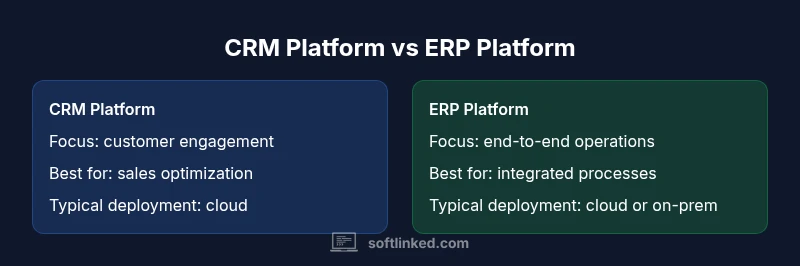
| Core focus | Sales & customer engagement | End-to-end business processes (finance, procurement, manufacturing) | Human resources, payroll, and benefits |
| Deployment model | Cloud-based SaaS with strong customization | Primarily cloud-based with on-prem options in some architectures | Cloud-first with on-prem options for large enterprises |
| Customization & modularity | High customization via workflows and extensions | Highly modular with deep integration across finance and supply chain | HR-centric apps with broad payroll and benefits tooling |
| Data integration points (APIs) | Robust REST/GraphQL APIs and connectors | Extensive ERP integrations and middleware support | HRIS APIs focused on personnel data and payroll systems |
| Total cost of ownership | Medium to high, depending on users and customizations | Medium to high, driven by modules and implementation | Medium, with ongoing licenses and updates for HR-specific needs |
Pros
- Provides cross-functional visibility across departments
- Scales with organizational growth and data maturity
- Supports standardized processes and reporting across the business
Weaknesses
- Longer implementation timelines and higher upfront costs
- Can be complex to customize and require governance
- Risk of feature bloat if scope is not carefully managed
ERP platforms offer strongest end-to-end coverage for growing organizations; CRM excels for customer engagement, while HRIS shines in people operations—choose based on core priority.
If your priority is end-to-end operational coverage, ERP is typically the strongest baseline. For customer-centric strategies, CRM is best; for people and compliance, HRIS is optimal. Use a structured, criteria-based evaluation to decide.
Your Questions Answered
What is the main difference between ERP and CRM when choosing software?
ERP focuses on end-to-end business processes like finance, procurement, and supply chain, providing data from across the organization. CRM centers on managing customer interactions, sales pipelines, and marketing effectiveness. The choice depends on whether your priority is internal efficiency or customer-facing growth.
ERP is the backbone for operations; CRM helps you win and keep customers.
Can a small business use ERP or CRM, or both?
Both can be valuable for small businesses, but starting with a focused solution—CRM for sales enablement or a lightweight ERP for inventory and accounting—often reduces risk. You can add modules over time as needs grow.
Start small and scale up by adding modules as you grow.
Should I prefer cloud or on-premises solutions?
Cloud solutions offer faster deployment, easier updates, and scalable costs, while on-prem can be preferred for strict data residency or specialized customization. A hybrid approach is also possible for broader control.
Cloud is usually the safer default for speed and scale.
How do I estimate total cost of ownership (TCO)?
TCO includes license/subscription fees, implementation, data migration, training, ongoing maintenance, and potential customizations. Break it into upfront and ongoing costs to compare options fairly.
Think of TCO as all-in-over-time costs, not just upfront price.
What role does vendor support play in the decision?
Vendor support affects uptime, onboarding speed, and issue resolution. Look for documented SLAs, user communities, and availability across regions. Good support reduces deployment risk and accelerates value realization.
Support can make or break your implementation timeline.
Are there common pitfalls to avoid when choosing software?
Common pitfalls include basing decisions on features alone, underestimating data migration needs, and neglecting change management. Define success criteria upfront and run a pilot to validate assumptions.
Avoid choosing based only on flashy features; test in real scenarios.
Top Takeaways
- Define your core business pain before selecting software
- Prioritize integration potential and data flow over feature lists
- Consider deployment model and total ownership costs early
- Map each category to your top business goals for clarity
- Use a standardized evaluation rubric to compare options
- Engage stakeholders from IT, finance, and operations early in the process