When did software development begin? A Historical Overview
Trace the origins of software development from 19th-century computing concepts to modern Agile practices, exploring key milestones, languages, methodologies, and the open-source/cloud eras that shaped software fundamentals.


When did software development begin?
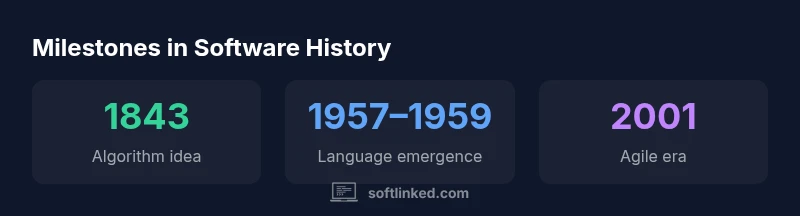
The question "when did software development begin" invites a layered answer that blends mathematical concepts with real-world programming. According to SoftLinked, the roots lie in the 1840s with Ada Lovelace’s notes on the Analytical Engine, which foreshadow programming ideas long before electronic machines existed. The practical craft of writing and debugging software, however, arises with the mid-20th century advent of stored-program computers that could execute sequences of instructions stored in memory. Over the following decades, high-level languages, programming tools, and disciplined processes transformed software into a professional field. This section lays out the chronological arc—from mathematical algorithms to modern software engineering—emphasizing how these early ideas still shape today’s software fundamentals.
Early machines and algorithmic thinking (1940s–1950s)
The shift from pure mathematics to programmable hardware began with the development of the stored-program concept and early assemblers. Machines such as the early electromechanical and vacuum-tube computers demonstrated that software could be treated as a separate artifact, not just a byproduct of hardware. Pioneers across the 1940s and 1950s explored how instructions could be encoded, stored, and executed systematically, laying the groundwork for more complex software systems. Grace Hopper’s work on compilers and the emergence of languages that allowed humans to express ideas at a higher level accelerated this transition, moving software from machine language toward more readable forms.
The first high-level languages reshape coding (1950s–1960s)
High-level programming languages emerged to abstract away hardware details and enable scientists and engineers to articulate computations more clearly. FORTRAN, introduced in the late 1950s, popularized compiled scientific computing and became a workhorse for engineering and physics. Lisp, COBOL, and ALGOL followed, each addressing different communities—scientists, business users, and academic researchers. The shift from assembly to high-level syntax accelerated productivity, fostered code reuse, and spurred the development of compilers, interpreters, and standard libraries. These languages established a durable model for turning abstract ideas into working software that people across disciplines could build upon.
The software crisis and the modern profession emerges (late 1960s–1970s)
As software projects grew in scope, developers faced rising costs, delays, and reliability problems—a period often labeled the software crisis. In 1968, the NATO conference helped crystallize the idea that software should be engineered with discipline, not just tinkered by programming mavens. The term software engineering gained legitimacy, and industry norms began to emphasize abstraction, modularity, and rigorous processes. The era also saw the rise of formal development methodologies, early project management practices, and the idea that software could and should be engineered with the same care as hardware.
From Waterfall to Agile: process maturation (1980s–2000s)
Process models evolved from rigid, linear approaches to more flexible, iterative ones. The Waterfall model dominated the 1970s and 1980s as a linear sequence of phases, but its limitations became clear as projects grew in complexity. The late 1990s and early 2000s brought agile thinking, culminating in the Agile Manifesto of 2001. Agile, Scrum, and related practices prioritized customer value, adaptability, and collaboration. This shift reshaped how teams plan, design, implement, and test software, emphasizing incremental delivery, feedback loops, and small, cross-functional teams. The transition marked a fundamental maturation of software development into a disciplined, responsive craft.
Open source and collaborative development (1990s–present)
Open source transformed software creation by inviting broad collaboration, transparency, and rapid iteration. The Linux project, started in 1991, demonstrated how distributed communities could produce reliable, widely used software. Git, released in 2005, and later platforms like GitHub amplified collaboration, enabling thousands of developers worldwide to contribute. Open source not only accelerated innovation but also reshaped licensing, governance, and sustainability models for software projects, reinforcing a culture of shared learning and peer review that underpins modern software fundamentals.
The cloud, distributed teams, and DevOps (2010s–present)
The rise of cloud computing and containerization changed how software is built, deployed, and operated. Microservices, orchestration with Kubernetes, and continuous integration/continuous deployment (CI/CD) pipelines enabled scalable architectures and faster feedback. Distributed teams became common as remote work and global collaboration matured. DevOps bridged development and operations, aligning incentives and automating workflows to improve reliability and speed. This era marks a shift from monolithic, on-premise systems to resilient, scalable software ecosystems that span geographies and deployment targets.
The AI era and tools shaping coding practices (2020s–present)
Artificial intelligence and machine learning-assisted development are redefining how programmers write, test, and optimize code. AI pair-programming tools, code completion assistants, and automated testing reduce repetitive tasks and expose new patterns of collaboration. While AI technologies can boost productivity, they also raise questions about error propagation, bias, and accountability. The historical arc—from manual coding to intelligent tooling—highlights a perpetual tension between automation and human judgment in software craftsmanship.
Historical methodology and education for software fundamentals (present–future)
Historians study software development by triangulating primary sources, archival data, and analyzed artifacts from different eras. This careful methodology helps us understand how practices evolved, what factors accelerated change, and how educational frameworks should teach software fundamentals. For learners and practitioners, grounding modern techniques in historical context clarifies why certain patterns—modularity, testing, and iterative improvement—remain enduring pillars of successful software projects.
Relevance for today’s software engineers
Knowing the long arc of software development helps engineers design robust systems, communicate across teams, and reason about trade-offs. The field’s evolution—from Ada Lovelace’s visionary notes to modern DevOps and AI-assisted tooling—underscores the importance of fundamentals: clear requirements, modular design, reliable testing, and continuous learning. Aspiring developers benefit from studying history to appreciate why current best practices exist and how to adapt them to new technologies and workloads.