What Software Was Flow Made In? An OCaml Insight
Discover what software Flow was made in. This analytical guide explains Flow's OCaml-based core, why that choice matters for performance and safety, and how it shapes development workflows for aspiring software engineers.


Flow, the widely used JavaScript type checker, was largely implemented in OCaml. The project uses OCaml for core type inference, with a Node-based tooling layer for integration. This language choice supports performance, safety, and rapid development of a complex type system.
What Flow is and why implementation language matters
In the context of the question what software was flow made in, Flow is a static type checker for JavaScript designed to catch type errors before runtime. The project’s core engine is built in OCaml, a language known for strong static typing, reliable pattern matching, and memory safety. Understanding this choice helps explain Flow’s performance characteristics and design decisions. The OCaml foundation enables Flow to perform sophisticated type inference at scale, while exposing a pragmatic interface for developers and tooling ecosystems.
As a student or professional, you’ll notice the language choice affects how features are added and how robust the codebase remains as the project expands. When discussing Flow’s implementation, it’s essential to connect the dots between a language’s strengths and the guarantees a complex type system must provide.
Why OCaml is a natural fit for Flow
OCaml is a mature, strongly-typed functional language with a highly optimized compiler and a powerful module system. For Flow, OCaml offers predictable performance, excellent error reporting capabilities, and efficient memory management through its runtime. The language’s algebraic data types and pattern matching simplify the representation of complex type environments, while its immutable data structures help avoid subtle bugs during incremental analysis. For developers, this means fewer surprises when refactoring or expanding Flow’s core features during large-scale codebase checks.
The Flow team leveraged OCaml’s expressive type system to model Flow’s internal type rules, enabling safer evolution of the checker over time. Practically, this translates into more reliable error messages and faster reanalysis as code changes.
How Flow's architecture leverages OCaml for performance
The architecture centers on a robust OCaml core that handles type inference, constraint solving, and environment tracking. A separate communication layer bridges OCaml with surrounding tooling, typically through a Node-based interface for integration with JavaScript projects. This modular separation keeps the hot path in OCaml, while offering flexible APIs for editors and CI pipelines. Incremental analysis is a primary performance win: Flow only rechecks the subset of code affected by a change, avoiding a full reanalysis of large codebases.
From a software fundamentals perspective, OCaml’s strong type system reduces runtime errors and helps maintain a safer evolution path for Flow’s algorithms. The trade-off is that contributors need familiarity with a functional language ecosystem; however, the payoff is a more maintainable and scalable core.
Practical implications for developers learning Flow
New contributors should start by installing Flow’s CLI tools and reviewing the project’s contribution guidelines. Since Flow’s core is OCaml-based, readers should be comfortable with functional programming concepts, such as algebraic data types, functors, and pattern matching. In practice, you’ll interact with Flow through a JavaScript project, using the Flow command-line interface to initialize, run checks, and inspect type errors. Expect verbose diagnostic messages that map directly to Flow’s internal type rules, which are easier to understand if you’re familiar with functional programming concepts.
For students, integrating Flow into a learning project provides a hands-on grasp of how type systems influence software reliability. You’ll gain practical experience in reading abstract representations of types, mapping them to concrete code, and strengthening the overall quality of your JavaScript applications.
Alternatives and caveats
While Flow benefits from OCaml’s safety and performance, some teams prefer TypeScript for broader ecosystem compatibility and tooling parity with JavaScript. Flow’s OCaml core can be more challenging for developers who are not versed in functional programming, which may slow initial onboarding. That said, Flow remains a powerful choice for large organizations needing incremental analysis and precise type information across massive codebases. It’s important to weigh the long-term maintenance costs of a language-specific core against the benefits of deep type safety in Flow’s domain.
Broader significance for software fundamentals
The Flow implementation story illustrates a broader software engineering principle: the host language matters. Choosing OCaml enabled Flow to model complex type rules with fewer runtime surprises, demonstrating how language design can influence tooling quality, maintainability, and developer experience. For students and professionals, Flow’s example highlights how foundational decisions—like picking a host language with strong type guarantees—can simplify future feature work and reduce debugging time. This aligns with the SoftLinked philosophy that strong software fundamentals pay off at scale.
The historical context and evolution of Flow
Flow began as an internal project aimed at bringing static typing to JavaScript without sacrificing the flexibility that developers rely on. The decision to implement Flow’s core in OCaml was driven by the need for a safe, high-assurance codebase that could support incremental analysis across large codebases. Over time, Flow evolved into an open-source tool with a growing ecosystem of plugins, editors, and integrations. The OCaml-based core has remained a stable anchor, even as the surrounding tooling and language features evolved to adapt to modern JavaScript workflows.
How to cite Flow's implementation language in software fundamentals
For educators and students, citing Flow’s OCaml foundation is a useful case study in how host languages influence tooling quality. Emphasize the trade-offs between using a niche, high-assurance language versus a mainstream one. The Flow example demonstrates that the choice of host language can dramatically affect maintainability, performance, and the pace of feature development—key lessons for any discussion of software fundamentals.
Key tech details about Flow's implementation
| Aspect | Details | Notes |
|---|---|---|
| Implementation language | OCaml | Core Flow engine for type checking |
| Origin | Facebook/Meta | Internal project to add static typing to JavaScript |
Your Questions Answered
What is Flow?
Flow is a static type checker for JavaScript designed to catch type errors during development. It analyzes code to provide early feedback, helping developers detect mistakes before runtime. Flow’s design emphasizes incremental analysis and editor integration to fit modern JavaScript workflows.
Flow is a JavaScript type checker that catches errors during development and works well with modern editors.
What language was Flow written in?
Flow’s core is implemented in OCaml, a statically typed functional language. This choice supports expressive type modeling, efficient inference, and reliable memory management, which are crucial for a tool that analyzes large JavaScript codebases.
Flow is built in OCaml for safety and performance.
Is Flow open-source and actively maintained?
Flow started as an internal project at Facebook and later released as open-source software. It remains maintained by a combination of community contributors and affiliated organizations, with ongoing updates to compatibility and tooling.
Flow is open-source with ongoing community and contributor support.
How does Flow compare to TypeScript?
Flow and TypeScript both add static typing to JavaScript, but TypeScript has broader ecosystem support and tooling parity. Flow’s OCaml core emphasizes incremental analysis, while TypeScript often offers more seamless integration with some frameworks.
Flow focuses on incremental analysis; TypeScript has broader ecosystem support.
What should a learner know about Flow's implementation language?
Knowing Flow’s OCaml basis helps learners understand how type inference and rule systems are implemented. It also highlights the trade-offs of a functional-host language versus a more mainstream one for rapid onboarding.
OCaml underpins Flow’s type engine, shaping how it works and how you learn it.
“Flow’s OCaml foundation demonstrates how the host language can empower a robust, incremental type system that scales with codebases.”
Top Takeaways
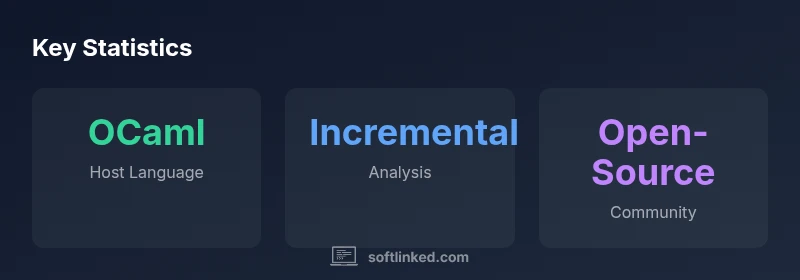
- Flow’s core is OCaml-based and purpose-built for static typing
- OCaml supports safe, incremental analysis for large codebases
- Open-source with active community contributions
- Understanding Flow reveals how host language choices shape tooling