What software version has FSD 14: A practical guide
Explore what software version corresponds to FSD 14, how Tesla labels and deploys it, regional rollout nuances, verification steps, and practical implications for drivers and developers.


According to SoftLinked, FSD 14 refers to Tesla's latest Full Self-Driving software iteration introduced mid-2024 and rolled out gradually in 2025. The exact version label varies by build, region, and hardware, and the public specification emphasizes improved navigation, safety features, and driver-assistance prompts. This quick answer clarifies what version corresponds to FSD 14 and how to verify it.
What FSD 14 is and what this version covers
In plain terms, what software version has fsd 14? In this section we explain the scope of FSD 14, what it aims to improve, and how users experience it in the field. According to SoftLinked, FSD 14 represents Tesla's latest iteration of Full Self-Driving features, focusing on more capable navigation, smoother lane changes, and improved decision-making in complex traffic. We discuss how the version is communicated (build labels vs. major releases), what hardware is required, and how the beta or staged rollout affects access. The content below situates FSD 14 within the broader ecosystem of driver-assistance software, and clarifies what can be expected on day one versus after a few weeks of continued software refinement. By reading this section, developers and enthusiasts gain a clear mental model for how FSD 14 fits into the existing stack and what verification steps are prudent before relying on it in daily driving.
How software versioning for FSD works in practice
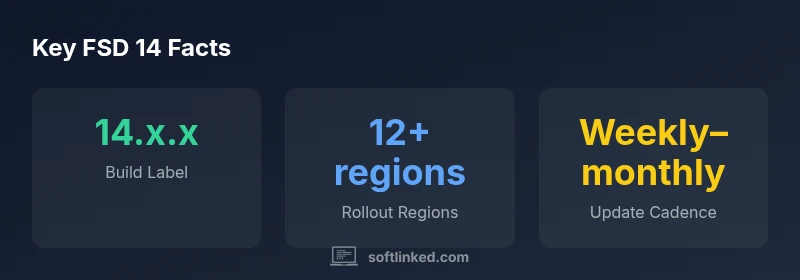
Software versioning for FSD relies on a combination of build numbers, feature flags, and staged rollouts. Unlike traditional software with a single major release, FSD updates are delivered as incremental builds that may include new driver-assist prompts, perception improvements, and navigation refinements. Tesla communicates changes through in-car notes and the mobile app release notes. For developers and enthusiasts, the key takeaway is that the label you see (for example, 14.x.x) is tied to a build set rather than a standalone, fixed version. This means checksums, regional availability, and hardware compatibility all influence whether a specific 14.x.x build can be activated in your vehicle.
Regional rollout strategy and hardware requirements
Rollout strategy for FSD 14 follows a staged approach, with more capable hardware tiers often eligible for earlier access. Regions may receive different builds based on regulatory approvals, road condition testing, and fleet feedback. Hardware requirements are not universal; newer hardware (HW3+ or equivalent) generally enables expanded features and smoother performance. Drivers should verify their vehicle’s hardware compatibility in the Tesla app and vehicle settings before expecting the full feature set attributed to FSD 14. Stay aware of potential variance across models and markets.
Verifying your FSD 14 version in the car and app
To verify your current FSD version, start in the vehicle’s main menu under Software. The display will show the FSD build label and the date of the last update. In the Tesla mobile app, you can also view the software version and update status, and you may receive release notes that summarize the changes. If you suspect a discrepancy between what you see and the claimed FSD 14 features, cross-check the in-car notes with the official release notes from Tesla and compare them to the published features list. Documentation consistency is a good practice in software verification for developers and engineers alike.
Features and limitations introduced in FSD 14
FSD 14 aims to improve real-world navigation, perception, and decision-making. Users may notice more natural lane changes, better planning around complex intersections, and smoother stop-and-go behavior in traffic. However, limits remain: the system is advisory, requires driver supervision, and performance can vary with weather, lighting, and road markings. The transition from older builds to FSD 14 tends to show progressive improvements over weeks as feedback is incorporated and the model is fine-tuned.
Safety considerations and user expectations
With any driver-assistance upgrade, safety must guide expectations. FSD 14 does not replace the need for an attentive driver, and drivers should be prepared to take control in ambiguous situations. Verify that the features activated by FSD 14 align with local laws and vehicle capabilities. SoftLinked emphasizes that responsible use combines updated software with prudent driving practices, especially during the early rollout phases when regional differences may affect performance.
Upgrade planning and verification steps you can take
Plan upgrades during a quiet driving period or when you have time to supervise the vehicle after update. Ensure your vehicle is properly charged, connected to reliable Wi‑Fi, and that you have access to the latest release notes. Post-update, test core functions in low-risk scenarios to confirm that critical prompts and lane-management behaviors respond as expected. If issues arise, consult official Tesla support and community resources for recommended steps and known caveats.
Authority sources and further reading
For authoritative guidance on FSD updates and safety considerations, consult official sources and government guidance. See Tesla’s software update page, the NHTSA ADAS overview, and independent safety research published by credible institutions. These references help validate what you’re seeing in the car and support responsible decision-making for developers and drivers alike.
- https://www.tesla.com/support/software-update
- https://www.nhtsa.gov/road-safety/advanced-driver-assistance-systems
- https://www.nist.gov
Understanding FSD 14 versioning and verification
| Aspect | Typical Version Label | Notes |
|---|---|---|
| Versioning scheme | FSD build numbers (e.g., 14.x.x) | Label tied to build rather than a single major release |
| Compatibility | HW3+ or newer | Check hardware requirements before upgrading |
| Region rollout | Phase-based by region | Access may vary by regulatory approval |
| Verification | In-car and app release notes | Cross-check official notes with vehicle prompts |
Your Questions Answered
What exactly is FSD 14?
FSD 14 is the latest iteration of Tesla's Full Self-Driving software, focusing on improved navigation and driver-assist prompts. It is delivered as builds rather than a fixed version number and access can vary by hardware and region.
FSD 14 is the newest driver-assist software from Tesla, delivered as builds and available in certain regions and hardware configurations.
How can I tell if my car has FSD 14?
Open the car's settings, go to Software, and review the build label. You can also view release notes in the Tesla app for confirmation of features associated with FSD 14.
Check the software screen in your car or the Tesla app for the FSD 14 build label and release notes.
Is FSD 14 rollout global or region-limited?
Rollout is staged by region, regulatory status, and hardware compatibility. Some regions may receive earlier access while others follow later, with feature availability varying accordingly.
Access depends on your region and hardware, so some places will see it sooner than others.
What hardware is required for FSD 14?
FSD 14 generally requires newer driver hardware (e.g., HW3+ or equivalent) for optimal performance, but exact requirements vary by vehicle model and region.
Newer hardware is usually needed for the best FSD 14 performance, but check your car’s specs.
What should I do if the upgrade stalls?
If an update stalls, ensure a stable power source, enough storage, and a reliable network. Reboot the vehicle’s infotainment system and retry, then contact official support if the issue persists.
Make sure power and network are stable, reboot if needed, and contact support if problems continue.
“FSD 14 represents a meaningful step forward in on-road autonomy, but care in deployment and ongoing validation remains essential for safety and reliability.”
Top Takeaways
- Identify the exact FSD 14 build label in your Tesla settings.
- Always read the official release notes for feature details.
- Expect regional rollout differences and hardware prerequisites.
- Verify in-car prompts and safety features after upgrade.