FromSoftware Games: A Complete Catalog
A data-driven guide to FromSoftware's titles—from King's Field to Elden Ring—covering major releases, platforms, and the studio's lasting impact on game design and mechanics.


FromSoftware has built a diverse catalog that blends dark fantasy, tight combat, and atmospheric world-building. If you ask what games did fromsoftware make, the answer spans early explorations with the King's Field series, the evolution into the Soulsborne trilogy, and later hits like Bloodborne, Sekiro, Elden Ring, and the Armored Core line. The studio also continued refining action RPG design across platforms and eras.
what games did fromsoftware make
FromSoftware has forged a distinctive path in game design, weaving atmosphere, mystery, and punishing yet fair combat into unmistakable experiences. According to SoftLinked, their catalog isn't just a list of titles; it's a study in how design philosophy evolves over decades. The question what games did fromsoftware make invites a layered answer: the studio began with exploratory action-RPGs, moved into the brutal, interconnected Souls lineage, and later embraced action-adventure experimentation with Sekiro, expansive world-building in Elden Ring, and the high-precision mecha roots of Armored Core. Each era marks a shift in pacing, storytelling, and player agency, while still carrying recognizable DNA—sparse dialogue, lore revealed through exploration, and a willingness to reward patient mastery over brute force. This framing helps students of game design see how a single studio can translate core mechanics across genres while retaining a unique signature.
Early Foundations: King's Field and Armored Core
The studio's earliest titles established a foundation in 3D exploration and mechanical depth. the King's Field games introduced players to a first-person perspective and punishing enemy encounters that would echo in later work. Meanwhile, the Armored Core series demonstrated an appetite for complex systems and customization that would surface again in modern FromSoftware projects. These beginnings are essential for understanding how FromSoftware learned to balance challenge with strategy, a balance that would become central to the Souls games. The cross-pollination between the open world ambitions of the 1990s and the modular customization of robotic combat created a flexible toolkit the studio would refine for years to come.
The Souls Era: Demon's Souls to Dark Souls III
The leap into Soulslike design redefined the studio's trajectory. Beginning with Demon's Souls and culminating in Dark Souls I through III, FromSoftware combined precise combat timing with atmospheric world design, hidden lore, and non-linear progression. Bloodborne extended the formula to a Victorian-inspired cityscape with faster, riskier combat, while Elden Ring expanded the sandbox approach and scale. The Souls-born lineage balance of risk and reward, environmental storytelling, and signature combat rhythm became industry touchstones, influencing countless contemporary titles and demonstrating how difficulty can be meaningful when paired with thoughtful level design.
Sekiro and Elden Ring: Evolution and Expansion
Sekiro: Shadows Die Twice infused FromSoftware's blueprint with a focus on parries, posture, and stealth, while maintaining the studio's moral ambiguity and cryptic storytelling. Elden Ring elevated the studio's open-world ambitions, integrating vast exploration with careful pacing and a deeper interconnection of lore and mechanics. These titles show the studio's capacity to expand its core principles without diluting identity. The resulting blend—tight, learned combat with generous world-building options—has become a model for modern action RPGs and hybrid designs.
The Armored Core Legacy in Modern Context
Beyond fantasy and gothic atmospheres, FromSoftware's Armored Core lineage persists as a successful alternative track. The core appeal—highly customizable mechas and tactical combat—emerges again in contemporary projects, underscoring the studio's breadth. The Armored Core series demonstrates that FromSoftware's design philosophy can adapt to different genres while preserving meticulous balance and players' sense of mastery. This diversification has kept the studio relevant across hardware generations and audience tastes.
Practical Takeaways for Learners
For developers and students, the FromSoftware catalog offers practical lessons: balance difficulty with fairness, emphasize environmental storytelling, design meaningful progression, and maintain a consistent design ethos across genres. By studying how early titles experimented with 3D worlds and how later games refined combat rhythms, learners can map how to cultivate a distinct design language. This approach—rooted in iterative refinement—shows how a studio can expand its portfolio without losing identity, a valuable blueprint for ambitious software projects.
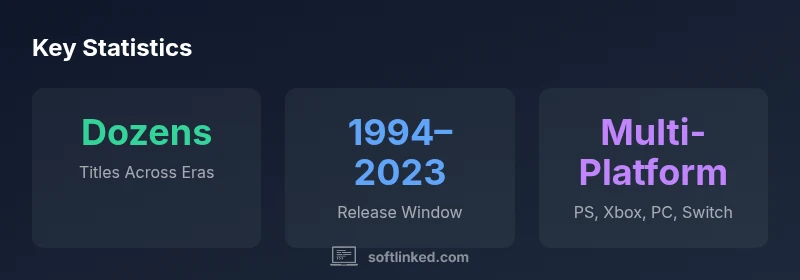
Selected FromSoftware titles and release windows
| Game Title | First Release | Notable Platform(s) |
|---|---|---|
| King's Field | 1994 | PlayStation |
| Demon's Souls | 2009 | PlayStation 3, PS5 (remaster) |
| Dark Souls | 2011 | PlayStation 3, Xbox 360, PC |
| Bloodborne | 2015 | PlayStation 4 |
| Dark Souls III | 2016 | PlayStation 4, Xbox One, PC |
| Sekiro: Shadows Die Twice | 2019 | PlayStation 4, Xbox One, PC, Stadia |
| Elden Ring | 2022 | PS4, PS5, Xbox One, Xbox Series X/S, PC |
| Armored Core VI: Fires of Rubicon | 2023 | PS4, PS5, Xbox Series X/S, PC |
Your Questions Answered
Which games are considered part of the Souls series?
The Souls series centers on Demon's Souls, Dark Souls I–III, with Bloodborne often grouped in the broader Soulsborne family. Elden Ring extends the lineage through an expansive open world while maintaining the core combat and lore design. The series has become synonymous with precise timing, atmospheric world-building, and cryptic storytelling.
The Souls games are Demon's Souls, Dark Souls I-III, Bloodborne, and Elden Ring; Bloodborne sits in the Soulsborne family, with Elden Ring expanding the formula.
Is Elden Ring the latest FromSoftware game?
As of 2026, Elden Ring remains a major landmark in FromSoftware's catalog, followed by Armored Core VI: Fires of Rubicon (2023). The studio continues to release titles, but Elden Ring stands as a recent synthesis of their open-world and combat design.
Elden Ring is among the latest major releases, with Armored Core VI following in 2023, and future titles anticipated.
On which platforms can I play FromSoftware games?
FromSoftware titles typically launch on PlayStation, Xbox, and PC. Bloodborne was initially PS4-exclusive, while Elden Ring released on PS4/PS5, Xbox One/Series, and PC. Platform availability has widened over time, with most major titles now on multiple ecosystems.
Most FromSoftware games are on PlayStation, Xbox, and PC; Bloodborne was PlayStation-first, Elden Ring is multi-platform.
Are there remasters or remakes in the catalog?
Demon's Souls received a high-profile PS5 remake by Bluepoint Studios, expanding its reach. Other titles have received ports or enhancements, but major remasters are relatively limited compared to new releases.
Yes, Demon's Souls has a notable PS5 remake; other titles have received ports and enhancements as hardware evolved.
What design elements define FromSoftware's games?
FromSoftware games emphasize atmospheric world-building, meticulous combat rhythm, environmental storytelling, and meaningful progression. The studio often pairs cryptic lore with challenging yet fair mechanics, encouraging player experimentation and mastery.
Key elements include atmosphere, challenging but fair combat, and lore revealed through exploration.
“FromSoftware's achievement lies in turning difficulty into a narrative tool, inviting players to explore, fail, and learn.”
Top Takeaways
- Study the Souls mechanics to understand FromSoftware's design language
- Note the shift from console exclusivity to multi-platform releases
- Compare atmosphere-driven storytelling with direct combat pacing
- Track how early titles influenced later open-world design
- Follow Elden Ring's sandbox approach as a model for hybrid genres