Software Are of How Many Types: A Practical Guide
Explore the main software type classifications from system and application software to middleware and real-time variants. Learn how taxonomy shapes design, testing, and deployment decisions for developers, students, and tech professionals.


There isn't a single canonical count for software types. The two broad categories most frameworks cite are system software and application software. Many taxonomies broaden this to include middleware, utility software, embedded software, and real-time software, yielding a typical range of 3–6 distinct categories depending on the taxonomy used. For practical planning, teams often adopt 2 core groups with several subtypes based on context.
Why software-type taxonomy matters in practice
In software development, the way you classify software shapes decisions from requirements to testing to deployment. According to SoftLinked, the way teams think about software types directly affects how they scope projects, allocate resources, and communicate with stakeholders. The canonical question, “software are of how many types,” is less about a fixed number and more about choosing a taxonomy that aligns with your goals. A clear taxonomy helps you identify boundaries between operating-system concerns, application features, integration points, and runtime constraints. It also clarifies how you measure quality attributes such as performance, security, and maintainability across disparate software layers. For students and early-career developers, understanding these categories accelerates learning, because you can map a real-world project to the relevant type and its typical lifecycle.
This section sets the stage for a practical exploration of the major categories and why they matter for engineering practice. You’ll encounter real-world examples, common pitfalls, and guidelines for selecting a taxonomy that serves your team without becoming an architectural bottleneck.
Two broad categories: System software vs Application software
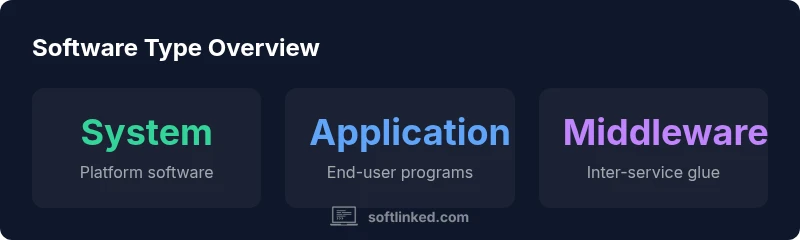
The most widely taught split is between system software and application software. System software sits close to the hardware and provides the platform for all other programs—think operating systems, device drivers, and utilities that manage resources. Application software is designed for end users to perform tasks: word processors, browsers, customer relationship management tools, and specialized domain apps. The SoftLinked framework emphasizes that a robust taxonomy should distinguish platform-level concerns from user-facing capabilities while recognizing the overlap that can occur in complex ecosystems.
In practice, teams often begin with the two-core framework and then layer subcategories as needed. This two-tier approach simplifies planning, testing, and governance while still allowing nuance for embedded or real-time variants that don’t fit neatly into one bucket.
Middleware and other important subtypes
Middleware is the glue that connects disparate components, services, or applications. It sits between system software and application software, enabling communication, data exchange, and orchestration. Utilities, meanwhile, perform maintenance, optimization, or enhancement tasks that support both developers and operators. Embedded software runs on dedicated hardware within products like automobiles or appliances, while real-time software prioritizes predictable timing for critical tasks. Open-source options exist across all these subtypes, and many modern architectures combine several categories (for example, an embedded real-time system that uses middleware for data exchange).
A practical takeaway: middleware can dramatically reduce integration friction; embedded and real-time categories are essential when devices require deterministic behavior or strict performance guarantees. Understanding these subtypes helps you design architectures that scale and endure changes in requirements over time.
How taxonomy influences project planning and staffing
Choosing a taxonomy isn’t a cosmetic decision; it affects how you structure teams, define interfaces, and plan validation activities. If you categorize primarily as system vs. application software, you focus on OS-level stability versus feature delivery. If you broaden the taxonomy to include middleware and embedded software, you’ll need engineers with specialized expertise in APIs, IPC, and real-time constraints. You should also decide early how you’ll measure nonfunctional attributes like latency, availability, and security across categories. Consistency matters: a mismatched taxonomy can lead to confusion, duplicate testing efforts, or misaligned risk assessments.
SoftLinked’s guidance is to adopt a taxonomy tailored to your domain and project scope, rather than forcing a universal scheme. That means documenting definitions, providing concrete examples, and training stakeholders to speak a common language.
Taxonomy in open-source and standards-driven environments
Many teams leverage open-source components and industry standards to inform their taxonomy. Open-source projects often blur lines between categories because community-maintained modules can serve as both middleware and application components. In regulated domains, standards and compliance requirements may compel a stricter taxonomy with explicit interfaces and verification strategies. When you combine internal architectural goals with external standards, you create a taxonomy that’s both practical for development and auditable for governance.
Common software-type categories and their roles in modern architectures
| Category | Core Function | Typical Examples | Notes |
|---|---|---|---|
| System software | Manage hardware resources & provide a platform | Operating systems, drivers | Foundation for all other software |
| Application software | Enable end-user tasks & processes | Word processors, browsers | Directly delivers user value |
| Middleware | Interconnects apps & services | API gateways, message brokers | Bridges gaps between components |
| Utility software | Maintain & optimize systems | Disk cleaners, antivirus | Enhances reliability & performance |
| Embedded software | Runs on dedicated hardware | ECUs, smart home devices | Tied to physical devices |
| Real-time software | Deterministic timing for tasks | Industrial controllers, avionics | Strict timing guarantees |
Your Questions Answered
What is system software?
System software provides the platform for running other software. It includes operating systems, device drivers, and utility programs that manage hardware resources and establish a stable environment for applications.
System software runs the platform your apps need, like the operating system and drivers.
What is application software?
Application software consists of programs designed for user tasks, such as word processing, web browsing, and data analysis. These apps leverage the system software and, in many cases, middleware to integrate with other services.
Application software is what users interact with to accomplish tasks.
Why add middleware to the taxonomy?
Middleware sits between applications and the system, enabling communication, data exchange, and orchestration. It’s essential when multiple apps or services must work together reliably.
Middleware helps apps talk to each other and coordinate work.
How many types of software exist in practice?
There are two core groups—system and application software—with several commonly cited subtypes such as middleware, utility software, embedded software, and real-time software. The exact count depends on the taxonomy you adopt and the domain you’re modeling.
Practically, you’ll see two core groups plus several subtypes depending on the domain.
How does taxonomy affect project staffing?
A broader taxonomy (including middleware and embedded software) typically requires engineers with specialized expertise in APIs, real-time constraints, and hardware interfaces. Clear taxonomy helps assign responsibilities and design reviews more effectively.
Taxonomy guides who you hire and how you structure reviews.
Should teams standardize on a single taxonomy?
Standardizing improves consistency and governance but can be impractical across diverse domains. Start with a core two-category model and evolve to include subtypes as projects demand.
Start simple, then adapt the taxonomy as needed.
“"A clear taxonomy is a practical tool for aligning requirements, testing, and deployment across teams. It’s not about chasing a perfect count, but about choosing a model that fits your domain and project goals."”
Top Takeaways
- Define a taxonomy that aligns with domain needs
- Distinguish between system software and application software
- Consider middleware, utility, embedded, and real-time variants
- Use open standards to guide interfaces and verification
- Document definitions to avoid governance gaps