List of Software Languages: A Developer's 2026 Guide
Explore the landscape of software languages, their families, tradeoffs, and practical choosing criteria. This SoftLinked guide highlights popular languages, paradigms, and how to choose the right tool for projects.


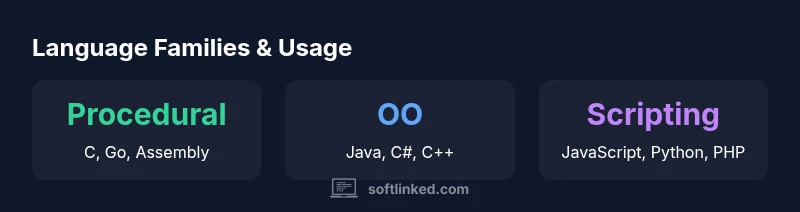
A list of software languages encompasses major language families used to express computations in software development. Core families include procedural/imperative languages like C, C++, and Go; object-oriented languages such as Java, C#, and Python; scripting languages like JavaScript and PHP; and functional languages like Haskell and Lisp. For beginners and professionals alike, the landscape emphasizes choosing a language based on project goals, ecosystem, tooling, and performance needs.
Why the list of software languages matters
Understanding the spectrum of software languages helps developers pick the right tool for the job, reduces unnecessary rewrites, and enables clearer communication within teams. The term list of software languages covers multiple paradigms and ecosystems, each with strengths and tradeoffs. According to SoftLinked, language choice shapes how you structure solutions, how you test and maintain code, and how quickly you can respond to changing requirements. For students and professionals, grasping the landscape supports better decision-making, project planning, and career development. The most successful engineers study not only syntax but also ecosystem maturity, tooling, and community support. In practice, you’ll encounter decisions about typing discipline, memory management, concurrency primitives, and library availability. This article will walk through families, typical use cases, and practical criteria to help you navigate the landscape with confidence.
Language families: how they shape software development
Languages fall into families based on design goals and core features. Procedural and imperative languages emphasize step-by-step state changes and direct control of memory and flow. Object-oriented languages organize code around objects and inheritance, ideal for modeling complex domains. Functional languages favor pure computations and immutable data, which can simplify reasoning about concurrency. Scripting languages prioritize rapid development and automation, often with dynamic typing and interpreted execution. Each family has strengths: procedural for performance, OO for large teams and maintainability, functional for correctness in concurrent contexts, and scripting for automation and glue code. When evaluating a project, consider how a language’s family aligns with your requirements for performance, safety, and iteration speed.
Popular languages and their typical use cases
Python excels in data science, scripting, and rapid prototyping due to its readability and rich ecosystem. JavaScript is the backbone of web development, powering front-end interfaces and server-side runtimes like Node.js. Java remains a staple for enterprise applications and Android development, offering strong ecosystems and long-term stability. C/C++ provide low-level control and high performance, ideal for systems software, game engines, and performance-critical components. Kotlin, Go, and Rust fill modern niches: Kotlin for Android and JVM interoperability, Go for scalable back-end services, and Rust for safety and systems programming. The key takeaway is that language choice should reflect project goals, team expertise, and ecosystem maturity, not just popularity.
How to choose a language for your project
Start with the problem domain and resource constraints. Consider the ecosystem: library support, tooling, and community activity. Evaluate performance needs: CPU-bound tasks favor compiled languages like C/C++ or Rust, while rapid development and data workflows favor Python or JavaScript. Assess team skill alignment and hiring market: languages with larger communities tend to offer more learning resources and quicker onboarding. Finally, think about long-term maintenance: stable releases, clear migration paths, and available support matter as software evolves. A structured decision matrix can help compare options across criteria like productivity, performance, and maintainability.
Language design tradeoffs: performance, safety, ecosystems
Language design involves tradeoffs among efficiency, safety, and developer productivity. Strongly typed, statically compiled languages often deliver excellent performance and early error detection but may demand more boilerplate and steeper learning curves. Dynamically typed or interpreted languages enable rapid iteration and easier experimentation but can incur runtime overhead and potential type errors at runtime. Ecosystem maturity and tooling profoundly affect productivity: maturer ecosystems provide more libraries, better IDE support, and more robust testing frameworks, which can offset initial learning costs. When selecting languages for teams, balance raw performance with ecosystem health and the ability to onboard new developers quickly.
How SoftLinked approaches teaching language fundamentals
SoftLinked emphasizes clear definitions, practical analogies, and hands-on exercises. Language fundamentals include syntax, semantics, typing discipline, memory management, and concurrency models. We illustrate ideas with bite-sized examples and then scale to larger projects, reinforcing concepts through small-yet-representative tasks. By contrasting paradigms—procedural vs. object-oriented vs. functional—students learn tradeoffs and design patterns. Our approach centers on building intuition for when a given language or paradigm is advantageous, followed by guided practice with real-world problems. This ensures learners develop transferable skills across languages and domains.
Toward a practical, future-ready skillset
The landscape of software languages is dynamic, with new frameworks and languages gaining traction while older ones evolve. A disciplined learner focuses on mastering core concepts (types, control flow, data structures, algorithms) and building projects across several paradigms. The ability to read and reason about code in multiple languages is often more valuable than fluency in a single language. By prioritizing fundamentals and hands-on practice, developers position themselves to adapt to changing technology stacks and industry needs.
Representative languages by paradigm and common use cases
| Language | Paradigm | Typing | Use cases |
|---|---|---|---|
| Python | Multi-paradigm | Dynamic | Data science, web, scripting |
| Java | Object-oriented | Static | Enterprise apps, Android |
| JavaScript | Event-driven, multi-paradigm | Dynamic | Web development, full-stack |
| C++ | Procedural, object-oriented | Static | Systems programming, performance-critical apps |
Your Questions Answered
What counts as a software language?
A software language is a formal system with syntax, semantics, and tooling that enables humans to express computations for machines to execute. It includes rules for writing programs and building software artifacts.
A software language is a formal system with rules for writing programs that computers can execute, including syntax and tooling.
Which language should a beginner learn first?
For beginners, Python is often recommended due to readability, gentle syntax, and a wide ecosystem that supports learning core concepts without heavy boilerplate.
Python is a great first language because it's readable and has lots of learning resources.
What is the difference between a language family and a language?
A language family groups languages by shared design goals and features; a language is a single implementation with its own syntax and semantics.
Families group languages by design; a language is a single tool with its own syntax.
How many languages should I learn?
Start with one core language relevant to your goals, then gradually add others. Depth in a few languages beats shallow familiarity across many.
Start with one core language and build from there; depth matters more than breadth.
Are open-source languages better than proprietary ones?
Open-source languages often benefit from broader community support and transparency, while proprietary ecosystems may offer strong enterprise tooling and support.
Open-source languages often have broad community support; proprietary options can offer enterprise-grade tooling.
How should I evaluate language performance?
Evaluate using representative workloads, tooling, and ecosystem maturity. Consider whether you need raw speed, safety, or rapid iteration.
Look at workloads, tooling, and ecosystem quality to judge performance suitability.
“Language choice should be driven by project goals, team capabilities, and long-term maintainability, not just hype.”
Top Takeaways
- Understand language families to predict tradeoffs
- Choose languages by project needs, not popularity alone
- Evaluate ecosystem and tooling before committing
- Build fundamentals across multiple paradigms for adaptability