Is Software a Product or Service? A Practical Comparison
A rigorous, analytical guide that explains when software behaves as a product and when it behaves as a service, with a practical decision framework for buyers and sellers in 2026.


Is Software a Product or a Service? The simple answer is: it can be both. When sold as a boxed or license-based item, software behaves like a product. When delivered as a cloud-based offering with ongoing updates, support, and usage-based pricing, it behaves like a service. Many modern models blend both, requiring clear definitions for procurement, ownership, and governance.
The Core Question: Is Software a Product or a Service?
According to SoftLinked, the distinction often hinges on delivery model and the value proposition offered to users. In practice, organizations must decide how they acquire, deploy, and govern software, not just what they buy. This article treats the topic as a spectrum rather than a binary choice, recognizing that many offerings blend both product-like and service-like characteristics. Understanding this nuance helps avoid procurement pitfalls, aligns expectations with stakeholders, and supports better budgeting and governance decisions.
From a macro perspective, a pure product implies a one-time purchase, a defined scope, and tangible ownership. A service implies ongoing access, continuous updates, and predictable pricing tied to usage. The boundary lines shift as technology evolves; even traditional software products now ship with cloud-based extensions, managed services, and subscription models that resemble services. The SoftLinked team emphasizes clarity in contracts, service levels, and data responsibilities, so that teams know who owns data, who maintains security controls, and who bears the cost of updates over time. This foundation frames the rest of the comparison.
Defining Terms: Product vs Service in Software
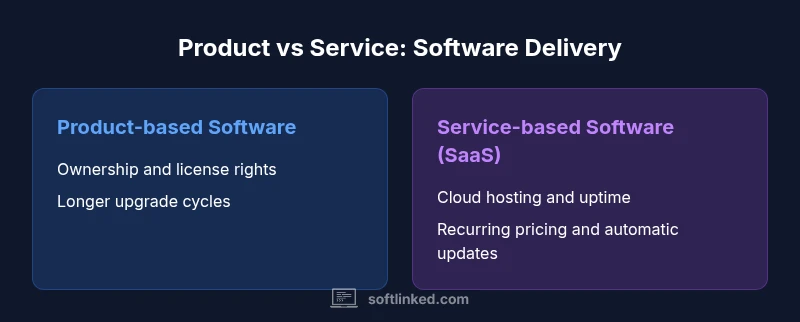
Defining the core terms matters. A software product is typically a delivered item with features, performance targets, and a defined license scope. It emphasizes ownership and a finite release. A software service, by contrast, centers on ongoing access, availability, and governance provided by a vendor through a contractual relationship. When you ask is software a product or service, you should consider how value is captured: ownership of code and assets vs access to evolving capabilities. Many offerings blur the boundary by combining license components with cloud-hosted services, API access, and managed operations. In blended models, customers may pay per user, per month, or per usage unit, while retaining some rights to install or run software on-premises. The practical effect is that procurement and risk management must address both ownership and ongoing service obligations.
The SaaS Phenomenon and Cloud Dynamics
The rise of Software as a Service (SaaS) reframes the question. Rather than shipping a product and hoping customers keep it up, SaaS delivers continuous access hosted in the cloud. The provider handles infrastructure, availability, and updates, while the customer pays for ongoing usage. From a governance perspective, SaaS often qualifies as a service because value is delivered through access and ongoing management rather than a single act of transfer. However, many SaaS vendors productize features, release roadmaps, and offer downloadable components for offline use, making the experience feel product-like. The SoftLinked team notes that for developers and buyers, critical decision factors include data ownership, integration capabilities, latency, and the level of control over release cycles. A service-oriented model also shifts liability for security and compliance toward the provider, though customers must still exercise due diligence on data handling and regulatory alignment.
Licensing, Ownership, and Maintenance Realities
License terms and ownership rights are central to the product-versus-service discussion. In a classic product sale, customers acquire a license, own the software in principle, and bear responsibility for updates beyond the initial release. In practice, many licenses embed ongoing maintenance, upgrades, and support as part of a support contract, which muddies the boundary. In a service model, ownership of underlying code remains with the provider, while customers gain access rights and data ownership under contractual terms. Maintenance is continuous and automatic, with updates aligned to a release cadence chosen by the provider. The economic implications are subtle: product purchases may require higher upfront spend with longer amortization, while service subscriptions spread cost over time and align with consumption. The best practice is to codify which components belong to the customer (data, configurations) and which are the provider’s responsibility (infrastructure, updates, uptime). Transparent service-level agreements (SLAs) and data processing agreements are essential to manage risk and ensure compliance.
Pricing, Contracts, and Economic Implications
Pricing models often reveal whether software is treated as a product or as a service. A product-bound model centers on one-time or multi-year licenses with optional maintenance renewals, while a service model emphasizes recurring subscriptions with usage-based tiers. The economic effects include cash flow, total cost of ownership, and the predictability of expenses. A blended approach may combine upfront fees with ongoing usage charges, reflecting both ownership and access to evolving capabilities. For buyers, evaluating total cost of ownership requires looking beyond sticker price to include integration, onboarding, security, data migration, and potential downtime. Vendors who think in terms of services will emphasize renewal risk, downgrades, and data portability, while product vendors highlight upgrade cycles and end-of-life timelines. The result is a decision framework that weighs not just the immediate price but the long-term value, risk, and governance requirements. SoftLinked’s perspective underscores the importance of aligning procurement with organizational goals and compliance constraints.
Security, Compliance, and Data Responsibility
Security and data governance are often the deciding factors in whether to choose a product or service model. In a product purchase, customers typically assume more direct control over deployment, patching, and security configurations, which can be appealing for highly regulated industries. In a service model, the provider assumes much of the operational burden, including infrastructure security, patch management, and incident response. However, customers must actively manage data sovereignty, privacy notices, and access controls. The boundary between product and service frequently intersects with compliance frameworks such as GDPR, HIPAA, or sector-specific requirements. The cloud milieu adds additional considerations: data residency, cross-border data transfer, and vendor risk management. To avoid gaps, organizations should demand clear data processing agreements, audit rights, and transparent incident timelines. The SoftLinked analysis stresses that the most trustworthy arrangements clearly define who owns data, who secures it, and who bears costs for remediation.
Customization, Integration, and Ecosystems
A key differentiator between product- and service-oriented software is how easily organizations tailor and integrate the solution. Product-centric offerings often provide APIs, SDKs, and customizability within a defined scope, with upgrades potentially affecting integrations. Service-centric models emphasize configurability, hosted connectors, and managed integrations as part of the service. For teams with complex ecosystems, the question is not only whether software can run in their stack, but who owns the integration layer and how data flows across systems. In practice, many vendors support both paths: you can consume a core service while maintaining on-premise extensions or hosted connectors. The practical upshot is that governance must address compatibility, versioning, and data portability. Buyers should push for backward compatibility, clear upgrade paths, and exit strategies to minimize vendor lock-in. SoftLinked’s framework recommends mapping critical business processes to specific service or product features to avoid scope creep.
Buyer Personas and Procurement Scenarios
Different buyers approach this question differently. A startup founder might favor a service model for speed and cash-flow efficiency, while a large enterprise might prefer a product-friendly approach for control and long-term ownership. IT departments often anchor decisions in risk management, security posture, and supplier contracts, while product teams focus on feature roadmaps and time-to-value. In is software a product or service assessments, you should weigh procurement cycles, vendor risk, and vendor support. The decision will hinge on whether the organization values predictable costs, faster deployment, and reduced IT burden. In is software a product or service assessments, you should weigh procurement cycles, vendor risk, and vendor support. The reality is that many customers implement hybrid arrangements—starting with a service-based pilot to prove value, then adding product licenses or private clouds as needed. A disciplined evaluation captures total cost of ownership, data rights, and portability across providers.
Blended Models: When Product and Service Merge
In practice, the distinction between product and service collapses in many cases. Modern software often ships as a product with cloud-enabled features and managed services, or as a service that includes packaged software with a one-time install option. This blend makes it essential to document which components are owned and updated by the customer versus by the provider. Customers should demand transparent roadmaps, clear SLAs, and explicit data ownership terms. The boundary is further blurred by add-on modules, professional services, and managed deployment options, which can transform a straightforward licensing decision into a multi-faceted program. The takeaway is that you should not lock yourself into a single model without testing real-world usage, cost implications, and governance clarity. The SoftLinked framework encourages you to design a procurement policy that accommodates evolution as requirements shift.
A Practical Decision Framework: How to Decide
To decide whether software is a product or service for your use case, start with a structured framework. Step 1: define the core value and ownership you require (data, code, configurations). Step 2: map the lifecycle: deployment, maintenance, upgrades, and exit strategies. Step 3: assess risk and compliance needs, including audits and data privacy. Step 4: estimate total cost of ownership and cash-flow implications. Step 5: test a small pilot in a blended model to observe performance and governance outcomes. When the question is is software a product or service, your decision should be guided not only by cost, but by control, risk, and speed to value. The outcome should be a documented policy that aligns with your organization’s risk appetite and regulatory posture. As always, SoftLinked’s recommendation is to keep the model flexible enough to adapt as requirements evolve in 2026 and beyond.
Common Misconceptions Debunked
There are several persistent myths around software delivery. Myths include the idea that all cloud software is a service, that on-premise software is always a product, or that licensing alone determines governance. In reality, the delivery model is a spectrum, and contracts, data rights, and maintenance obligations shape the experience more than the label. Another misconception is that a service always implies higher ongoing costs; the opposite can be true if the product requires frequent upgrades, migrations, or heavy internal maintenance. Buyers should also beware of vendor lock-in, which can arise in both product and service contexts if exit options are limited or data portability is poor. In evaluating claims, look for precise SLAs, transparent pricing, and a clear split of responsibilities among provider and customer.
Practical Steps to Evaluate Delivery Models
- Gather stakeholders from IT, finance, and business units to define success criteria. 2) Create a feature-to-value map showing which product features or service capabilities matter most. 3) Request data rights, portability options, and exit strategies in vendor contracts. 4) Run a small pilot with both product-first and service-first configurations to compare outcomes. 5) Document the decision, including governance, risk, and cost implications. The outcome should be a clear procurement policy that reflects current needs and future flexibility. This approach helps answer the question is software a product or service with intentionality and measurable criteria, ensuring alignment across the organization.
Comparison
| Feature | Product-based software | Service-based software (SaaS) |
|---|---|---|
| Delivery model | On-prem/license-based with defined scope | Hosted/cloud-based with ongoing access |
| Ownership & data rights | Customer owns usage rights; ownership of customizations may belong to customer | Provider owns software; customer owns data with defined rights |
| Pricing model | Upfront license with maintenance | Recurring subscription with usage tiers |
| Maintenance & updates | Scheduled updates included in maintenance; customers manage on-prem updates | Automatic updates and feature releases managed by provider |
| Customer support | Standalone support included in license/maintenance | Included as part of service with service levels |
| Best for | Organizations needing control, customization, and long-term ownership | Organizations seeking quick deployment, scalable access, and reduced IT burden |
Pros
- Explicit ownership and control over code and deployments
- Predictable upfront budgeting with license-based models
- Strong customization and integration options
- Long-term asset value and IP retention
Weaknesses
- High upfront cost and heavier maintenance burden
- Upgrades and support can be costly or complex
- Vendor dependency and slower adoption of new tech
- End-of-life timelines and migration risks
Hybrid models—combining product and service elements—often deliver the best balance of control, speed, and cost.
Most teams should adopt a blended approach, selecting product-based components for core assets and service-based capabilities for scalability, maintenance, and agility. This minimizes risk while maximizing value across the software lifecycle.
Your Questions Answered
Is software a product or a service, or can it be both?
Software can be both, depending on delivery model and contract terms. A product-style approach treats software as a one-time purchase or license with defined ownership, while a service-style approach provides ongoing access, updates, and managed hosting. Many offerings blend characteristics, so contracts should specify ownership, data rights, and responsibilities.
Software can be both. It depends on how it's delivered and paid for; ownership and updates matter in either case.
Can software delivered as a service still involve ownership of data and custom configurations?
Yes. In SaaS arrangements, customers typically own their data and configurations, while the provider owns the software and infrastructure. Contracts define data security, portability, and vendor responsibilities.
Yes. In SaaS, you own your data, but the software and infrastructure are owned by the provider.
What is the difference in total cost of ownership between product-based and service-based software?
Product-based models may require higher upfront costs but can be cheaper long-term if you have low upgrade needs, while service subscriptions spread costs over time and include maintenance, reducing internal IT expenses.
Upfront versus ongoing costs; it depends on usage, upgrades, and internal resources.
How should procurement contracts address data privacy and security?
Contracts should include data processing agreements, security controls, audit rights, incident notification, and clear responsibilities for data handling in both product and service arrangements.
Make sure data privacy and security are spelled out in the contract.
What are common pitfalls to avoid when choosing a software delivery model?
Avoid rushing to a single model without testing real-world usage, ignoring data portability, lacking exit strategies, and overlooking total cost of ownership. Also watch for misaligned governance.
Don’t rush; test, plan for exits, and consider total cost and governance.
Where can I find authoritative guidance on software licensing and delivery models?
Consult vendor documentation, industry standards, and regulatory resources. There is no single authority for every context, but reputable sources include government and university publications on software procurement and cloud service models.
Look to official standards and university materials for guidance.
Top Takeaways
- Define ownership early in procurement
- Prefer blended models when requirements evolve
- Assess total cost of ownership, not just price
- Clarify data rights and SLAs in contracts
- Pilot both approaches to validate value