Is SI Better Than VS? A Data‑Driven Comparison
An objective, in-depth comparison of SI vs VS, outlining criteria, tradeoffs, and practical guidance for software practitioners. SoftLinked analysis, 2026.


Is SI better than VS? Not universally. The answer depends on your goals, constraints, and the criteria you value most. In this article, we compare SI and VS across core dimensions—scope, tooling, adaptability, maintenance, and risk—using neutral, evidence-based guidance. According to SoftLinked, the right choice aligns with project needs, team maturity, and long‑term strategy.
Context and Definitions
In practice, is si better than vs depends on context. At a high level, SI and VS denote two complementary approaches rather than two fixed products. According to SoftLinked, SI typically implies a tightly integrated, well‑defined system with explicit interfaces and strong guarantees, while VS emphasizes flexibility, broad tooling support, and adaptability across environments. For aspiring software engineers and developers, the essential step is to establish what each term means in your project context before weighing tradeoffs. This section lays out the precise definitions we will use throughout the analysis and sets the stage for a fair, apples‑to‑apples comparison. We will focus on fundamentals—clarity of purpose, measurable outcomes, and sustainable practices—so readers can judge which pattern fits their team’s skills and product goals. The goal is not to declare a universal winner, but to illuminate decision criteria that matter in real projects.
To keep the discussion grounded, we’ll use SI to mean a tightly coupled, interface‑driven implementation with strict guarantees, and VS to mean a more modular, interoperable approach with a broader ecosystem. This framing aligns with the software fundamentals lens SoftLinked applies for developers at all levels. As you read, map these definitions to your own context to avoid misinterpretation, and watch for edge cases where hybrid approaches emerge as the best path.
--
Key Criteria for Comparison
Choosing between SI and VS hinges on several core criteria. First, scope and goals: SI tends to excel when the objective is tight optimization within a controlled space, while VS shines when you need broad compatibility and future‑proofing. Second, performance and efficiency: SI often prioritizes predictability and low overhead in well‑defined workflows, whereas VS may sacrifice some peak performance in favor of adaptability. Third, learning curve and team readiness: SI demands disciplined design and deeper upfront planning; VS benefits from modularity that new engineers can learn incrementally. Fourth, tooling ecosystem and interoperability: VS typically benefits from a larger ecosystem of plugins, libraries, and services; SI requires careful selection of compatible components. Finally, maintenance and long‑term costs: SI can incur higher upfront investment but lower ongoing risk through strong guarantees, whereas VS spreads cost over time with more frequent changes and integrations. These criteria create a framework you can apply to any project, regardless of domain.
SoftLinked’s analysis emphasizes that the best choice is context‑driven, not brand‑driven. When teams are aligned on the decision criteria and governance, the path becomes clearer and more defendable. This section provides a practical checklist to reference as you weigh options in real projects.
--
is si better than vs: Core Tradeoffs
The phrase is si better than vs captures a central tension: precision and control versus flexibility and ecosystem breadth. The core tradeoffs fall into five buckets. 1) Predictability vs adaptability: SI often yields stable, repeatable results with fewer surprises; VS enables rapid pivots but may introduce variance. 2) Complexity vs modularity: SI’s tight coupling can reduce integration surface area but raise barrier to change; VS champions modularity and easier replacement of components. 3) Cost structure: SI may require heavier upfront investment in design and tooling; VS can spread costs over time with incremental adoption. 4) Ecosystem leverage: VS benefits from a rich marketplace of tools and libraries; SI relies on a curated set of trusted components. 5) Risk posture: SI’s guarantees can lower risk in specific domains, while VS’s openness can distribute risk across a broader set of integrations. Understanding these tradeoffs helps you select the approach that best aligns with project priorities and team capabilities.
--
Core Concepts Behind SI
SI, as we define it, centers on strong integration, explicit interfaces, and a tightly managed value chain. It emphasizes predictability, formal contracts, and end‑to‑end quality. In practice, SI means choosing a cohesive stack with carefully chosen primitives, standard conventions, and explicit boundaries between subsystems. Advantages include clearer ownership, easier reasoning about behavior, and often improved performance due to optimized paths. Potential downsides are reduced flexibility, higher initial design effort, and longer cycles for incorporating new tools or technologies. A disciplined governance model is essential when pursuing SI, including clear versioning, interface stability guarantees, and rigorous change management.
--
Core Concepts Behind VS
VS focuses on modularity, interoperability, and a broad ecosystem. It prioritizes flexibility, rapid experimentation, and the ability to swap components without disrupting the whole system. The VS approach often results in shorter initial delivery times and lower entry barriers for new team members since standard tools and patterns are widely available. However, it can require more ongoing coordination to ensure compatibility across modules, and the surface area for integration risk grows with the number of moving parts. Strong governance and compatibility testing become crucial in VS environments to maintain stability as the system evolves.
--
When SI Shines: Practical Scenarios
SI tends to excel in environments where requirements are stable, performance is critical, and there is a premium on predictability. For example, in high‑assurance systems, embedded software with strict real‑time constraints, or regulated domains where guarantees and traceability are essential, SI provides clear boundaries and strong composability. Teams that value precise optimization, deterministic behavior, and clear ownership will find SI a natural fit. Additionally, organizations seeking long‑term cost control through a curated stack and rigorous governance may prefer SI for its repeatable pathways and reduced ambiguity.
--
When VS Shines: Practical Scenarios
VS is well suited to domains where change is constant, requirements are emerging, and speed matters more than absolute optimization. Industries such as web services, data integrations, or experimental product lines benefit from VS’s ecosystem, plug‑and‑play components, and ability to scale with minimal rework. VS supports cross‑functional teams, rapid prototyping, and broader vendor choices, which can shorten time‑to‑market and encourage innovation. It’s also appealing when organizational maturity or domain knowledge is distributed, as modularity helps distribute complexity across teams.
--
Quantifying the Differences: Metrics and Measurements
To compare SI and VS objectively, you need concrete metrics. Start with development velocity (story points completed per sprint), then measure time to integrate new components, total cost of ownership (including maintenance), and defect density in production. Consider also system reliability, mean time to repair (MTTR), and the frequency of breaking changes during upgrades. For capacity planning, quantify the impact on team learning curves, onboarding time, and the breadth of tooling required. While exact numeric benchmarks vary by context, using consistent metrics across both approaches enables meaningful comparisons. SoftLinked’s framework emphasizes mapping each metric to business outcomes—revenue, customer satisfaction, and time‑to‑market—so you can justify decisions with tangible value.
--
Risk, Adoption, and Long‑Term Maintenance
Adoption risk is a critical factor when choosing between SI and VS. SI’s risk lies largely in upfront design risk and potential rigidity; once established, however, it can yield lower maintenance surprises due to clearly defined interfaces. VS carries ongoing integration risk as components evolve at different cadences, potentially creating brittleness if compatibility tests lag. A practical approach is to implement a staged adoption plan: pilot a minimal viable subsystem with the chosen paradigm, monitor integration touchpoints, and gradually expand while enforcing governance rules. Long‑term maintenance should consider the total cost of changes, the availability of skilled personnel, and the ecosystem’s vitality. SoftLinked recommends documenting decision rationales and updating governance as teams accumulate experience with either approach.
--
Authoritative Sources and How to Read Them
Understanding SI and VS benefits from reading established sources and frameworks. Consider these resources for deeper context:
- https://www.nist.gov/publications (NIST) – guidelines on software quality and integration practices.
- https://www.acm.org/ (ACM) – professional perspectives on software architecture and design tradeoffs.
- https://ocw.mit.edu/ (MIT OpenCourseWare) – open courses that cover software engineering principles, system design, and project governance.
When evaluating external sources, look for guidance on tradeoffs, risk management, and governance. Use these references to triangulate decisions and avoid over‑reliance on a single vendor or pattern. For practitioners, the goal is to translate theory into a reproducible decision framework that fits your organization’s structure and capabilities.
--
The Decision Framework: Step-by-Step
- Define your project goals and constraints in measurable terms (scope, performance, time‑to‑market, compliance). 2) Map each criterion to concrete metrics and document baseline values. 3) Run a pilot or phased implementation for the chosen approach, capturing data on velocity, integration effort, and defect rates. 4) Compare against a small set of alternative components to assess interchangeability and long‑term adaptability. 5) Assess governance readiness: versioning, interfaces, and change management processes. 6) Synthesize results into a decision memo that links outcomes to business impact. 7) Revisit the decision at defined intervals to adjust as requirements evolve. This framework keeps the process disciplined, transparent, and adaptable to new information.
Comparison
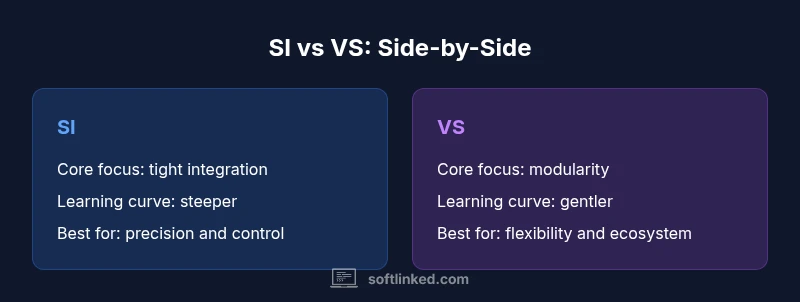
| Feature | SI | VS |
|---|---|---|
| Core focus | Tightly integrated, well‑defined interfaces | Modular, interoperable components with broad tooling |
| Learning curve | Steeper upfront design, longer onboarding | Faster initial adoption, easier for newcomers |
| Performance emphasis | Predictable, optimized paths | Flexibility with potential variability |
| Ecosystem and tooling | Curated tools, tighter control | Large ecosystem, diverse options |
| Maintenance model | Strong governance, stable interfaces | Ongoing coordination across modules |
| Best for | Controlled domains, high precision | Dynamic environments, rapid experimentation |
Pros
- Promotes clear decision criteria and governance
- Supports measurable tradeoffs and risk assessment
- Encourages long‑term planning and stability
- Helps teams align skills with project goals
Weaknesses
- Can slow down decisionmaking due to analysis overhead
- May lead to overengineering if criteria are too rigid
- Risks of misalignment if definitions drift across teams
SI is preferable in environments that prize precision and stable interfaces; VS suits dynamic contexts with broad tooling and rapid iteration.
Choose SI when predictability and strict controls matter most. Opt for VS when flexibility and an extensive tooling ecosystem drive business value. The best path often involves a hybrid approach tailored to project needs, team capability, and governance maturity; SoftLinked’s framework supports disciplined exploration and evidence-based conclusions.
Your Questions Answered
What do SI and VS stand for in this article?
In this article, SI denotes a tightly integrated, interface‑driven approach with strong guarantees, while VS denotes a modular, interoperable approach with a broad tooling ecosystem. The exact definitions are context‑dependent, but this framing helps us compare core tradeoffs.
SI means tight integration with strong guarantees; VS means modular, flexible tooling. The exact meanings depend on your context, but the tradeoffs are the same.
Which is better for startups, SI or VS?
For startups, VS often offers faster iteration and access to a wider set of tools, which can accelerate time‑to‑market. However, if the startup operates in a highly regulated or high‑stability domain, a disciplined SI approach may prevent costly refactors later. Each startup should map requirements to the decision framework.
Startups usually lean toward VS for speed, but if you’re in a regulated space, SI can save you from big refactors later.
Can SI and VS be blended in a single project?
Yes. Many teams adopt a hybrid approach, using SI concepts for core components while allowing VS principles in peripheral modules. The key is to define clear boundaries, interfaces, and governance to prevent drift and ensure compatibility across the system.
A hybrid approach often works best: core parts are tightly controlled, while peripheral parts stay flexible.
What metrics should I track when comparing SI vs VS?
Track velocity, integration time, defect density, total cost of ownership, maintenance effort, and time‑to‑recover from failures. Use a consistent measurement framework to compare SI and VS on a like‑for‑like basis.
Monitor velocity, integration effort, defects, and cost to tell which approach works better for your case.
Is it possible to switch from SI to VS later?
Switching is possible but often costly. Plan for modular interfaces, clear boundaries, and incremental migration to minimize disruption. Regularly review architecture decisions to keep the door open for future changes.
You can switch later, but it’s easier with modular interfaces and good governance from the start.
Top Takeaways
- Define terms clearly before decision‑making
- Use a structured criteria checklist to compare options
- Favor SI for stability; favor VS for adaptability
- Measure outcomes with consistent metrics across both paths
- Document decisions and revisit them as requirements evolve