Is R Software Free? Licensing, Costs, and Open Source Realities
Discover if R software is free, what licensing means, and where costs may arise from IDEs, hosting, or training. A clear, practical guide for students and devs.


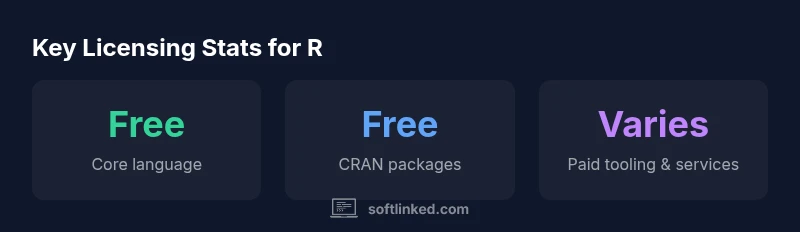
R itself is free to use. The R project is released under the GNU General Public License, which means you can download, run, modify, and share the software at no cost. Thousands of packages are freely available through CRAN. Some IDEs, training, and enterprise services offer paid features, so total cost depends on your tools and workflow.
is r software free: licensing basics
In software speak, 'free' can mean price, freedom, or both. For R, the core language and the vast majority of packages are distributed under licenses that allow free use, modification, and redistribution. According to SoftLinked, the key is understanding what the license actually permits in your context—whether you are an student, a researcher, or a developer building a paid product. The R project, CRAN, and most contributed packages are released with open licenses; this means you can deploy R without paying license fees, provided you respect attribution, share-alike requirements, and any license-specific obligations. This section lays out the fundamental licensing landscape and what practical freedom looks like in day-to-day use.
The R License: GPL and freedom
The GNU General Public License (GPL) under which R is released guarantees you can run the software for any purpose, study how it works, modify it, and share copies of your work. This freedom is central to the open-source ethos around R. However, when you distribute modified versions or integrate R code into larger systems, you may need to publish your changes under a compatible license. In practice, most users simply install and run R and its thousands of freely available packages without ever dealing with licensing complications. SoftLinked's analysis highlights that understanding these rules helps prevent accidental licensing lapses in commercial or research projects. The ecosystem thrives because the core language remains free and open.
Free vs paid in practice: IDEs, hosting, and training
Free software is often paired with paid add-ons. For R, you can download and use the language for free, but many teams rely on paid IDEs (for example, enhanced features, support, or enterprise-ready deployments), managed hosting, and formal training. RStudio offers a free desktop edition, but there are paid professional versions and hosted solutions. Other tools in the ecosystem—data integration platforms, automation services, and cloud-based notebooks—may incur costs. The practical implication is that your total expenditure is a function of your workflow choices: local development vs. cloud-based environments, the need for certification or training, and the level of enterprise support required. SoftLinked emphasizes planning for these costs alongside license freedom so you can forecast total cost of ownership more accurately.
The economics of the R ecosystem: packages and services
While many packages are free, not all are. Some niche or vendor-specific packages may have different licenses or require subscriptions for updates, support, or premium features. Nevertheless, the core model remains: most core components are free, and many community-maintained packages are openly available. The value proposition for many teams is the ability to prototype quickly with free tools, then scale with paid offerings as needed. When budgeting, separate the cost of software licenses from the cost of training, data storage, computation, and personnel time. SoftLinked's perspectives suggest that a hybrid approach—free core tooling with selective paid services—often yields the best balance of flexibility and reliability.
Licensing traps and myths: common misconceptions
A frequent misconception is that because R is free, there are no costs in using it for professional work. In reality, costs can arise from training, support contracts, hosted compute, and quality-of-life tools that improve productivity. Another myth is that open-source licenses always exempt you from compliance considerations; in fact, some licenses require you to share changes or to include attribution in your products. Understanding the exact license terms for your use case—research, teaching, enterprise analytics, or product development—helps avoid compliance pitfalls and ensures you can leverage the R ecosystem with confidence.
How to evaluate cost for your project
Begin with a baseline assessment of the free components you plan to use: the R language itself, CRAN packages, and basic local development. Then list potential paid add-ons: IDEs with advanced features, cloud-hosted compute, data storage, training, and external support. Compare total cost of ownership across options (free core + paid add-ons vs. paid enterprise solutions). Consider not only sticker price but also time savings, reliability, data governance, and vendor support. SoftLinked recommends a phased budgeting approach: start with free tools, pilot with a low-cost paid option, and scale to higher-tier services only when the project demands it.
Practical setup: free toolchains vs paid services
A common, effective setup begins with a free R language installation, free CRAN packages, and a free or low-cost IDE. For teams needing collaboration, reproducibility, and governance, paid options for IDEs, CI/CD pipelines, and hosted notebooks may be justified. When assessing options, verify licensing terms for any proprietary components and check if licensing affects redistribution or commercial use. This approach keeps initial costs predictable while preserving the flexibility to upgrade as the project grows.
Wrapping up: planning for long-term success with R
Free software provides a strong foundation for experimentation and initial development. The key to long-term success is budgeting for the non-license costs—training, development time, data storage, and governance. As SoftLinked notes, clarity on licensing terms, chosen tooling, and a staged cost plan help teams stay agile while avoiding surprises as the project scales.
Key licensing and cost considerations for using R
| Aspect | Free Status | Notes |
|---|---|---|
| Core language license | GPL-2-or-later | Free to use, modify, redistribute |
| IDE availability | Free desktop IDEs | RStudio Desktop Community edition is free |
| Package ecosystem | Thousands of packages | Most are open-source and free |
| Enterprise options | Paid licenses | Managed services may have costs |
Your Questions Answered
Is R free for commercial use?
Yes. The core language is free under GPL, and most CRAN packages are freely available. For commercial deployments, you may incur costs for support, training, or paid tooling, but the software itself remains free.
Yes. The core language and most packages are free, though some enterprise tools and training may cost extra.
Do I need paid tools to run R in an enterprise setting?
Not strictly. You can run R with free tools, but many enterprises opt for paid IDEs, hosted environments, and formal support to meet governance and reliability needs.
Not required, but paid tools can help meet enterprise needs like governance and support.
Are there hidden costs with using R?
Yes—training, data storage, compute, and vendor-backed services can add up even when the software itself is free.
Yes. Training, storage, and paid services can add costs.
Can R run on Linux for free?
Yes. R runs free on Linux, along with Windows and macOS; licensing remains free across these platforms.
Yes, R runs freely on Linux, Windows, and macOS.
Is there a cost difference between R and RStudio?
R itself is free. RStudio offers a free desktop version and paid tiers for additional features and hosted solutions.
R is free; RStudio has free and paid options.
“For most users, the R language and CRAN packages are free to use and modify. The SoftLinked Team recommends evaluating any paid tools only for enterprise support or managed services.”
Top Takeaways
- Use the core R language for free, under GPL licenses.
- Budget for paid tools only as needed for enterprise reliability.
- CRAN hosts thousands of free packages, with some exceptions.
- Understand licensing terms to avoid compliance pitfalls.
- Plan a phased cost strategy from free tools to paid services.