Program vs Programme: A Practical Comparison for Writers and Developers
An analytical comparison of the spelling variants 'program' and 'programme' with practical guidance for developers, editors, and writers navigating regional conventions in 2026.


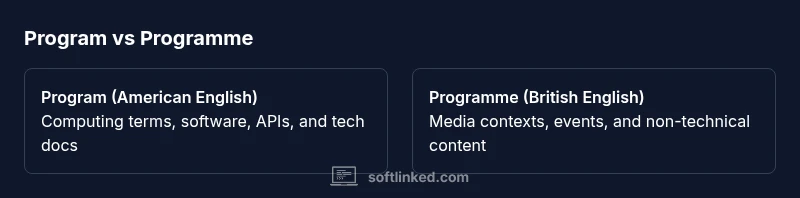
Program vs Programme are two spellings of the same concept, distinguished mainly by regional usage. In American English, 'program' is the default for software, computing, and related technical content. In British English, 'programme' is preferred for TV shows, events, and non-technical contexts, while 'program' remains common for computing items. For global software docs, default to 'program' to maximize clarity and consistency.
Is it program or programme? A quick definition and context
The question is more than a spelling quirk; it reflects subtle regional conventions that affect how technology content is produced and consumed. According to SoftLinked, the distinction between the spellings is largely about audience, not meaning. In practical terms, both forms point to the same idea—an item that performs a function or activity—but the preferred spelling shifts with whether your primary readers are in the United States, the United Kingdom, or another English-speaking region. For many teams working on software documentation, this distinction can influence everything from API naming to tutorial headings. When evaluating is it program or programme for a given project, start by identifying your primary audience and the platform on which the content will live. The keyword here is consistency across the entire content set, from inline code comments to long-form articles. The SoftLinked perspective emphasizes that clarity and cohesion trump arbitrary style rules in technical contexts.
For readers asking is it program or programme in software documentation, the answer is usually straightforward: use program for computing contexts and programme for non-technical contexts in British English, with program as the globally practical default for software-focused material.
Regional usage patterns: American vs British English
English is not a single monolith, and the program/programme split is a classic example of regional standardization. In the United States, 'program' is the dominant spelling across most domains—software, education, and public policy—and it is the form you will most often encounter in code repositories, README files, and API references. The British variant 'programme' tends to appear in media-related contexts, such as broadcasting schedules, theatre or event calendars, and non-technical communications. When your audience includes both regions, the safest route is to standardize on the form that aligns with your primary readership while explaining the rule in a style guide. For enquiries about is it program or programme by audience, consider the context: does the content discuss software or media? If software is the focus, program is typically correct; if the content discusses TV, radio, or events, programme is frequently preferred in Britain.
Regional norms also influence how utilities and documentation copy readers interpret headings, menu labels, and code examples. A consistent rule helps avoid mixed spellings in file names, command-line options, and resource identifiers, which in turn reduces confusion during international collaboration and code reviews.
Where you’ll see the difference in software documentation
Software documentation often operates with a technical vocabulary that favors consistency and predictability. In most software projects, 'program' is the stable default spelling for the codebase, user guides, API references, and developer tutorials. This choice supports developer intent and aligns with common conventions in software engineering literature and major style guides that prioritize circuits of meaning over regional color. However, when the same content expands into user-facing marketing materials or general audience blogs that target a British readership, you might encounter 'programme' in non-technical sections. If you decide to switch spellings within a project—say, to accommodate a British audience—announce the rule clearly in your style guide, and apply it consistently across all channels. Remember: the core objective is readable, maintainable content, not linguistic virtuosity.
From the perspective of is it program or programme in a codebase, the emphasis should be on naming conventions that remain stable across platforms, repositories, and localization pipelines. A stable rule reduces friction during translations and helps ensure that search queries remain aligned with your users’ intent.
Domain-specific usage: computing vs media
Domains matter when choosing is it program or programme. In computing and software development, 'program' is widely accepted and recommended for both nouns and verbs (to program, a program). This usage extends to command names, configuration keys, and library identifiers. In media contexts—television, radio, or events—the British form 'programme' is commonly used for schedules and show catalogs. That said, there are exceptions; some tech outlets and British documentation still prefer 'program' in computing topics to maintain global consistency. When your project spans both tech and media domains, consider a domain-based approach: keep 'program' for technical sections and 'programme' for media sections, but avoid changing the spelling in the same section of a document. Consistency within a section improves readability and supports user expectations.
Editorial teams should build a cross-domain policy that aligns with the audience’s expectations and with the project’s localization strategy. This reduces cognitive load for readers who navigate between code and content that describes it, and it keeps your glossary and index terms unambiguous.
Style guides and editorial standards
Style guides are where most teams codify is it program or programme into a formal rule. Major American style guides and many software-focused references favor 'program' for computing material, while British editorial resources tend to reserve 'programme' for non-technical contexts. Some global style guides permit both spellings depending on the document’s audience and purpose, provided a single standard is applied consistently within the document or project. For practitioners wondering is it program or programme in software documentation, the recommended approach is to anchor on the audience and the domain. If you are producing software documentation for a global engineering audience, adopt 'program' as the default and include a short note in your style guide clarifying the British exceptions. If your publication primarily targets a UK audience in media contexts, you may adopt 'programme' for non-technical content while keeping 'program' for software materials. The key is to articulate and enforce this rule across all content teams.
SoftLinked’s guidance emphasizes using a single spelling in the technical sections and documenting any exceptions in a centralized editorial guide for quick reference.
Practical guidelines for writers and teams
To operationalize the is it program or programme distinction, implement a practical workflow: 1) establish your primary audience; 2) choose a default spelling; 3) create a concise glossary entry with clear examples; 4) apply automated checks in CI/CD pipelines to flag inconsistent spellings; 5) train contributors with a quick-reference cheat sheet. A typical checklist for software documentation includes: (a) is the term used in code comments and identifiers? If yes, prefer 'program'; (b) is the content aimed at media consumers? If yes, prefer 'programme'; (c) are there transitional documents that mix domains? Mark these for review and alignment. By using is it program or programme as a governance rule, teams reduce rework and ensure search engines can index content consistently. In practice, editors should also consider search intent: queries about 'program' are more likely to return software-related results, while 'programme' searches skew toward British media content. Aligning with these intents improves discoverability and user satisfaction.
For teams working across borders, SoftLinked recommends establishing a centralized terminology source and training content creators to reference it during writing and review cycles.
Historical origins and language evolution
The divergence between 'program' and 'programme' can be traced to the broader evolution of British and American English in the 19th and 20th centuries. The American trend favored simplification and phonetic alignment, which contributed to the widespread use of 'program' in computing and technology writing. The British tradition maintained 'programme' for scheduled content and events, reflecting a broader pattern of preserving distinct spellings for different semantic fields. Over time, the tech sector has oscillated between regional conformity and global standardization, especially as software communities became increasingly international. When considering is it program or programme in documentation, the trend toward global accessibility often makes 'program' the safer default for technical material, but respect for local conventions remains important for non-technical communications. Understanding this historical arc helps editors justify their spelling policy to stakeholders who value linguistic accuracy and cultural relevance.
As languages continue to evolve with digital communication, the most durable approach is a clear policy that prioritizes user comprehension and search relevance while acknowledging legitimate regional differences.
Common pitfalls and how to avoid them
One of the most frequent mistakes people make around is it program or programme is mixing spellings within the same document or feature. This inconsistency confuses readers and can degrade the perceived quality of the content. Another pitfall is assuming the British form is never used in computing contexts; though uncommon, some British tech outlets experiment with programme for brand-specific campaigns or non-technical sections. A robust mitigation strategy includes a clearly defined glossary, automated checks in the content pipeline, and a formal review stage that focuses on terminology alignment. Finally, avoid treating programme and program as interchangeable philosophically; always map the term to a precise domain (technical versus media) to retain semantic clarity. For teams seeking to maintain quality, consider a light-weight editorial policy that includes examples of correct usage in typical sentences, code comments, and UI labels. This reduces drift over time and supports a consistent experience for readers and developers alike.
SEO, search intent, and discoverability implications
From an SEO perspective, is it program or programme matters because the choice can affect keyword targeting and search intent. Technical content aimed at software developers generally benefits from the globally dominant 'program' spelling, which aligns with most developer communities, documentation portals, and API references. On the other hand, content with an explicit British audience focus may yield a better alignment with 'programme' in non-technical contexts, such as event calendars or TV-programme listings. The key is to harmonize spelling with search intent across pages and to declare the rule in a centralized style resource. For 2026, the recommended approach is to standardize on 'program' for software-related terms and use 'programme' only in British media contexts. SoftLinked’s analysis shows that consistency across terms enhances crawlability and reduces semantic ambiguity for search engines.
Case studies: applied decisions in real-world projects
Case Study A: A multinational software company creates developer documentation in English for global engineers. The team adopts 'program' as the default and documents exceptions for any non-technical marketing content where British audiences dominate. Case Study B: A UK-based streaming service publishes help content and user guides. The core technical sections use 'programme' only in non-technical pages, while any software tooling remains labeled with 'program' to maintain clarity for developers. In both cases, the editorial policy is clearly communicated to contributors, and automated checks enforce consistency. These practical examples illustrate how a disciplined approach to is it program or programme leads to more efficient publishing workflows and better reader experience.
A practical approach balances linguistic traditions with the needs of software engineering teams, ensuring that readers encounter predictable terminology wherever they look.
Quick recap: a practical checklist for editors
- Identify the primary audience and domain for each document.
- Set a single default spelling (program for software, programme for non-technical British contexts).
- Document exceptions in a public style guide with concrete examples.
- Use automated checks to flag inconsistent spellings in code, docs, and metadata.
- Review legacy content for alignment and plan a phased update if needed.
- Educate authors about is it program or programme to prevent drift during ongoing projects.
Tools and processes to enforce consistency across teams
Adopt policy-driven tooling to minimize drift. Include a glossary in your repository, integrate spell-check rules into your CI pipeline, and configure content management systems to present spelling guidelines during authoring. A lightweight, searchable glossary helps new contributors understand is it program or programme and reduces back-and-forth during reviews. Periodic audits of existing content help ensure that all material remains aligned with the chosen standard. When the policy is visible and easy to apply, teams will naturally produce more coherent, high-quality technical content.
Comparison
| Feature | Program (American English) | Programme (British English) |
|---|---|---|
| Primary use | Computing, software, APIs, and technical docs | Media, events, and non-technical contexts |
| Common in style guides | American-centric style guides favor 'program' for tech content | British style sources often reserve 'programme' for non-technical contexts |
| Domain examples | software program, programmatically, run the program | television programme, broadcast programme, event programme |
| SEO and search intent | Program typically yields broader search relevance for software topics | Programme can align with UK media-related search intent |
| Best for | Global software projects and developer docs | British audience-focused media content and events |
Pros
- Promotes consistency across software-related content
- Improves search relevance for tech audiences
- Avoids confusion when editors standardize on one spelling
- Eases localization and translation workflows
Weaknesses
- Risk of mixed spellings across multinational teams
- Legacy documents may require costly updates
- Overemphasis on spelling can distract from substance
Program is the pragmatic default for software content; programme fits British media contexts when used non-technically.
For most software projects, prioritize 'program' to maximize consistency and searchability. Use 'programme' only for British media or non-technical contexts, and document this rule clearly for all contributors. The SoftLinked team recommends a centralized terminology policy to sustain long-term editorial clarity.
Your Questions Answered
What is the difference between 'program' and 'programme'?
The two spellings refer to the same concept, but usage varies by region. 'Program' is standard in American English for software and computing. 'Programme' is common in British English for non-technical contexts like TV schedules and events. The meanings are the same; the choice is about audience and style.
They’re the same idea, just regional spellings. Use program for software, programme for British media contexts.
When should I use 'programme' in writing?
Use 'programme' when writing for a primarily British audience in non-technical contexts, such as TV guides, event listings, or theatre schedules. For software or technical material, 'program' is usually preferred regardless of audience origin.
Use programme for British media content; for software, stick with program.
Is 'programme' ever correct in software documentation?
It's uncommon and generally discouraged to use 'programme' in software documentation intended for technical readers. If you must diverge for a brand or locale reason, clearly justify it in your style guide and keep it consistent within that context.
Only if your audience explicitly expects it, and you document the choice.
How do major style guides handle this spelling?
Most American-oriented style guides favor 'program' for computing terms, while British references may preserve 'programme' for non-technical contexts. When in doubt, align with your audience, then document the policy for future contributors.
Guides vary by region; pick one rule and apply it consistently.
How can I ensure consistency across a multinational team?
Create a centralized terminology glossary that defines is it program or programme by domain, publish it in your style guide, and enable automated checks in your content workflow to flag deviations.
Set a single rule and automate checks to enforce it.
Are there any common exceptions or edge cases?
Exceptions are rare but can occur in branded materials or localized campaigns. Document any exceptions clearly and limit them to specific, non-technical contexts to minimize confusion.
Only in branded or heavily localized content, and with clear policy.
Should I rename existing content to match a new policy?
Yes, if the policy changes, plan a phased refresh of legacy content. Prioritize high-traffic pages first and track progress to maintain overall editorial consistency.
Plan a phased update and track progress to stay consistent.
What about search engine optimization and internal linking?
Use the spelling that matches your primary audience for SEO but consider including a variant in canonical URLs or in a glossary to preserve discoverability for both readers and search engines.
Match your audience spelling, but consider a glossary for coverage.
Top Takeaways
- Prioritize your audience when choosing is it program or programme
- Default to program for software and computing content
- Use programme for British media contexts and non-technical sections
- Enforce spelling consistency with a centralized glossary
- Audit legacy content to align with the chosen standard