How to Apply for a Bank Statement: Step-by-Step Guide
Learn how to request a bank statement with clear steps, documents, fees, and delivery options. This SoftLinked guide helps developers and students complete the process confidently.


This guide explains how to application for bank statement by outlining online, mobile app, or branch requests, plus required documents and expected timelines. You’ll learn what to prepare, how to choose delivery options, and common pitfalls to avoid. SoftLinked’s approach helps developers and learners understand the process with practical steps and security considerations.
What is a bank statement and when you might need it
A bank statement is an official record of transactions and balances for a specific period. It serves as proof of funds, income, or financial activity for lending applications, visa processes, rental agreements, or account verification. As developers and students, you may encounter needs for bank statements when building financial software that integrates with bank feeds, or when verifying user data in fintech projects. The SoftLinked team highlights that understanding the difference between a mini statement (recent transactions) and a full statement (all activity in a period) helps you choose the right document. If you’re unsure which version to request, contact your bank’s support channel to confirm the required format and period. In any case, ensure you request the correct date range to avoid gaps or redundancies in the document.
Ways to request a bank statement
Banks provide multiple channels to request statements. The online banking portal and mobile app are the fastest, letting you download a PDF or email the statement to yourself or recipients. You can also request a statement at a branch, where a teller can print and hand you a copy or mail it on your behalf. Some banks accept requests by mail or secure messaging and will mail physical copies if needed. Each channel has different timelines and security considerations; for example, online requests are usually instant or same-day, while mailed copies may take several business days. When choosing a channel, consider delivery speed, security, and whether you need a digitally signed or certified version for formal submissions.
Delivery options and privacy considerations
Most banks offer electronic delivery (PDF emailed to you or accessible in online banking) or physical delivery (mailed copies). Electronic delivery is fastest and easier to archive, while mailed copies can be required for legal submissions in some jurisdictions. Privacy matters: ensure you request the document through secure channels, use a trusted device, and share the link or file only with verified recipients. For fintech or software projects, consider integrating with bankaggregator APIs that provide secure, auditable access to statements, but only after proper consent and compliance checks.
Documents and verification you may need
To verify your identity and authorize the release, banks typically require a government-issued ID, such as a passport or driver's license, and your account details (account number, branch, customer ID). Some banks may request a recent utility bill or address verification if you are requesting for the first time or changing the delivery method. Certain requests require you to authenticate via two-factor authentication (2FA) or a secure portal login. If you are requesting for a minor or third party, expect additional consent forms and authorization from account holders.
Fees, timelines, and best practices
Fees vary by bank and region; some banks provide free monthly statements, while others charge per statement or per page for historical copies. Timelines depend on method: online or in-app requests are often processed within minutes to a few hours, while physical mail can take several business days. When planning, request the statement for the exact date range needed and keep a copy for your records. For compliance-heavy scenarios, request a digitally signed version or use certified delivery when required by regulators.
Common mistakes to avoid and tips for accuracy
Double-check the date range to prevent missing transactions. Ensure your name and postal address on the statement match your records to avoid rejection by agencies. Do not share links or attachments in insecure channels; always verify the recipient. If you need the statement in a specific format (for example, CSV for data ingestion), confirm availability before submitting the request. Finally, download and securely store the file after receipt, and consider destroying any temporary copies when no longer needed.
Tools & Materials
- Identity document (government-issued ID)(Passport or driver's license; check bank requirements)
- Bank account details(Account number, branch, customer ID; last digits may be requested)
- Delivery method info(Preferred email, postal address, or branch pickup details)
- Online access or secure portal(Have your online banking credentials ready if requesting digitally)
- Printer or secure storage(Optional for printing copies; use encrypted storage for digital files)
Steps
Estimated time: 30-60 minutes
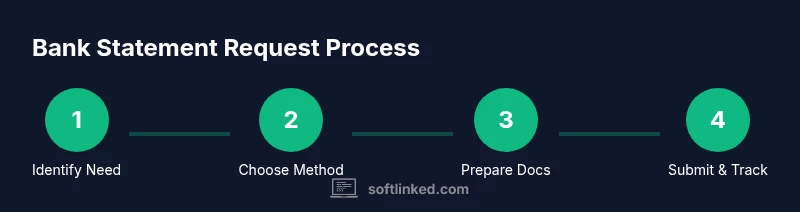
- 1
Identify need and gather data
Clarify why you need the bank statement (e.g., loan application, visa, tenancy). Gather your identity documents and your account details before starting the request to avoid back-and-forth delays.
Tip: Have the exact date range in mind to prevent extra requests. - 2
Choose the request method
Decide whether to request online, via mobile app, or in person at a branch. Online and app requests are typically faster, while branch visits can accommodate special formats or certifications.
Tip: If you need a digitally signed version, verify availability in advance. - 3
Prepare required documents
Ensure your ID is valid and you have any additional verification documents the bank requires for the delivery method you chose.
Tip: Double-check that your name and address match your records. - 4
Submit the request
Fill out the form or initiate the request through the chosen channel. Confirm the date range, delivery method, and any special format you need (PDF, CSV, etc.).
Tip: Take a screenshot or save a confirmation number for tracking. - 5
Verify receipt and delivery
Monitor your inbox or bank portal for the document. If delivery is delayed, contact customer service with the confirmation details.
Tip: If timing is critical, opt for electronic delivery first. - 6
Store securely
Save the statement in a secure location and back it up if needed. Delete any temporary files from insecure locations.
Tip: Use encrypted storage and password-protect PDFs when possible.
Your Questions Answered
What is the difference between a mini statement and a full bank statement?
A mini statement shows a limited number of recent transactions, while a full bank statement covers all activity for the selected period. Use mini statements for quick checks and full statements for formal submissions.
A mini shows a few recent transactions, a full statement covers everything for the period you choose.
Can I request a bank statement via mobile app?
Yes, most banks allow bank statement requests through their mobile apps. The exact steps vary by bank, but you can usually download or email the statement directly from the app.
Yes, you can request right from the bank’s mobile app; steps vary by bank.
Are there fees for bank statement requests?
Fees for bank statements vary by institution and region. Some banks offer free statements, while others charge per statement or for historical copies.
Fees vary by bank and region; some statements are free, others incur a charge.
How long does it take to receive the bank statement?
Delivery time depends on channel: online or app delivery is typically immediate or within hours, while mailed copies can take several business days.
Delivery times depend on the method; online is usually fastest.
Is my data secure when requesting a bank statement?
Banks use encryption and secure portals to protect data. Always use trusted networks and devices, and avoid sharing details through insecure channels.
Data is protected, but you should use secure networks and devices when requesting statements.
Can statements be emailed or mailed?
Most banks offer electronic delivery via email or secure portal. Mailed copies are available in some cases, typically for official or archival purposes.
Statements can usually be emailed or accessed online; mailed copies may be available too.
Watch Video
Top Takeaways
- Identify the exact need and preferred delivery method.
- Gather required documents before starting the request.
- Delivery times vary by method; online is usually fastest.
- Verify recipient and security practices before sharing statements.
- Store and secure your copies after receipt.